Multa por exceso de velocidad en Orlando: multas, puntos y cómo disputarla
Obtén un plan claro para una multa por exceso de velocidad en Orlando, que incluye las sanciones según el Estatuto de Florida 316.187, el impacto de los puntos, las opciones judiciales y cómo Ticket Shield protege tu

Blue lights hit in the mirror on I-4, the 408, or a busy Orange County arterial, and the first thought is usually the same, how bad is this going to be? That's the wrong first question. The right one is whether you let a routine Orlando speeding ticket turn into points, a record entry, and a suspension risk that follows you for years.
Florida treats this as a moving violation under Chapter 316, not a throwaway notice. The officer's citation starts a clock, and what you do next controls the damage. If you're deciding whether to pay, fight, or push for a no-points result, start with the legal structure, then make the move that protects your license.
Table of Contents
Why an Orlando Speeding Ticket Is Not a Simple Fine
A stop on I-4, the 408, or a downtown Orlando street can feel routine until the citation lands in your hand. Drivers fixate on the dollar amount and miss the real problem, the ticket can follow them into court, into the state record, and into future license trouble.
A speeding citation in Florida is a moving violation, not a parking ticket in disguise. Under Florida's framework, a violation of a speed limit established under Florida Statute §316.187 must be cited as a moving violation and punished under Chapter 318, which means the case can affect your driving record as well as your wallet (Florida Statute §316.187). Paying fast may close the court file, but it can still leave you with a conviction on your record.
Practical rule: treat the citation like a license problem first, and a money problem second.
Orange County procedure makes that split matter. The court file tracks the citation, while the state driver record tracks convictions, points, suspensions, and license status. Before anyone pays, defense lawyers evaluate the citation itself, and the traffic ticket attorney guidance for 2026 walks through that evaluation in plain terms.
Deadlines start with the citation date, not with the day the ticket shows up online. If you wait, you narrow your options fast.
The Florida Statutes Behind an Orlando Speeding Ticket
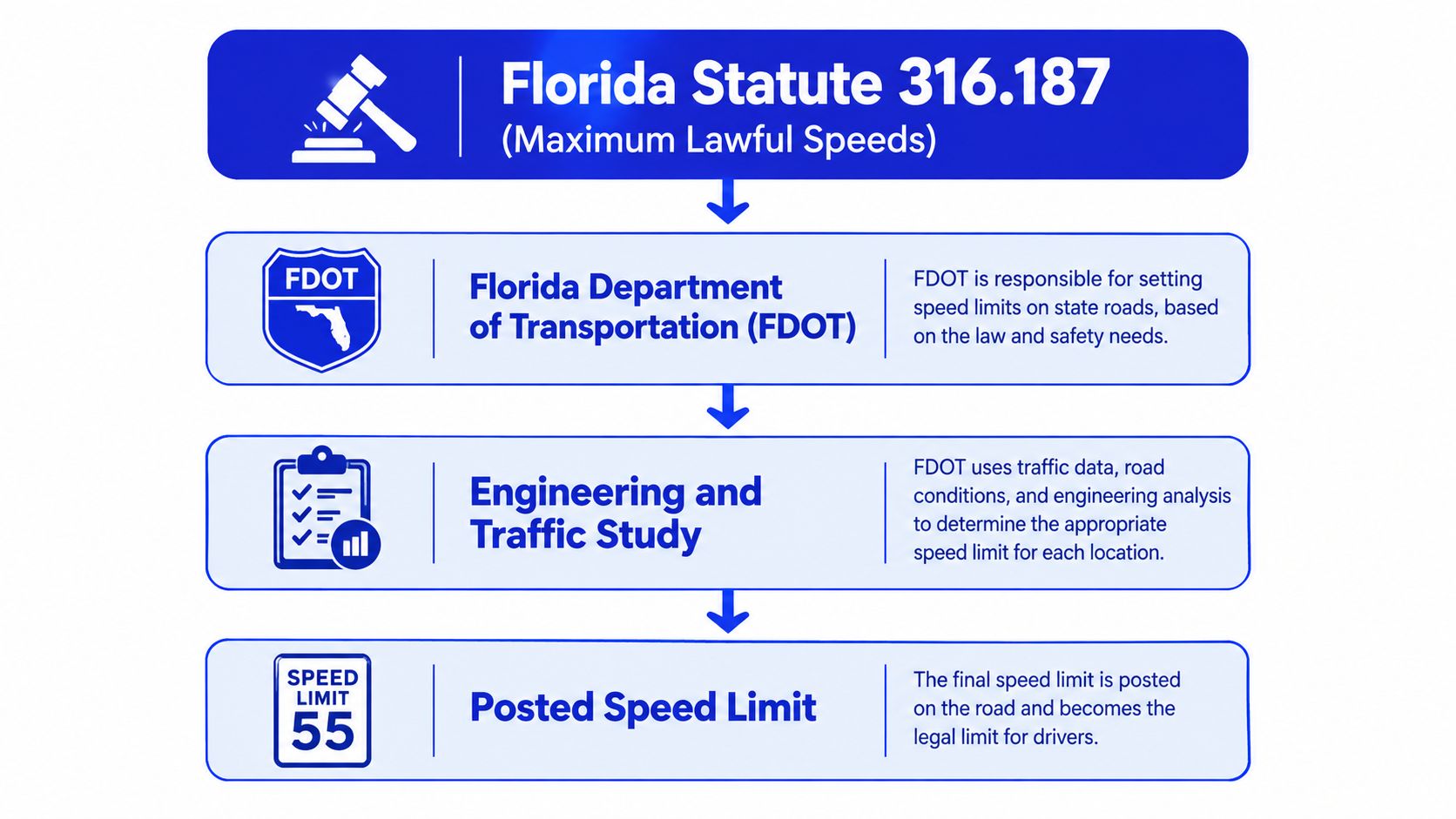
Orlando speeding cases start with the statute, not the officer's mood. Florida law lets the state set and enforce speed limits through the statute framework, and those limits can be based on an engineering and traffic investigation. The Florida Department of Transportation may establish limits of 70 miles per hour on limited-access highways, 65 miles per hour on certain divided highways outside urban areas with at least four lanes, and 60 miles per hour on other roads under its authority. If the posted limit comes from that process, the citation is tied to a moving violation under state law.
Read the citation like a lawyer would
Start with the subsection, not the number on the speedometer. Section 316.187(3) says a violation of an established speed limit must be cited as a moving violation and punished under Chapter 318. Section 316.189 covers municipal and county speed zones, and Section 316.1926 deals with the harsher treatment for a driver alleged to be more than 50 miles per hour over the applicable limit (Florida Statutes Chapter 316). That distinction matters in Orlando because the same ticket language can point to very different consequences depending on where the stop happened and how fast the officer says you were going.
Florida also caps the civil penalty in Section 318.14, which allows up to $500 in ordinary cases and up to $1,000 in a school or construction zone (Section 318.14). The statute also leaves room for driver-improvement school, so you should never treat the citation as a simple pay-it-and-move-on problem.
Bottom line: the statute printed on the citation tells you what the State says happened, where it says it happened, and how hard it can push.
For a plain-English walkthrough of the rules that matter here, the Florida traffic laws guide ties the citation language to Chapter 316 and Chapter 318. If the ticket leaves the subsection unclear, treat that as a warning sign.
Fines, Court Costs, and the Full Cost of Paying
Florida's fine schedule gives you the first number, not the last one. Under Chapter 318, the listed fine rises with the alleged speed, and a school or construction zone can double the base amount. Court costs, surcharges, and insurance fallout can push the price far beyond the amount printed on the citation.
Florida Speeding Fine Schedule for Orlando Citations | Alleged Speed Over Limit | Base Fine | School or Construction Zone |
|---|---|---|---|
1–5 mph | generally a warning | warning | warning |
6–9 mph | $25 | $25 | doubled fine, up to $50 |
10–14 mph | $100 | $100 | doubled fine, up to $200 |
15–19 mph | $150 | $150 | doubled fine, up to $300 |
20–29 mph | $175 | $175 | doubled fine, up to $350 |
30 mph or more | $250 | $250 | doubled fine, up to $500 |
The statutory ceiling is plain. In an ordinary case, Chapter 318 allows up to $500, and in a school or construction zone it allows up to $1,000 (Chapter 318 fine schedule). That is why the zone on the citation matters as much as the number on the officer's radar gun.
Paying usually means you accept the charge as written. In an Orlando speeding case, that can close out the clerk's file while still leaving you with a conviction on your record and a problem with your insurance. If you want to compare the fine schedule with the cost of taking that path, the speeding ticket fines breakdown lays out how the charge can grow once the citation is treated as a conviction.
A school zone or construction zone demands immediate attention. The location is not a side note, it changes the exposure and can change the way you should respond on day one.
How Points and License Suspensions Stack Up
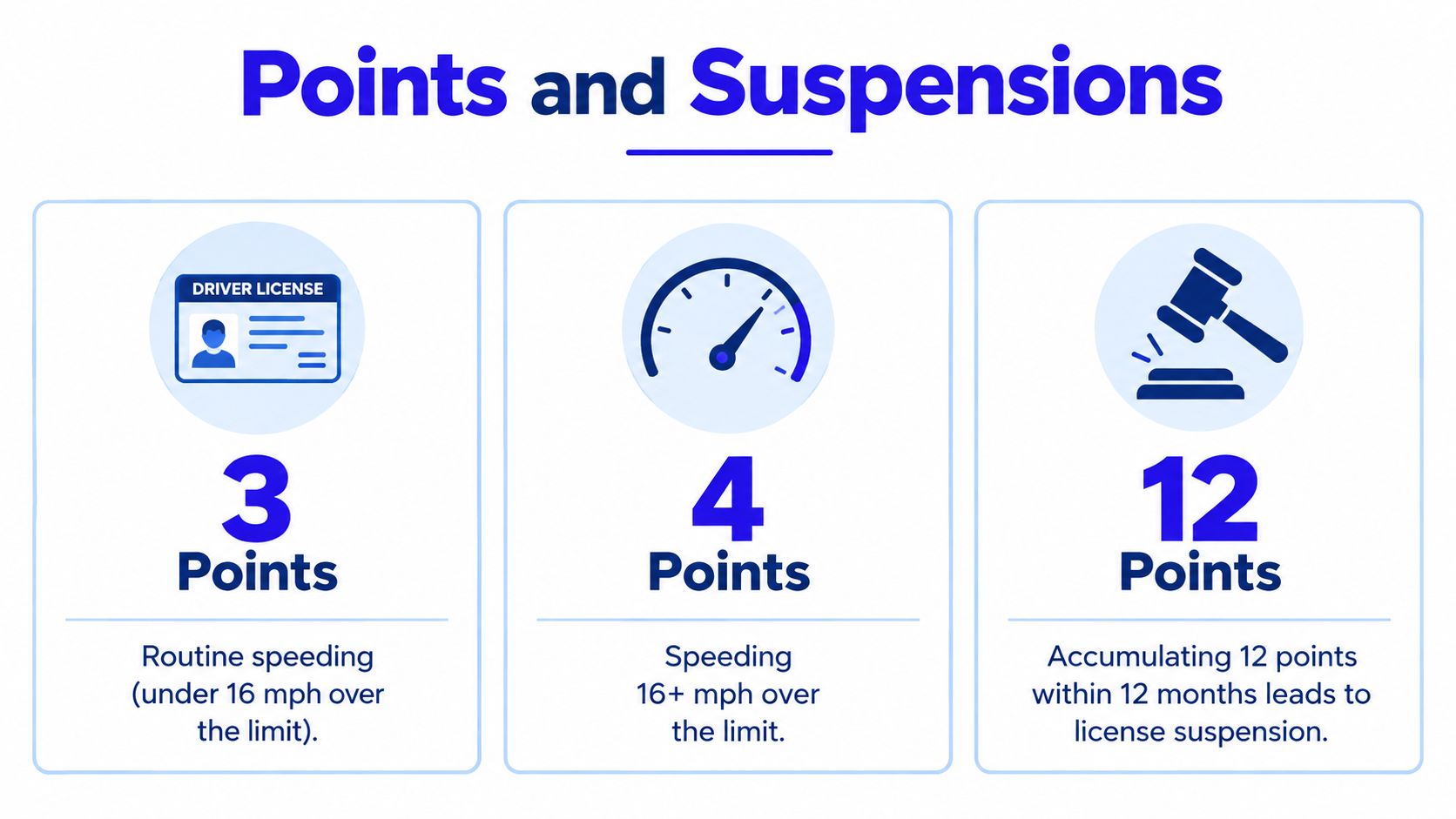
A citation gets serious once points hit your record. A routine Florida speeding conviction generally adds 3 points, and a speeding offense over 15 miles per hour above the limit adds 4 points under the FLHSMV point schedule (FLHSMV points and suspensions). Those points remain on the record for at least five years from the disposition date.
The suspension math you need to care about
Florida uses fixed thresholds. 12 points within 12 months brings a 30-day suspension, 18 points within 18 months brings a three-month suspension, and 24 points within 36 months brings a one-year suspension (FLHSMV points and suspensions). If you already have prior tickets, one more Orlando speeding citation can push you past the line.
A speeding allegation of more than 50 miles per hour over the limit is a 4-point offense. At that level, the case is not just about a bigger fine. It moves you closer to suspension territory fast, especially if your record already has points on it.
Rule of thumb: do not ask whether the ticket is minor, ask whether it adds points to an active record.
If you want to see how one citation stacks against earlier tickets, use the Florida speeding ticket points guide. If you are near a threshold, aim for No Points.
Your Four Options After the Citation
Orange County gives you four real choices after a speeding ticket, and the right one depends on the alleged speed, the zone, and how fast you act. You can pay the fine, contest the ticket, request mitigation, or elect a Florida-approved Basic Driver Improvement course if you qualify (Orange County traffic ticket options). Do not treat those options as interchangeable. They carry different record consequences.
If you were cited for 30 miles per hour or more over the limit, Florida bars the Basic Driver Improvement option that a routine driver might otherwise use (FLHSMV BDI rules). That pushes many drivers out of the easiest path immediately.
Timing is the other trap. Orange County says you generally must make your election within 30 calendar days of the citation date, and the ticket may take up to 10 days to show up in the county system (Orange County official information). Waiting for the online record can cost you the deadline.
Use the right path for the right case
Pay the Fine: Use this only if you are willing to accept the conviction and the record consequences that follow.
Contest the Ticket: Choose this when the alleged speed, signage, zone, or measurement method gives you a real defense.
Request Mitigation: Use this if you want the court to consider the circumstances, but understand it does not erase the record issue by itself.
BDI Course: Use this only if you are eligible and the citation is not in a disqualifying category.
A driver-improvement option is not a magic fix. It is one tool, and Florida decides who can use it. For a broader example of how another state treats defensive-course choices, the guide for Colorado crash victims is useful, but Florida's eligibility rules control your case here.
Orange County Courthouse Logistics and Timelines
Orange County traffic cases move through a narrow path, and the clerk's office controls the first step. If you pay, request a hearing, or push the case into a contested posture, the courthouse process starts there. A more serious speeding allegation can shift into criminal-traffic handling, which changes the paperwork and the appearance requirements. That is a different track from an ordinary civil ticket.
The practical problem is timing, not confusion. You cannot wait for the system to look convenient. Orange County can take time to post a citation in its records, and the deadline to act still runs from the citation date. Treat the paper in your hand as the controlling document.
What happens at the courthouse
Go to the correct clerk window or hearing location with the citation, your photo ID, and any paperwork tied to your response. If you are contesting the ticket, expect a hearing setting, not a casual counter conversation. Show up early, follow security screening, and have your documents ready before you reach the clerk or the courtroom.
If you are appearing for a traffic hearing, dress like it matters and speak only to the judge or the clerk when invited. Keep your explanation short. Bring proof that supports your position, such as documents tied to the speed zone, the stop, or any correction you are asking the court to consider.
A driver who wants to challenge the citation should also understand what the hearing looks like before walking in. The court appearance guide gives a clear picture of the process in Orlando.
A lawyer can often appear for you in an ordinary traffic case, which keeps you out of a courthouse morning and helps you avoid saying the wrong thing under pressure. If the ticket has moved into a criminal-traffic posture, handle it as a court case, not a simple payment problem.
Defenses and Evidence to Collect Before Court
Speeding cases win or lose on proof. If the officer used radar or LIDAR, the device should have proper calibration and maintenance records. If the stop relied on pacing, the officer's method matters. If the sign was missing, blocked, or inconsistent with roadway conditions, that matters too.
What you should pull on day one
Dashcam Video: It can show traffic flow, lane changes, signage, and the officer's position.
GPS Logs: They can help confirm timing and location.
Timestamped Photos: They can preserve signs, detours, or work zones before conditions change.
Witness Statements: A passenger or nearby driver may remember details you won't.
Roadwork or Detour Records: These can matter if temporary traffic control changed the posted environment.
A Florida traffic lawyer turns those items into pressure on the State. That pressure can lead to a reduction, an amendment, or a dismissal when the proof is weak enough. The right move is to gather the records before they disappear, not after the first hearing date is already on the calendar.
The radar gun speeding ticket defense guide is worth reading if your stop involved a speed-measurement device. The defense isn't magic. It's document pressure, timing pressure, and forcing the State to prove what it says it saw.
Why Hire Ticket Shield and What to Do Next
You need a lawyer-led response, not an app that routes you through a script and a queue. Ticket Shield, PLLC handles Florida traffic citations with direct attorney communication by phone or text, which is the difference between getting answers from the person defending you and getting passed between layers of support. That matters when the issue is your license, not just a piece of paper.
The firm's model is built for drivers who want a practical outcome, not busywork. Flat-fee representation starts at $39.99, and the firm says more than 99% of clients never appear in court. If your goal is to protect your record and keep the case from adding points, that structure makes sense in a speeding case where the deadline and the allegation both matter.
What you should expect from a real response
Direct lawyer access: You can talk to the attorney, not just an intake desk.
Traffic-focused strategy: The response is built around the citation, the speed allegation, and the zone.
Court handling: The case is managed without turning your day into a courthouse errand.
If you got cited on I-4, the 408, or anywhere in Orange County, stop treating the ticket like a nuisance. The clean outcome is No Points, not just a smaller headache.
Visit Ticket Shield, PLLC for a free consultation and get a direct defense plan focused on No Points, a clean Florida driving record, and protected insurance rates.