Guía de multas de tránsito en Port St. Lucie: Cómo disputarlas
¿Recibió una multa de tránsito en Port St. Lucie? Conozca los plazos, las opciones para declararse y cómo Ticket Shield le ayuda a evitar puntos y aumentos en el seguro.

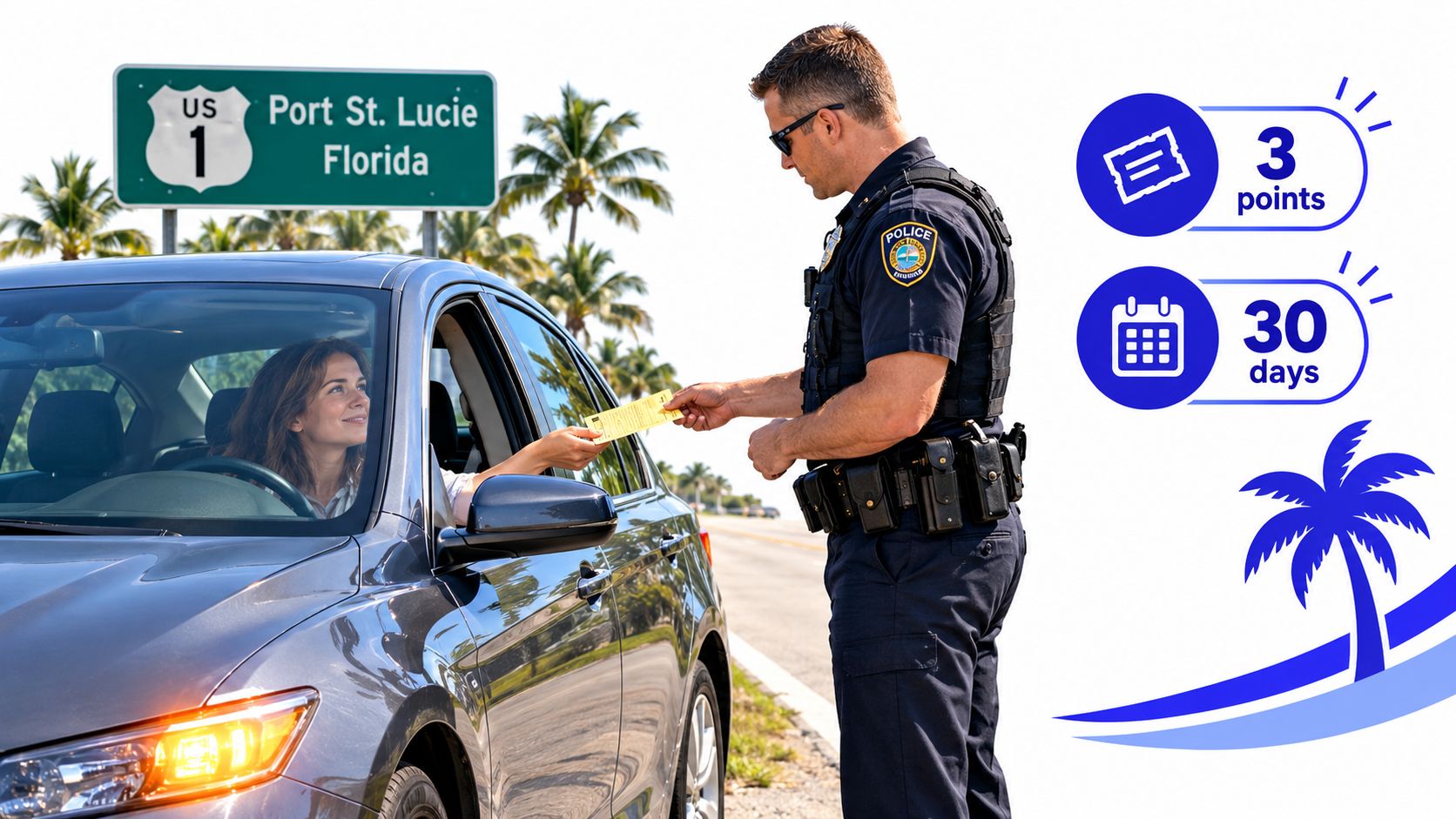
You've just been pulled over on US-1 or Port St. Lucie Boulevard. The officer hands you a citation, you check that you're free to go, and you may feel relieved that the stop is over. It isn't. A Port St. Lucie traffic ticket starts a deadline-driven process that can affect your license, driving record, and insurance. The first move isn't automatically to pay. It's to protect your options while you still have them.
Table of Contents
Why a Port St Lucie Traffic Ticket Is More Serious Than It Looks
The 30-Day Deadline and the 7-Day Clerk Delay Most Drivers Miss
Florida Point Exposure and the Speed Rules That Drive Suspensions
Why a Port St Lucie Traffic Ticket Is More Serious Than It Looks
You drive away with a piece of paper, but Florida treats paying a civil traffic penalty as a conviction. Points may be assessed when the violation carries them, and points or a conviction can have consequences beyond the fine. Before choosing what to do, review the potential costs of a Florida traffic ticket and consider how the disposition could affect your record and insurance.
This isn't a routine municipal task. Port St. Lucie's 2024 Annual Financial Report records 48,434 traffic citations issued in 2024, compared with 48,578 in 2023, 49,326 in 2022, 53,591 in 2021, and 41,116 in 2020. Those reported figures total 241,045 citations over five fiscal years, an average of approximately 48,209 per year. The longer series varies sharply, including 6,349 citations in 2018 and 21,990 in 2019, so changes over time should be interpreted carefully. The city's 2025 police annual report separately lists 53,858 citations and written warnings for 2024, a broader measure than the financial report's citation-only total. (Port St. Lucie Police Department's annual report)
The scale matters because your citation can turn on choices made before the deadline. Paying may close the court matter, but it can also count as a conviction and bring points when applicable. Florida's highway-safety agency warns that points may contribute to insurance costs or a license suspension. Don't treat the fine as the whole problem, and don't assume payment is the safest choice just because it's convenient.
Protect your options first: Read the citation, identify the due date, and understand the point exposure before you elect a response.
The 30-Day Deadline and the 7-Day Clerk Delay Most Drivers Miss
The deadline and the online upload delay are separate clocks. You generally have 30 calendar days from the violation date to make one election with the St. Lucie County Clerk: pay in full, elect an approved driver-improvement course if eligible, or request a hearing in writing. But the Clerk says a citation can take approximately seven days to appear online. A missing search result doesn't extend your deadline. (St. Lucie County Clerk traffic-ticket guidance; Clerk traffic FAQs)

During the upload delay, use the citation in your hand. Keep it, read the printed due date and court instructions, and don't wait for the online system before planning your response. If the citation remains unavailable, contact the Clerk at 772-462-6900. Out-of-state drivers and people who move should be especially careful to keep their citation and contact details accessible.
Choose one election, and document it
Pay in full: This resolves the ticket through payment, but Florida DHSMV treats payment as a conviction and assesses points when applicable. (Florida DHSMV's traffic-citation guidance)
Elect driver improvement: This may be available for eligible drivers and violations. Non-moving violations generally aren't eligible, and you must meet the applicable requirements.
Request a hearing: Submit the request in writing through the Clerk's traffic-document process. Keep a copy and proof of delivery. Merely calling a lawyer or starting a course doesn't make the required election for you.
The most common avoidable mistake is doing nothing. After the response period, the Clerk may add fees and DHSMV may suspend your driving privilege. Handle the election before the deadline, not when the online record finally appears. If you're weighing whether to pay online, compare the consequences and alternatives in this guide to paying a Florida traffic ticket.
The Clerk also provides this overview of the citation process:
Florida Point Exposure and the Speed Rules That Drive Suspensions
Calculate your point risk before you elect an option. Florida assigns three points for ordinary speeding and four points for speeding more than 50 mph over the limit under the listed statutes. Sections 316.187 and 316.189 address speed-limit rules, while 316.1926 specifically addresses exceeding the limit by more than 50 mph under the statutes it identifies. These are moving violations with potential consequences beyond the immediate penalty. (Florida Statutes, Chapter 316)

Florida also assigns four points for certain other moving violations, including some school-bus violations. Points remain on your driving record for at least five years from disposition. That means the relevant date is when the case is resolved, not just the day the officer stopped you. (Florida DHSMV point system and suspension thresholds)
Know the suspension thresholds before choosing
Florida's point-based suspension thresholds are:
Points accumulated | Suspension period |
|---|---|
12 points within 12 months | 30 days |
18 points within 18 months | Three months |
24 points within 36 months | One year |
These thresholds make a seemingly modest citation more consequential if you already have recent convictions. Get your complete driving record, include recent and pending matters in your review, and check whether you've previously elected traffic school. Then compare the ticket's potential points with the threshold that applies to your record.
Don't decide by the fine alone. A careful review of your record can change which response makes sense.
Where Florida law allows it, an approved course or a disposition with adjudication withheld may avoid points. DHSMV says an insurer generally can't impose an additional premium, cancel, or refuse to renew solely because of an infraction when adjudication is withheld and no points are assessed, subject to the statutory crash-loss exception. For more context on how points affect a Florida driving record, see this Florida points-system overview.
Three Ways to Respond to the Citation in Port St. Lucie
The right election depends on three variables: whether the violation is moving, whether you are eligible for traffic school, and how close your record is to a suspension threshold. Treat them as separate checks. The 30-day election window controls when you must act, the Clerk's upload lag can keep a fresh citation out of the portal for about seven days, and the point chain reaction decides what the choice costs later.
Decision check | Pay the citation | Elect driver improvement | Ask for a hearing |
|---|---|---|---|
Deadline pressure | Pay within the response period, even if the portal is slow to show the case. | File the election before the deadline, then complete the course on time. | Get the written request to the Clerk before the cutoff and keep proof. |
Record effect | Closes the case quickly and can leave a conviction with points where the charge carries them. | Can keep points off only when the charge and your history qualify. | The court can dismiss, withhold adjudication where permitted, or enter a conviction. |
Best use | A minor charge, a clean record, and no near-term suspension risk. | A moving violation where school eligibility is clear and prior elections have not used it up. | A stop with weak facts, a documentation problem, or exposure that makes a conviction costly. |
Main risk | Fast resolution can raise insurance and point exposure. | School is unavailable for some charges and repeated elections can be limited. | Requires preparation and can end with the same or worse result. |
Start with the record, not the fine. If the charge is non-moving, school may add cost without protecting your license. If it is moving, check traffic-school eligibility before paying anything, because a quick payment can close the case while leaving the point damage in place. If your record is near a suspension threshold, payment is usually the weakest choice.
My recommendation is blunt: contest or elect school when points can reach your record, and reserve payment for citations that cannot move you toward a suspension. If a hearing is the better path, send the request through the Clerk's traffic-document process, calendar every date, and bring proof of service, photos, witness names, and the citation itself. A hearing is valuable only when the evidence gives the court a reason to rule for you.
Working With the St Lucie County Clerk and Court System
The Clerk's case record, your DHSMV driving record, and your license status are three separate tasks, not one. Resolve the court case, confirm the disposition on your Florida driving record, and verify whether any suspension has been lifted. Closing one does not prove the other two are finished. Drivers who assume otherwise usually discover the gap at the worst time, during a renewal or a traffic stop.

The Port St. Lucie traffic service location is the South County Annex, 250 N.W. Country Club Drive, and the Clerk's traffic line is 772-462-6900. Use the Clerk's online case-search system to review citation details, payment status, school elections, and hearing dates. The Clerk's traffic FAQs, linked earlier in this article, answer the basic filing questions.
Close the case, then check the record
Confirm the Clerk's case shows the outcome you chose, whether payment, a school election, or a court hearing. Save the receipt, the course-completion certificate, and any court order. Then ask the Clerk's office to confirm in writing which disposition was entered. That Clerk record is what your insurer will request if you ever dispute a premium change, so get it right before you leave the counter.
Next, pull your Florida driving record and confirm the disposition and point status match the court file. If you think your license might be suspended, check your status with DHSMV directly rather than assuming the Clerk's case search answers that question. If a suspension was in place, verify reinstatement separately and keep proof of every required step. (Florida DHSMV traffic-citation and court-suspension guidance)
Expect the occasional mismatch: the Clerk shows the case closed while DHSMV still shows points or an open suspension. That is a records problem, not a closed matter. Fix it by presenting the Clerk's paperwork to DHSMV, not by waiting for the systems to sync on their own.
For a plain-language look at preparing to challenge a speeding citation, Olson & Sons offers a resource on how to fight a speeding ticket in traffic court. For the local process, review this Florida traffic-court guide.
Why a Lawyer-Led Defense Beats an Automated Ticket App
Automated apps collect information; the question is who evaluates it. Ticket Shield, PLLC describes its service as lawyer-led, with clients communicating with their attorney by phone or text rather than through middlemen, corporate answering services, or chatbots. The firm states that it serves Florida drivers statewide, offers representation starting at $39.99, has over 25 years of experience including former prosecutors, and reports that over 99% of its clients never appear in court (why a local lawyer beats an automated ticket app). Treat those as the firm's stated service details, not a guarantee about your individual case.
That distinction matters when a citation raises a specific legal issue under Chapter 316 or when point consequences could put your driving privilege at risk. A lawyer reviews the citation, assesses the available defense, handles required filings, and represents you in court. No one can promise a dismissal or a no-points outcome in advance, but you should know who is handling your case and how to reach them.
Ask direct questions before hiring any provider. Who will review the citation? Can you speak with your attorney by phone or text? Who files the paperwork and handles the hearing? A clear answer matters more than an automated status update.
For a serious speeding allegation, especially one under Section 316.1926, weigh the legal strategy and your record consequences above the convenience of an app.
Your Immediate Action Plan and How to Reach Ticket Shield
Act today, even if the citation isn't online yet. Keep the paper citation and use its printed instructions while the Clerk processes the record.
Mark the deadline: Count 30 calendar days from the violation date.
Check the Clerk's system: If the citation hasn't appeared after approximately seven days, call the Clerk.
Review your record: Identify recent points and compare them with the applicable suspension thresholds.
Choose your response: Decide whether to pay, elect an eligible course, or request a hearing in writing.
Keep proof: Save every receipt, certificate, filing confirmation, and court order.
Don't confuse closing the court case with confirming your driving record or license status. If you're unsure which election protects your options, get legal advice before the deadline passes.
Visit Ticket Shield, PLLC for a free consultation about your Port St. Lucie traffic ticket and a lawyer-led review of your options. Contact an attorney directly by phone or text, and pursue the goal of “No Points” on your license while protecting your driving privilege.