Multa de tráfico en el condado de Hendry: Qué hacer en un plazo de 30 días
¿Recibió una multa de tránsito en el condado de Hendry? Conozca su plazo de 30 días, las opciones entre pagar o disputarla, las reglas de la escuela de tránsito y cómo proteger su récord de manejo de Florida.

You're back in your car with a citation beside you, wondering whether to pay it and move on. Before you enter your card information, stop. Your response to a Hendry County traffic ticket should protect your license and insurance position, not just clear a payment screen.
Read the citation, preserve your records, and decide how to respond before committing to a disposition. A quick payment isn't automatically the right decision.
Table of Contents
What to Do in the First 48 Hours After Your Ticket
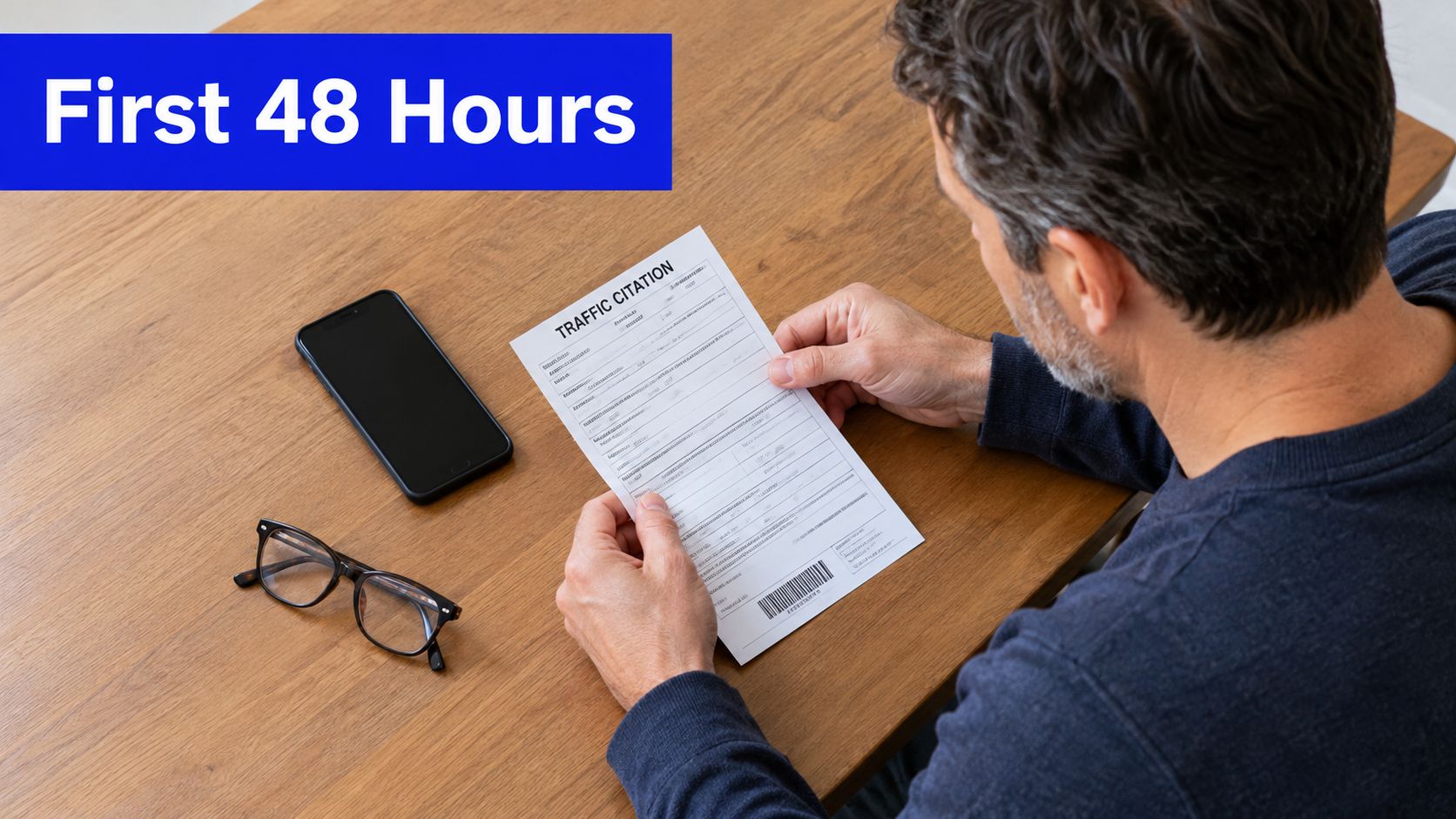
When the officer hands you the citation, your first job is to preserve information. Don't rely on memory, and don't assume the payment instructions explain every consequence of your decision. Treat the citation as a legal document that needs careful review.
Start at the top and read through both sides. Identify what the officer alleges, where the alleged violation occurred, and which court or clerk appears on the form. Mark anything you don't understand for follow-up rather than guessing.
Build Your Ticket File Before Making Decisions
Create a dedicated folder on your phone or computer. Keep the original citation somewhere safe and use clear copies when discussing the matter with the Clerk or an attorney.
Capture both sides. Photograph or scan the citation so every instruction, handwritten notation, and identifying detail is readable.
Record your recollection. Write down the location, posted speed or sign, weather, traffic conditions, and what the officer said. Separate what you remember from what you're unsure about.
Gather relevant documents. Save your license, registration, insurance information, and any paperwork connected to the alleged violation.
Flag discrepancies. Note unclear descriptions or information that appears inconsistent. Have an attorney evaluate its significance rather than assuming it invalidates the ticket.
Don't return to an unsafe roadside location to collect evidence. Record what you can safely document, and preserve existing photographs or other relevant materials without altering them.
Check Your Starting Position
If you already have license problems, establish your current status early. Check your driving record and any notices you've received about registration, insurance, or driving privileges. Give those records to the attorney reviewing your citation so the advice accounts for your situation.
Hendry County's historical workload reinforces the value of organized records. Civil-traffic filings rose from 5,529 in 2012 to 7,192 in 2015, then fell to 4,281 in 2017, according to the Hendry and Glades court annual report. Those historical figures don't establish today's processing speed, but they show why you shouldn't assume the court's workload stays constant.
Practical rule: Keep your own complete file. Don't depend on a phone conversation or an unconfirmed submission as your only record.
Use this guide to what to do when you get a ticket as a preparation checklist. Your immediate objective is straightforward: understand the allegation, preserve useful information, and identify any existing license concerns before choosing a response.
Meeting the 30-Day Election Deadline
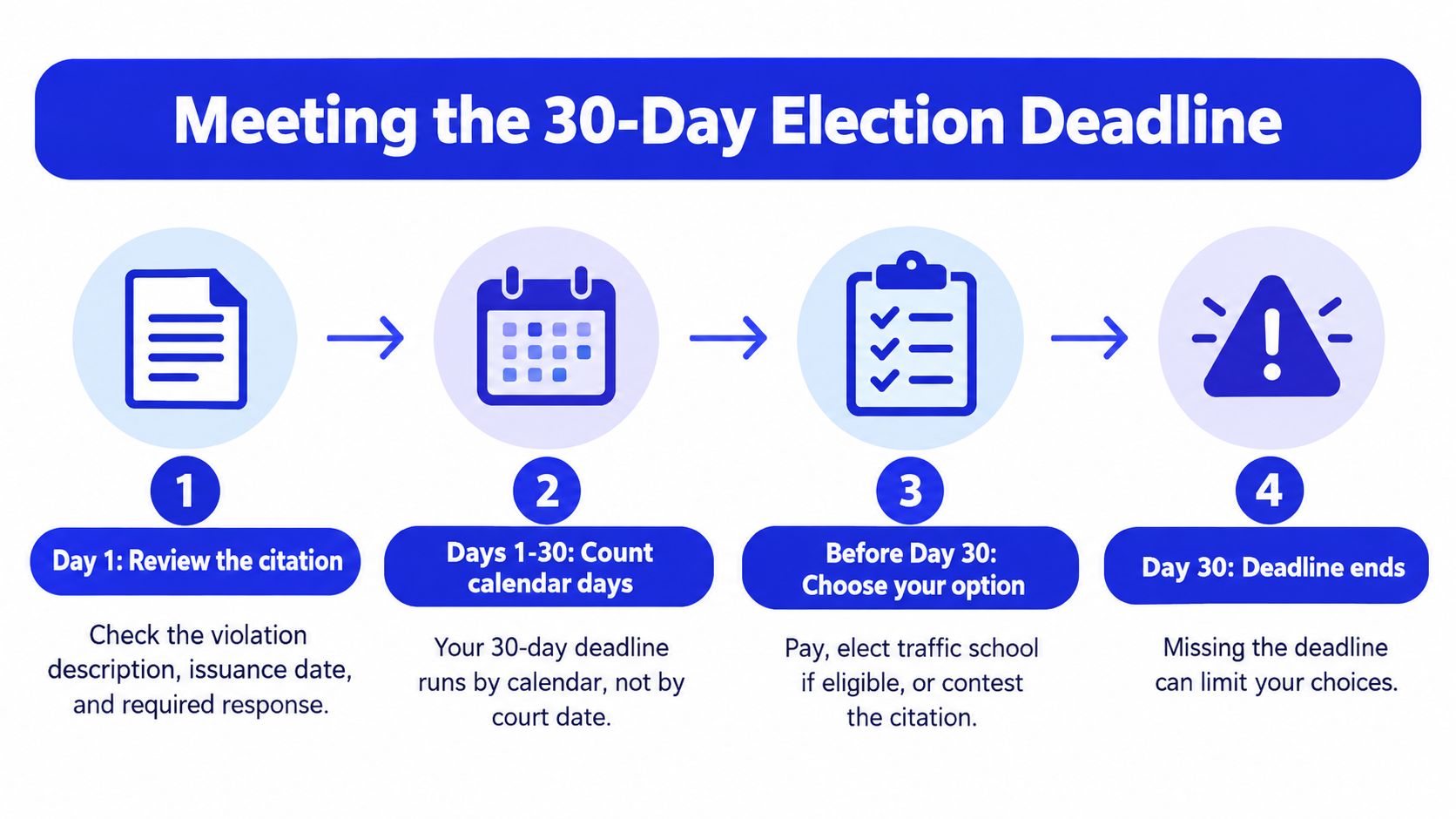
Your initial response deadline matters more than a court date you may receive later. For a Hendry County civil traffic citation, such as speeding or careless driving, you must make an election within 30 calendar days of issuance: pay the penalty or establish a payment plan, elect an eligible driver-improvement course, or contest the infraction, as explained by the Hendry County Clerk's Traffic Division.
Put the response deadline on your calendar immediately. Don't treat the arrival of another letter, an attorney inquiry, or a future hearing date as permission to postpone the election.
Make Contact Before Committing
Begin with the Clerk identified on your citation. Use the Traffic Division to confirm the procedure for that specific ticket, not to choose your legal strategy for you.
Have the citation available when you contact the office. Ask staff to identify the required election process, any necessary forms, and how you'll receive confirmation. If you're considering a hearing or traffic school, resolve procedural questions before submitting payment.
Use this sequence:
Identify the correct record. Match your citation information to the Clerk's case information.
Confirm the available procedure. Ask how to submit your intended election and what documentation accompanies it.
Make the election deliberately. Don't click through a payment process merely to see what happens next.
Save the confirmation. Retain submission records, receipts, and any instructions that follow.
A draft email, an unfinished online form, or a message asking for advice isn't the same thing as a confirmed election. Ask for acknowledgment and keep it with your ticket file.
Don't Confuse an Extension With Preserving Your Defense
The Clerk's guidance also identifies a particularly important local trap: requesting a payment extension waives the right to contest the citation. If you need more time, ask what each available arrangement means before requesting it.
A payment plan and a payment extension shouldn't be treated as interchangeable terms. State exactly what you're asking for and get a clear explanation of the consequences.
Needing more time to pay is a financial problem. Whether to surrender the right to contest is a separate legal decision.
If the deadline is approaching, tell the attorney reviewing your ticket immediately. Ask who will submit the election and how completion will be confirmed. Don't assume that sending a citation for review means someone has already filed your response.
Failure to make a timely election can create avoidable compliance and license problems. Act while your choices remain available, and preserve proof of what you chose.
Paying Versus Contesting Your Citation
Payment is a disposition, not just an administrative convenience. The Clerk guidance discussed above treats payment as a conviction, with applicable points potentially following. That makes the pay-now button a decision about your driving record, not merely your bank balance.
Contesting takes a different approach. You ask the court to address the alleged infraction instead of resolving it through payment. Whether that makes sense depends on the allegation, the available evidence, your driving record, and the consequences you're trying to avoid.
Pay, Contest, or Traffic School at a Glance
Option | What Happens | Points and Record Impact | Key Risk |
|---|---|---|---|
Pay | You resolve the citation through payment under the Clerk's procedure. | Payment is treated as a conviction; applicable points may follow. | Closing the payment obligation without considering the record consequences. |
Contest | You challenge the infraction through the court process available for your citation. | The result depends on the court's disposition. | Assuming a challenge guarantees dismissal or a point-free outcome. |
Traffic school | If eligible, you elect and complete an approved course and satisfy proof requirements. | Proper completion can result in adjudication withheld and no points assessed. | Choosing the course without confirming eligibility or completing the required process. |
The table identifies the decision categories. It doesn't replace a review of your particular charge or establish that every option is available to you.
Let the Actual Offense Guide Your Decision
Florida's traffic rules provide a concrete framework for evaluating consequences. Under Florida Statutes section 316.650, the Department of Highway Safety and Motor Vehicles must distribute a traffic-infraction reference guide identifying each infraction's classification, penalty, points, and related information, as stated in the Florida Senate's published statute.
That's why the description and statutory reference on your citation deserve attention. Don't make your decision solely because a friend paid a similar-looking ticket or because the amount seems manageable.
Ask an attorney to connect the alleged offense to the disposition you're considering. The useful question isn't whether you can afford payment. It's whether that choice fits your record and your goal of avoiding additional license or insurance exposure.
For a closer look at that decision, review whether you should fight your traffic ticket. Use the discussion to prepare questions about your own citation, not to assume the same answer applies to every driver.
Contest With a Purpose
A productive defense review starts with facts. Provide the citation, your recollection, relevant documents, and any existing license notices. Ask counsel what issues deserve investigation and what outcomes are realistic.
Clarify the allegation. Make sure you understand the conduct the officer recorded.
Identify relevant evidence. Ask which documents or factual details could matter.
Understand the objective. Discuss dismissal, point avoidance, and other potential dispositions without treating any result as guaranteed.
Confirm your responsibilities. Get clear instructions about notices, submissions, and any required participation.
Don't contest just to delay payment. Contest because you've evaluated the allegation and have a reasoned strategy. Likewise, don't pay only because it appears easier. Convenience isn't a substitute for understanding the consequences.
Traffic School, Points, and Insurance Costs
For an eligible non-commercial driver, approved basic driver improvement is generally the lowest-risk point-avoidance option to evaluate. But enrolling in a course on your own isn't enough. The election, completion, and proof requirements all matter.
Florida's guidance limits traffic-school elections to no more than one in a 12-month period and eight during a lifetime, excludes commercial driver's-license holders from using that election to avoid points, and states that proper completion results in adjudication withheld with no points assessed; the same FLHSMV driver-improvement FAQ warns that points may increase insurance costs.
Confirm Eligibility Before Enrollment
Start with your driving history and license type. Don't rely on remembering whether you previously took a course, and don't assume a provider's enrollment page establishes your legal eligibility.
Ask the Clerk to confirm the election procedure for your citation. If the answer remains unclear, have an attorney review it before you commit.
Check your prior elections. Verify your history rather than estimating it.
Confirm the offense qualifies. Don't assume every traffic allegation permits the same treatment.
Use an approved provider. Match the course to the requirement you're trying to satisfy.
Get the proof instructions. Know where completion documentation must go and how acceptance is confirmed.
For additional preparation, review the explanation of traffic violator school. Then verify the requirements applicable to your Hendry County citation.
Protect the Result After Completing the Course
Keep the completion certificate with your election confirmation. Submit proof through the required channel and retain evidence of submission. After processing, verify that the disposition and driving record reflect the expected result.
Pay particular attention to the difference between finishing coursework and completing the legal process. A certificate sitting in your email doesn't establish that the Clerk received or accepted it.
Record check: Don't stop at course completion. Confirm that the required proof was received and the expected disposition was recorded.
The common errors are preventable: paying before evaluating the school election, missing the proof deadline, and assuming enrollment alone resolves the citation. Use written instructions and calendar reminders rather than memory.
Insurance deserves separate attention. Avoiding points is not a promise that your premium will remain unchanged. Don't accept a guaranteed savings claim without a basis specific to your policy and circumstances.
Compare the immediate expense with the broader objective: protecting your driving record while satisfying every requirement. If you're uncertain whether school or a court challenge better serves that objective, get legal advice before making the election, not after completing the wrong process.
Hendry County Court Contacts, Hearings, and Typical Costs
Start with the contact information printed on your citation, then confirm current instructions through the Hendry County Clerk's official traffic page referenced earlier. Don't rely on an old directory, a search-result summary, or another driver's account of a different case.
A practical citation journey begins with a focused conversation. Have your document open, explain what procedural information you need, and write down the answer. Your purpose is to leave with clear next actions, not a general impression that everything is handled.
Turn Clerk Contact Into a Written Checklist
Suppose you're considering contesting the allegation. Ask how to request a hearing, which forms apply, and how the office handles written or online submissions. Don't assume that a particular submission method is available until the Clerk confirms it.
Keep a contact log with the date, staff member's name, and instructions received. Save notices alongside that log so you can distinguish general guidance from a case-specific direction.
Question to Ask | Record to Keep |
|---|---|
Which procedure applies to this citation? | The relevant form or written instruction. |
How is a hearing requested? | Submission confirmation and any resulting notice. |
What amount is currently required? | A citation-specific balance or written breakdown. |
What remains outstanding? | A checklist of documents, proof, or other required action. |
Read every later notice when it arrives. If you hire counsel, forward it promptly and ask whether you need to do anything. Don't assume that an earlier phone conversation answers a later written instruction.
Verify Costs Instead of Using a Generic Estimate
There isn't a useful universal price for resolving a Hendry County traffic ticket. Fine amounts and court costs depend on the offense and its classification. Ask for the amount associated with your citation and clarify what it includes before authorizing payment.
If you're comparing representation with self-handling, keep the categories separate. Ask counsel about the legal fee and ask the Clerk about citation-specific amounts. Don't assume either figure includes the other.
This guide to court costs for a traffic ticket can help you frame those questions. The current information for your case should control your financial planning.
Historical enforcement figures also require care. Florida's official report recorded 8,597 Hendry County violations in 2010, according to the FLHSMV county citation statistics. Citation totals measure enforcement activity, not the same thing as court filings, and that historical figure doesn't predict your hearing date or current processing time.
Act early because you need room to resolve uncertainty. If instructions conflict or a balance doesn't make sense, request clarification before proceeding. Clear records and confirmed instructions are more useful than assumptions about how quickly the office should respond.
When Hiring Ticket Shield Makes Sense for Your Case
Hire counsel when the consequences require more than a payment decision. An at-risk license, uncertainty about your driving record, an approaching election deadline, or concern about insurance exposure all justify a focused legal review. You need advice tied to your citation and circumstances.
The service model matters. Direct attorney communication lets you ask the person evaluating your defense why a particular approach fits your case. That's a different experience from relying on an automated app or a ticket-mill process built around intermediaries.

Choose Legal Judgment, Not Just Document Intake
Ticket Shield provides a lawyer-led defense with direct attorney communication by phone or text, rather than routing your legal questions through middlemen, corporate answering services, or automated chatbots. The practical value is access to an attorney who can discuss your allegation, your record, and the response under consideration.
An upload portal can collect a citation. It can't substitute for a conversation about why you're worried about your license or what you don't understand about the available choices. Don't confuse a convenient intake experience with a complete defense strategy.
Before retaining representation, ask direct questions:
Who will advise me? Confirm how you'll communicate with the attorney handling your matter.
What does the engagement cover? Request a clear explanation of the work included and your responsibilities.
What should happen immediately? Identify any election or submission that still needs confirmation.
What outcomes are realistic? Ask for an assessment, not a guaranteed result.
Use this discussion of whether traffic ticket lawyers are worth it to evaluate representation against your actual risk. The decision should reflect what's at stake for you, not just the face amount of the citation.
Arrive Prepared for a Useful Consultation
Send a readable citation, relevant notices, and a concise description of your concerns. Identify existing license issues and explain whether you've already made any payment, election, or extension request. Those details help the attorney understand what has happened and what still needs attention.
If a submission channel has file-size restrictions, PDFWix offers a resource to compress PDFs for legal submissions. Check that the resulting document remains legible, preserve the original, and confirm your attorney's preferred method before uploading sensitive records.
Ask for transparent pricing and a clear scope of representation. Value-driven legal service means understanding what you're paying for and how the proposed work addresses your situation.
No Points is the goal, not a guaranteed outcome. An attorney should explain the available strategy and its limitations. Make the consultation useful by bringing complete records, asking specific questions, and acting before your remaining choices narrow.
Ticket Shield, PLLC offers lawyer-led Florida traffic defense with direct attorney access by phone or text. Visit Ticket Shield, PLLC at TicketShield.com today for a free consultation about your Hendry County traffic ticket, and take action toward the goal of No Points on your license.