¿Cuánto cuesta disputar una multa de tránsito en Florida?
¿Cuánto cuesta apelar una multa de tránsito? - Conozca cuánto cuesta apelar una multa de tránsito en Florida. Descubra tarifas de abogados, aumentos de seguro y por qué

Está mirando una multa de tráfico de Florida y pensando lo mismo que la mayoría de los conductores: "¿Cuánto me va a costar esto, y puedo simplemente pagarla y seguir adelante?" Ese instinto mete a la gente en problemas.
En Florida, pagar una multa suele ser la forma más rápida de convertir una molestia a corto plazo en un problema financiero a largo plazo. Bajo el Capítulo 316, las infracciones de tráfico no son solo papeleo. Pueden afectar su historial de manejo, su seguro, su tiempo y su licencia. Si su citación implica exceso de velocidad, por ejemplo, el Estatuto de Florida 316.187 es una de las leyes que pueden meterlo en el sistema con una condena si lo maneja de la manera incorrecta.
Si todavía está decidiendo qué hacer después de la parada, este desglose práctico de los pasos para una audiencia judicial en GA es útil para comprender cómo funciona la preparación en el tribunal en general, aunque su caso necesite una estrategia de defensa específica para Florida. También debería repasar qué hacer cuando recibe una multa antes de tomar cualquier decisión que confirme su culpabilidad.
Índice de Contenido
Su Multa de Tráfico en Florida: Una Decisión Que Debe Tomar Bien
El Precio de Etiqueta vs. El Costo Real de una Multa en Florida
Preguntas Frecuentes y Cálculos de Costos de Multas de Tráfico en Florida
Su Multa de Tráfico en Florida: Una Decisión Que Debe Tomar Bien
En Florida, pelear una multa de tráfico puede costar una tarifa legal por adelantado, pero la cifra más grande es el costo total de una condena. Pagar la multa puede parecer más fácil, pero puede desencadenar puntos, aumentos en el seguro y otros gastos que a menudo cuestan mucho más.
Recibió la multa. Ahora se abre la trampa.
La mayoría de los conductores miran la multa y la tratan como una factura. Quieren que desaparezca. La pagan en línea, cierran la pestaña y asumen que el problema terminó. No es así. En muchos casos en Florida, pagar la multa significa declararse culpable y aceptar consecuencias que le seguirán cobrando después de que la multa se haya liquidado.
Por eso la pregunta principal no es "¿Cuánto es la multa?". Una pregunta más pertinente es cuánto cuesta pelear una multa de tráfico en comparación con el costo total de una condena.
Consejo de protección: Si está decidiendo basándose únicamente en el monto impreso en la citación, está decidiendo con información incompleta.
El Precio de Etiqueta vs. El Costo Real de una Multa en Florida
El número impreso en su multa es el precio de etiqueta. No es el precio total.
Los conductores se dejan engañar porque la parte visible parece manejable. El resto permanece oculto hasta más tarde. Consecuencias judiciales. Repercusiones administrativas. Presión del seguro. Tiempo perdido de trabajo. Estrés para el que no tenía presupuesto. Una condena bajo la ley de tránsito de Florida puede llegar mucho más allá de la parada en la carretera.
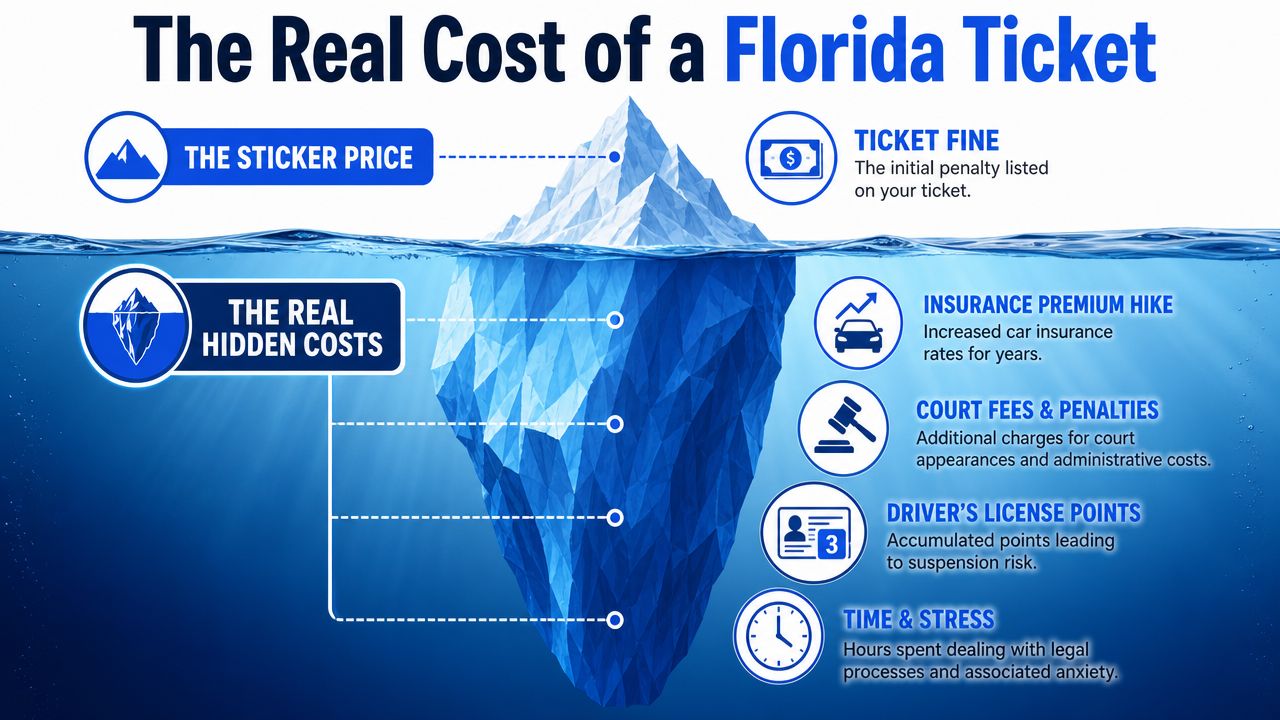
Por qué el número en la multa engaña a los conductores
Gran parte del contenido en línea habla de los honorarios de los abogados o de los costos judiciales como si fueran asuntos separados. Eso no da en el blanco. El análisis más inteligente es el panorama económico total.
Un ejemplo citado muestra que los costos judiciales básicos por sí solos pueden rondar los $254 para una infracción de tráfico menor, unos $362 para una infracción de tráfico grave, y unos $1,381 para un caso de DUI en algunas jurisdicciones, que es exactamente la razón por la cual el costo total puede variar drásticamente según la acusación y el condado, como se explica en este desglose de multas de tráfico y costos judiciales.
Esa fuente señala algo que muchos conductores pasan por alto. Los honorarios del abogado son solo una partida. La carga completa incluye los gastos judiciales de bolsillo, las consecuencias posteriores y el riesgo de ahorrar dinero hoy solo para gastar mucho más mañana.
Por qué el costo total importa más que la multa
Si está intentando recuperar el control de sus finanzas después de una citación, ayuda mirar esto de la misma manera en que abordaría un reinicio mensual estricto. Una guía práctica para el presupuesto de base cero puede ayudarle a planificar cada dólar. Esa mentalidad presupuestaria importa aquí porque los casos de tráfico no son eventos de un solo pago. A menudo crean una cadena de gastos.
Use ese marco de referencia al leer cuánto pueden costar las multas por exceso de velocidad. No pregunte solo cuál es la multa. Pregunte qué sucede después de que una condena afecte su expediente.
Aquí está la simple verdad:
La multa es solo la parte visible. Es la parte que el tribunal imprime.
Los costos ocultos llegan más tarde. Las compañías de seguros, las consecuencias sobre la licencia y los procedimientos adicionales no aparecen en el primer momento.
Su tiempo tiene un precio. Faltar al trabajo, manejar el papeleo y perseguir fechas de audiencias, todo suma.
Una mala decisión se acumula. Una vez que se registra la culpabilidad, sus opciones por lo general disminuyen.
No está lidiando con un recibo de estacionamiento. Está lidiando con un evento legal que puede seguir costándole incluso después de sentir que el caso terminó.
Cuáles Son los Costos Iniciales para Pelear una Multa
Recibe la citación, mira de reojo la multa y decide que el camino más barato es manejarlo usted mismo. Entonces comienza la cuenta total. Pierde horas de trabajo, pasa tiempo en el tribunal, se salta un paso del procedimiento y, aun así, termina con el mismo riesgo que intentaba evitar.
In el Complejo Judicial del Condado de Broward en Fort Lauderdale, los conductores descubren rápido que el tribunal de tráfico funciona con reglas, plazos y presentación. Las buenas intenciones no reducen el riesgo. Un enfoque informal puede convertir una multa manejable en un problema mucho más costoso.

Lo que realmente cuesta la autorrepresentación
Manejar su propia multa no significa que el caso sea barato. Significa que usted está asumiendo cada categoría de costo por sí mismo.
Eso incluye los gastos obvios, pero el mayor problema es la exposición al riesgo. Usted es responsable de la presentación de documentos, las comparecencias, la programación y de tomar las decisiones correctas bajo presión. Si se le pasa un plazo o interpreta mal el proceso, el tribunal no reducirá las consecuencias porque usted estaba intentando ahorrar dinero.
Los costos iniciales comunes de pelear una multa por su cuenta incluyen:
Cargos relacionados con el tribunal: Incluso una citación menor puede conllevar gastos judiciales adicionales.
Pérdida de trabajo: Las fechas de audiencias y la gestión del caso a menudo interfieren con las horas laborales pagadas.
Tiempo de viaje y de espera: El estacionamiento, el transporte y las horas en el tribunal se acumulan.
Riesgo de procedimiento: Un error puede dejarlo pagando penalizaciones después de haber invertido su propio tiempo y esfuerzo.
Regla práctica: La autorrepresentación solo tiene sentido si su tiempo es barato, su horario es flexible y se siente cómodo asumiendo la total responsabilidad por el resultado.
Para muchos conductores, nada de eso es cierto.
Lo que suele costar contratar a un abogado por adelantado
Los abogados de tráfico suelen cobrar una tarifa fija o una tarifa por hora. Para un asunto sencillo, los honorarios a menudo caen en el rango de tarifa fija de $200 a $500, mientras que los casos más complejos pueden facturarse a $150 a $400 por hora, según esta descripción general de los modelos de precios de abogados de tráfico.
Esa cifra asusta a los conductores porque la tienen delante de inmediato. Pero esa es la forma incorrecta de evaluarla. Los honorarios del abogado son el gasto controlado. Los gastos peligrosos son los que siguen a un mal resultado.
Antes de decidir, revise los problemas comunes de costos judiciales en casos de tráfico. Luego compare ambos caminos como una decisión financiera madura, no como una reacción rápida al monto de la multa.
Categoría inicial | Pelearla usted mismo | Contratar un abogado |
|---|---|---|
Previsibilidad | Baja | Normalmente más controlada |
Carga de tiempo | Sobre usted | Reducida para usted |
Riesgo del proceso | Mayor | Transferido al representante legal |
Gestión judicial | Usted la maneja | El abogado gestiona la estrategia y comparecencias donde se permita |
Aquí está la cruda verdad. Los honorarios de un abogado pueden parecer caros por un día. Una condena puede seguir siendo costosa durante años.
Si su único objetivo es gastar menos esta tarde, puede que elija la opción que le costará mucho más con el tiempo. Si su objetivo es proteger su historial, su perfil de seguro y sus finanzas a la larga, pagar por una defensa suele ser la inversión más inteligente.
Las Penalidades Financieras Ocultas de Declararse Culpable
En Florida, el movimiento peligroso suele ser el más fácil. Paga en línea. Piensa que resolvió el problema. Lo que pudo haber hecho es declararse culpable.
Eso importa bajo el Estatuto de Florida 316.187, que cubre la velocidad ilegal. Si su multa cae bajo una infracción de tránsito en movimiento del Capítulo 316 y la resuelve de manera incorrecta, puede crear un problema en su expediente que va más allá de la propia multa. La condena es lo que importa. Eso es lo que le persigue.
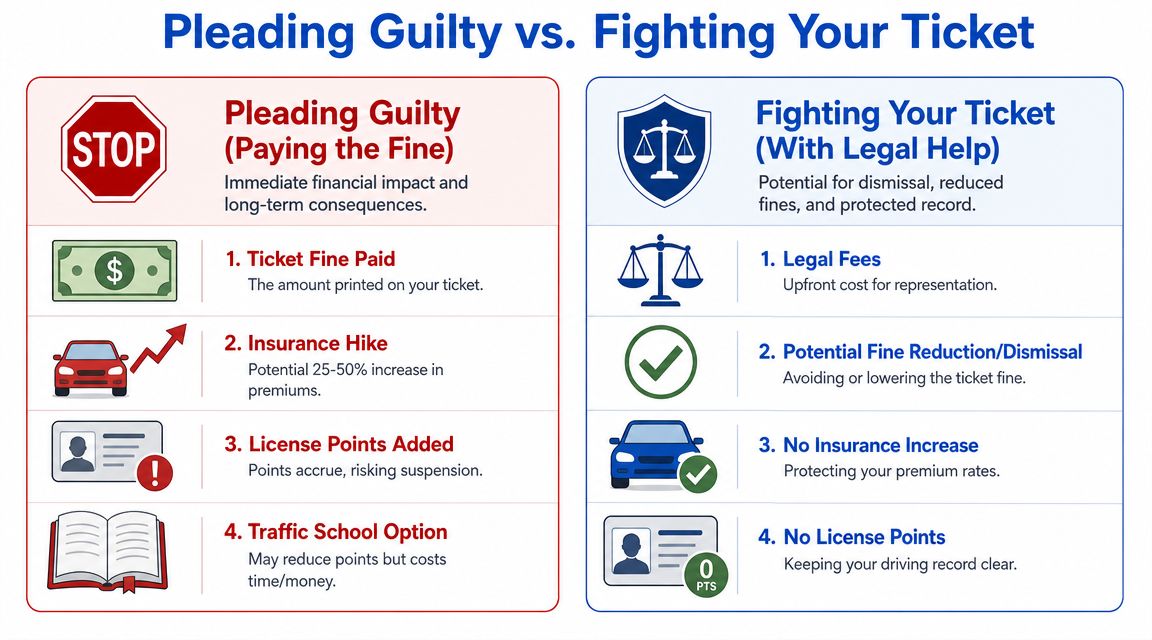
Qué cambia cuando paga la multa
La respuesta más corta es esta. Pagar la multa puede ser la opción más costosa.
Puede que evite la molestia de disputar la citación en el momento. Pero a cambio, puede asegurar consecuencias que son más difíciles de revertir. Los puntos importan. El historial del expediente importa. La evaluación de riesgos del seguro importa.
Incluso cuando la multa inmediata parece manejable, una fuente citada señala que las multas de tráfico pueden oscilar entre $45 y $600 en Nueva York y pueden incluir un punto de partida de $300 de DRA (Evaluación de Responsabilidad del Conductor) por separado, mientras que la misma fuente señala que una sola multa por exceso de velocidad puede aumentar el seguro de un 12% a un 30%. El ejemplo estatal no es ley de Florida, pero la lección financiera es universal. La condena a menudo cuesta más que la citación misma.
Una multa de tráfico duele más después de que deja de pensar en ella.
Costo de la condena vs. costo de la defensa
Aquí está la comparación que los conductores necesitan ver antes de hacer clic en "pagar".
Factor | Opción 1: Pagar la Multa / Declararse Culpable | Opción 2: Contratar a Ticket Shield / Buscar Desestimación o Sin Puntos |
|---|---|---|
Gasto inmediato de bolsillo | Multa y cualquier pago requerido relacionado | Tarifa legal por adelantado |
Historial de manejo | Persiste el riesgo de condena | Estrategia orientada a proteger el historial |
Impacto en el seguro | Posible aumento de la prima después de la condena | El objetivo es evitar la condena que desencadena ese aumento |
Riesgo para la licencia | Los puntos pueden acumularse y aumentar el riesgo de suspensión | La defensa se centra en reducir ese riesgo |
Carga de tiempo | Usted todavía lidia con las secuelas | La ayuda legal puede reducir la carga del procedimiento |
Control a largo plazo | Limitado una vez que se registra la culpabilidad | Más margen de maniobra antes de que se cierre el caso |
Observe lo que muestra esta tabla. La opción de "pagar y seguir adelante" solo parece más barata si se niega a tener en cuenta el futuro.
La tarifa de un abogado es una única cifra visible. Una condena genera una serie continua de costos. Por eso los conductores que solo comparan la multa con los honorarios del abogado suelen comparar las dos cifras incorrectas.
Cuándo Contratar a un Abogado Realmente le Ahorra Dinero
Le ahorra dinero cuando la multa amenaza sus ingresos, su horario o su historial más que a su orgullo. Ese es el caso de la mayoría de los adultos que trabajan.
Para conductores que ganan su sustento con su vehículo
Si conduce para repartos, viajes compartidos, rutas de trabajo o servicios móviles, su automóvil es parte de su fuente de ingresos. Una citación no es solo una molestia. Puede convertirse en un problema laboral.
Por eso la ayuda legal a menudo tiene sentido rápidamente. Una fuente citada señala que utilizar un abogado de multas de tráfico generalmente significa que usted no tiene que comparecer ante el tribunal, lo cual representa una compensación de costos significativa para las personas que, de lo contrario, perderían salarios o faltarían a sus obligaciones, como se analiza en este artículo sobre disputar una multa de tráfico y las cargas de comparecer ante el tribunal.
Si su jornada laboral depende de mantenerse en la carretera, la tarifa de un abogado puede ser más fácil de justificar que la interrupción de encargarse de todo usted mismo.
Para profesionales que no pueden perder un día de tribunal
En el Tribunal de Edgecomb en Tampa, su caso puede ser solo un elemento en una agenda saturada. Incluso una comparecencia simple puede consumir horas. Los profesionales con reuniones, plazos de entrega, pacientes, clientes, turnos o vuelos no necesitan más teoría legal. Necesitan contención.
Esa es la misma lógica que la gente aplica en otros entornos legales. Alguien que compara los costos de un derecho familiar no disputado podría leer sobre cómo evitar abogados de divorcio costosos y enfocarse en pagar solo por el nivel de ayuda que protege el tema en juego. La defensa de tráfico debe abordarse de la misma manera. Gaste estratégicamente. Proteja el activo más grande.
También debería sopesar sus opciones revisando si pagar una multa o contratar a un abogado. La respuesta correcta suele depender de lo que le costaría una condena después del tribunal, no solo de lo que cuesta la representación antes del juicio.
Para miembros del servicio militar y trabajadores sensibles a su historial
Considere que algunos conductores no pueden permitirse manchas en su historial porque su trabajo depende de la confiabilidad, el privilegio de conducir o un historial de cumplimiento limpio. Esto incluye al personal militar, trabajadores en áreas de seguridad sensible y conductores cuyos empleadores revisan los historiales de forma rutinaria.
Para esas personas, el honorario del abogado no es la carga. La carga es la repercusión de una condena evitable.
La Diferencia de Ticket Shield: Un Abogado en su Esquina
Muchos servicios de multas están estructurados como embudos de captación. Usted envía la información. Un intermediario la recopila. Un sistema la procesa. Usted espera. Eso no es lo mismo que una defensa legal.
En el Edificio de Justicia Richard E. Gerstein en Miami y en los tribunales de toda Florida, los casos de tráfico siguen siendo manejados por personas: jueces, fiscales, secretarios, oficiales y abogados. Si su defensa se está canalizando a través de una experiencia tipo aplicación móvil, es posible que nunca reciba el juicio estratégico que su caso necesita.

Por qué importa el acceso directo al abogado
Debería poder hablar directamente con su abogado por teléfono o mensaje de texto. No con un bot. No con un gestor de casos que no puede responder preguntas legales. No con una fábrica de multas por volumen que trata su citación como un código de barras.
Esa diferencia importa cuando los hechos cambian, los plazos se acortan o la postura del tribunal varía.
Qué cambia con un modelo liderado por abogados
Una opción que utilizan los conductores de Florida es el servicio de abogados para multas por exceso de velocidad de Ticket Shield, el cual está estructurado como un modelo de defensa dirigido por abogados en lugar de un flujo de trabajo de aplicación automatizada. La firma declara que los servicios pueden comenzar desde $39.99, y la diferencia operativa clave es la comunicación directa con el abogado en lugar de canalizar a los clientes a través de intermediarios.
Eso es lo que debería exigir a cualquier bufete que contrate. Precios claros. Juicio legal real. Acceso directo. Una estrategia de defensa construida alrededor del único resultado que realmente lo protege: Sin Puntos.
Si un servicio no puede decirle quién está manejando realmente su caso, debería pensarlo dos veces antes de entregar su historial de manejo.
Preguntas Frecuentes y Cálculos de Costos de Multas de Tráfico en Florida
Recibe una multa de camino a casa, mira de reojo el importe y asume que ese es el precio del problema. Así es como los conductores de Florida convierten una citación manejable en meses o años de gastos adicionales.
En el Tribunal del Condado de Orange en Orlando, al igual que en otros tribunales de Florida, los plazos y el procedimiento importan. Su decisión financiera es más simple de lo que parece. Deje de comparar la multa con los honorarios del abogado de forma aislada. Compare los honorarios del abogado con el impacto financiero total de un resultado de culpabilidad.
Cuánto cuesta pelear una multa de tráfico
Para una multa sencilla, los honorarios legales iniciales suelen ser de unos pocos cientos de dólares, como se mencionó anteriormente. Esa cifra importa, pero no es el número que debería controlar su decisión.
La pregunta principal es si esa tarifa le ayuda a evitar puntos, aumentos en el seguro, tiempo fuera del trabajo y una mancha en su historial de manejo. Si es así, la tarifa no es solo una factura más. Es una protección contra un resultado mucho más costoso.
Qué pasa si la pelea usted mismo
Representarse a sí mismo no hace que el caso sea barato. Traslada la carga hacia usted.
Los costos judiciales, las tarifas adicionales, la alteración de su agenda y las visitas repetidas al tribunal pueden convertir una defensa de "hágalo usted mismo" en un error costoso. Un desglose detallado de los costos de multas de tráfico y por exceso de velocidad muestra cómo estos cargos adicionales pueden acumularse más allá del valor nominal de la citación.
Las estructuras de tarifas de Florida varían según el condado y el tipo de caso. La advertencia sigue siendo la misma. Si maneja el caso solo, usted se encarga de la labor legal, la pérdida de tiempo y el riesgo de obtener un resultado incorrecto.
Qué debería hacer ahora mismo
Use esta lista de verificación antes de pagar o declararse culpable:
Verifique el plazo de respuesta: Pasarlo por alto limita sus opciones rápidamente.
Lea la acusación exacta: Una infracción de tráfico en movimiento bajo el Capítulo 316 puede afectar mucho más que la multa.
No trate el pago como un cierre definitivo: Pagar puede significar una condena.
Haga la matemática completa: Incluya la exposición al seguro, los puntos, el tiempo de trabajo y los costos judiciales.
Obtenga asesoría legal antes de actuar: Una estrategia temprana le brinda la mejor oportunidad de proteger su expediente.
Si se está preguntando cuánto cuesta pelear una multa de tráfico, comience con la cifra más grande. Los honorarios del abogado son la inversión inicial. El costo real es lo que un mal resultado puede drenar de sus bolsillos mucho tiempo después de que el caso se haya cerrado.
Si desea proteger su licencia, su expediente y su seguro, hable con un equipo de defensa de Florida liderado por abogados antes de pagar cualquier cosa. Visite Ticket Shield, PLLC para una consulta gratuita y concéntrese en el resultado que más importa: Sin Puntos.