
Florida No Valid Drivers License Immigration Impact Guide
Discover how a no valid drivers license immigration issue in Florida can impact your status. Learn about criminal charges, deportation risks, and your rights.
For a non-citizen in Florida, seeing flashing blue and red lights in the rearview mirror can feel terrifying. The immediate worry isn't just about the ticket—it's about something far more serious: can a citation for no valid driver's license have immigration consequences?
The short answer is yes, it can. But the severity of those consequences hinges on one crucial detail: whether you're facing a simple civil infraction or a criminal charge. A criminal conviction is what can create real problems for your immigration case, affecting everything from adjusting your status to what a judge decides in a discretionary hearing.
Attorney Advertisement. Office in Broward. Submitting information via forms does not create an attorney-client relationship. Past results do not guarantee future outcomes.
Your First Question: What Happens If You Are Undocumented And Get Pulled Over In Florida?
Getting pulled over is stressful for anyone, but if you're undocumented, that stress is multiplied. The single most important factor that will shape what happens next is the type of charge the officer gives you.
Here in Florida, driving without a valid license can go one of two ways. It’s vital to understand that not all "No Valid Driver's License" (NVDL) citations are created equal. One is basically just a traffic ticket; the other is a crime.
The Civil Infraction vs. The Criminal Charge
Think of it like this: a civil infraction for driving without a license is like a parking ticket. It's an administrative issue, not a criminal one. You typically pay a fine, and it won't show up on a criminal background check. For your immigration case, this is a very low-risk situation.
A criminal charge, on the other hand, is like being arrested for shoplifting. In Florida, this is usually charged as a second-degree misdemeanor. This means you've been formally accused of a crime, and if convicted, you will have a permanent criminal record. This is the scenario that gets the attention of immigration officials.
A criminal conviction, no matter how minor it seems, becomes a permanent mark on your record. Federal agencies like U.S. Citizenship and Immigration Services (USCIS) and Immigration and Customs Enforcement (ICE) can and will see it.
To help you understand the difference at a glance, here's a quick breakdown of the two types of charges and what they could mean for you.
Florida No Valid Driver's License: A Quick Risk Assessment
Charge Type | Common Example | Potential Legal Penalties | Immigration Risk Level |
|---|---|---|---|
Civil Infraction | First-time offense where you simply never obtained a license. | A fine, no jail time, no criminal record. | Low |
Criminal Misdemeanor | Driving on a suspended/revoked license, or a second NVDL offense. | Fines, probation, up to 60 days in jail, and a permanent criminal record. | Moderate to High |
As you can see, keeping the charge in the "civil" column is critical. A criminal conviction introduces a whole new level of risk to your life in the U.S.
Why Immigration Officials Care About Criminal Traffic Offenses
Immigration law is incredibly complicated, but a key concept that comes up again and again is an applicant's "good moral character." While a single misdemeanor for NVDL usually isn't enough to get you deported on its own, it can still do serious damage to your case. Here’s how:
Inadmissibility: A criminal record can make you "inadmissible," which is a legal term that means you're barred from getting a green card or even re-entering the country legally.
Discretionary Decisions: In many immigration cases, like asylum or cancellation of removal, the judge has a lot of leeway. A criminal conviction gives them a concrete reason to rule against you, arguing you don't deserve a favorable outcome.
A Pattern of Disregard: Even a "minor" conviction can be framed by a government attorney as proof that you don't respect U.S. laws, which can weaken your entire immigration case.
The first step in protecting yourself is knowing exactly what you're up against. You can get more details on the specifics in our guide on what qualifies as No Valid Driver's License in Florida. Your primary goal should always be to avoid a criminal conviction to keep your immigration path clear.
Understanding The Difference Between A Ticket And A Crime
When you're pulled over for not having a valid driver's license, the single most important detail for your immigration status is what the officer hands you: a civil ticket or a criminal citation. This isn't just legal semantics—it's the fork in the road that separates a minor headache from a major threat to your future in the United States. Getting this difference straight is the first and most critical step in protecting yourself.
Think of a civil traffic infraction as being in the same ballpark as a parking ticket. It's a non-criminal violation that exists outside the criminal justice system. You pay a fine, and that's usually the end of it. Critically, it doesn't create a criminal record. For immigration officials, a civil infraction is typically a minor blip on the radar.
A criminal traffic offense, on the other hand, is a whole different ballgame. Now you're being treated like someone accused of a crime, like shoplifting. You’ve been formally charged with breaking a criminal law, and a conviction means a permanent criminal record that federal agencies like U.S. Citizenship and Immigration Services (USCIS) can easily see.
Why A Criminal Charge Poses A Greater Risk
In Florida, driving without a valid license falls under Florida Statute 322.03. A first-time offense might just get you a civil ticket. But if it happens again, or if you're caught driving while knowing your license is suspended, you’re almost certainly looking at a criminal charge. A second offense is typically a second-degree misdemeanor.
Immigration authorities take criminal convictions very seriously. A criminal record can be used as proof that you don't respect U.S. laws, which can torpedo your immigration case. Even a misdemeanor that seems small can be enough to sway an immigration judge's decision on things like an asylum claim or your green card application.
This infographic breaks down the two very different paths you can go down after a traffic stop.
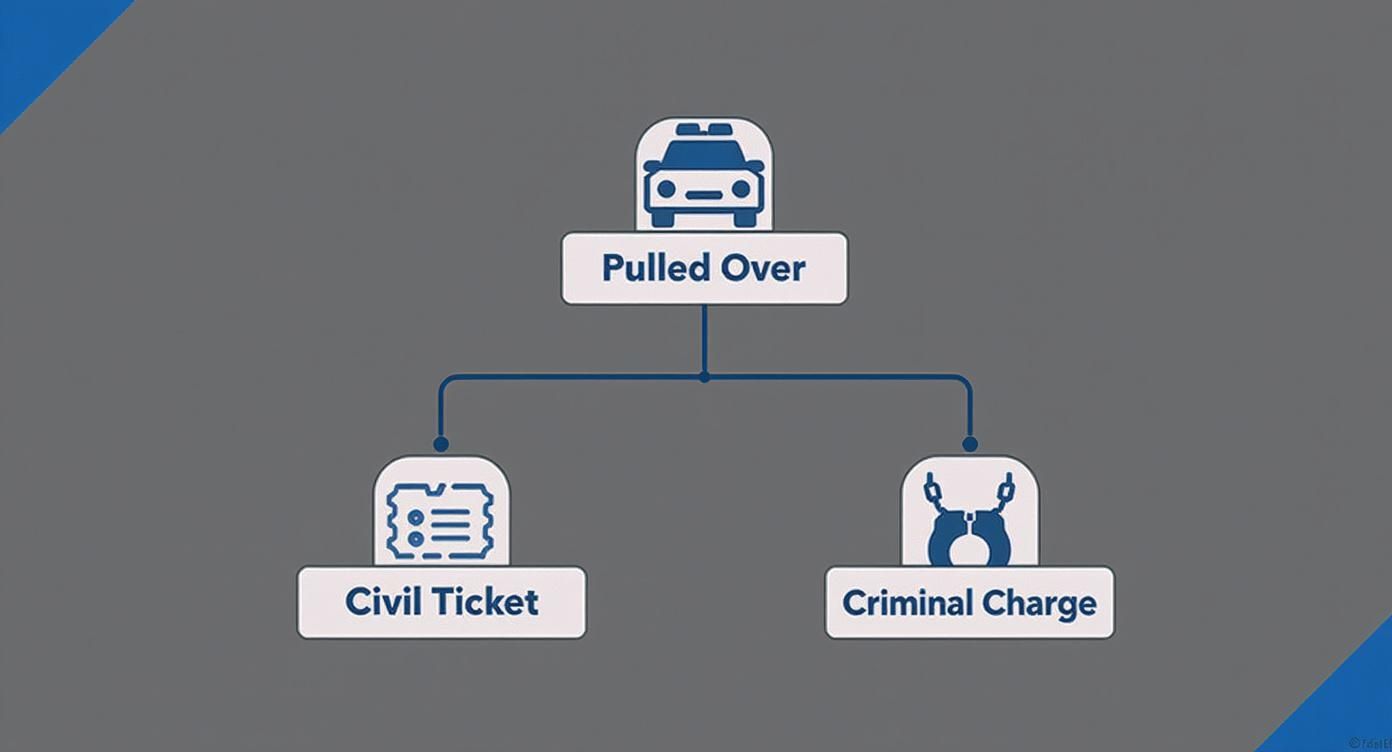
As you can see, a civil ticket ends with you paying a fine. A criminal charge, however, can lead to court dates, potential jail time, and a permanent criminal record—the very thing that creates problems for immigration.
The Consequences Of A Conviction
It’s easy to underestimate a criminal charge, but it’s far more than a piece of paper. A conviction carries real penalties that ripple out long after you leave the courtroom. While a single misdemeanor for no valid license is unlikely to get you deported on its own, it adds a black mark to your permanent record.
A criminal record becomes a permanent part of your history. It doesn’t fade away over time and can be a significant hurdle in any future interaction with the U.S. immigration system. Our goal is to protect your license and record by preventing a conviction from ever happening.
The immediate penalties for a criminal charge are also much more severe than a simple fine. You could be facing:
Jail Time: A second-degree misdemeanor in Florida can land you in jail for up to 60 days.
Probation: A judge could place you on probation, forcing you to follow a strict set of rules.
Substantial Fines: The fines for criminal offenses are much higher than those for civil tickets.
Things get even more complicated if your license was suspended when you were pulled over, as that comes with its own harsh punishments. You can learn more in our guide on the penalties for driving with a suspended license. The bottom line is that the stakes are far too high to treat a criminal traffic charge casually. Understanding the danger you're in is the first step toward building a defense that protects your future.
How A Criminal Conviction Can Affect Your Immigration Case
When you're facing a criminal traffic charge like No Valid Driver’s License (NVDL), the court case is just the first hurdle. The final outcome ripples through your entire immigration journey, often for years to come.
While a single NVDL conviction won't usually get you automatically deported, it's a permanent black mark on your record. It fundamentally changes how immigration authorities see you.
To get a handle on this, you need to understand two critical concepts: inadmissibility and deportability. Think of it this way: inadmissibility is like a locked door, stopping you from entering the U.S. or getting a green card. Deportability is the trapdoor that can have you removed from the country entirely.
A criminal traffic conviction can put you at risk in both areas. It might not be a "deportable offense" on its own, but it weakens your case and gives officials a reason to say no.
The Concept of Moral Turpitude
Immigration law is especially tough on crimes involving "moral turpitude." It sounds complicated, but it's a legal term for acts that are just plain wrong—inherently base, vile, or depraved. Think of serious offenses like fraud, major theft, or violent crimes.
Here’s the good news: a simple charge for driving without a valid license is generally not considered a Crime Involving Moral Turpitude (CIMT). That means it’s unlikely to trigger the harshest, most automatic immigration consequences all by itself.
But don't breathe a sigh of relief just yet. The conviction is still there, creating a formal criminal record that immigration officials will scrutinize closely.
The Power of Discretionary Decisions
So much of immigration comes down to a judge’s personal call. These aren't simple yes-or-no situations; they are discretionary decisions based on the story your record tells. And this is precisely where an NVDL conviction can do the most harm.
To an immigration judge, a criminal conviction signals a disregard for U.S. laws. Even a "minor" offense becomes a piece of the puzzle they use to decide your future.
Let’s look at how this plays out in real-world scenarios:
Asylum Cases: To win asylum, you have to be seen as credible and deserving of protection. A government attorney can—and will—use any criminal record, no matter how small, to chip away at your credibility.
Cancellation of Removal: This is your chance to ask a judge to stop your deportation. A key requirement is proving you have good moral character, and a conviction is a direct blow to that argument.
Bond Hearings: If you end up in immigration detention, a judge decides whether to let you out on bond. A criminal record makes it easy for them to label you a flight risk or a danger, leading to a denied or sky-high bond.
Suddenly, the no valid drivers license immigration issue isn't so minor anymore. It becomes a piece of negative evidence you have to actively fight to overcome.
The Totality of the Circumstances
Immigration judges rarely look at one thing in a vacuum. They weigh the "totality of the circumstances"—every piece of your history, both good and bad. A single NVDL conviction might not sink you if the rest of your record is spotless.
But what if you have other minor issues? What if this is your second or third traffic offense? Now, it starts to look like a pattern. This is why it’s absolutely critical to fight every single criminal charge you face.
For instance, an outcome like a "withhold of adjudication" might sound like a win in state court, but federal immigration law still treats it as a conviction. To grasp the full scope, you should learn more about what adjudication withheld means in Florida and its serious consequences.
It's also worth noting how easily a simple charge can feed into a false narrative. While some try to link undocumented status with dangerous driving, the data tells a different story. The staggering economic costs of drug use and drunk driving, which top $240 billion annually in the U.S., aren’t driven by any single demographic.
Our focus is to stop a minor traffic incident from being twisted to paint you in a negative light. The goal is simple: keep your record as clean as humanly possible and give an immigration judge fewer reasons to rule against you.
How This Plays Out in The Real World: Two Scenarios
Theory is one thing, but seeing how these laws actually impact people's lives is what really matters. Let's walk through a couple of common situations to see how a No Valid Driver's License immigration issue can unfold in the Florida court system.
Keep in mind, these are just examples. Every single case has its own unique details. Past results do not guarantee future outcomes. Prospective clients may not obtain the same or similar results.
Scenario 1: The Asylum Seeker
Meet Maria. She's an asylum applicant in Orlando who has never held a driver's license in the U.S. One day, while stopped at a red light on her way to work, she gets rear-ended. When the police show up, they discover she isn’t licensed and issue a criminal citation for No Valid Driver's License (NVDL).
What Happens in Court?
This is a criminal charge, so Maria has a mandatory court appearance. Her number one goal is to avoid a criminal conviction. A traffic defense attorney would likely explore a couple of key strategies:
Negotiate a lesser charge: The attorney can talk to the prosecutor about amending the criminal NVDL charge down to a simple, non-criminal civil infraction like "No License on Person." This is a common and often successful strategy for a first offense, especially if Maria has a clean record otherwise.
Move for dismissal: If there was something wrong with the traffic stop itself or how the ticket was written, her lawyer could file a motion to have the entire case thrown out.
The Immigration Connection
For Maria, the outcome of this traffic case is huge. A criminal conviction on her record is permanent. When she has her asylum hearing, the government's lawyer could use that conviction to argue she doesn't respect American laws. This could seriously hurt her credibility and weaken her entire case.
But if her lawyer gets the charge reduced to a civil ticket, there's no criminal conviction. Her record stays clean, and a major potential roadblock in her asylum journey is removed.
Scenario 2: The Expired License
Now let's look at Carlos, a Miami resident with a green card application in progress. He has a Florida license, but he forgot to renew it and it expired two months ago. He gets pulled over for speeding slightly, and the officer hits him with a criminal NVDL citation.
What Happens in Court?
Carlos is in a much different spot than Maria because he was previously licensed. This gives his attorney a powerful defense.
The best move here is almost always to "cure the defect." Carlos should renew his license immediately. By showing up to court with a valid, renewed license, he and his attorney prove the violation was just an oversight, not a blatant disregard for the law.
When a prosecutor sees the renewed license, they will almost certainly agree to dismiss the criminal charge. This is a very common and positive outcome in Florida for these kinds of cases.
The Immigration Connection
A dismissal is the best possible result for Carlos. The charge vanishes, leaving no conviction to report on his green card application. It keeps his record spotless and avoids any questions about his "good moral character" during his immigration interview.
If he had tried to just pay a fine (which you can't do for a criminal charge anyway) or pleaded guilty, that conviction would have created a real headache. It could have led to delays or a dreaded Request for Evidence (RFE) from USCIS, complicating his entire case.
A Note on Driving Behavior and Immigration
These situations show just how much the context of a traffic stop matters. It's also worth pointing out that the data often busts common myths. A major nationwide study, for instance, found no significant statistical connection between a state's undocumented immigrant population and its rate of fatal drunk driving incidents. This could suggest that many immigrants drive with extra caution, fully aware of the severe immigration consequences of any legal trouble. You can dig into the full study about immigration status and driving behaviors for more details.
Ultimately, both of these stories drive home a critical point: for a non-citizen, a strategic defense in traffic court isn't just about avoiding points or a fine. It’s an essential step in protecting your entire future in the United States.
What To Do Immediately After A Traffic Stop

The moments right after a traffic stop can be a blur of flashing lights and rising anxiety. It's easy to feel overwhelmed, but what you do next is absolutely critical. The choices you make on the side of the road can have a massive impact on both your traffic case and your immigration standing down the line.
Your main goal is to protect your rights without making the situation worse. Think of it as damage control. Let's walk through the clear, practical steps you need to take right after being cited or arrested for driving without a valid license.
Know Your Rights and Stay Silent
This is the most important piece of advice you will ever get for a situation like this: you have the right to remain silent. You are only required to provide your name and basic identification. That’s it.
You are not obligated to answer questions about where you were born, how you came to the U.S., or your citizenship. A polite but firm, "I choose to remain silent," is a complete sentence and a valid response. Spilling details about your immigration status won't help your traffic case—it can only open a can of worms you don't want to deal with.
Your immigration status is a federal matter, not a state traffic violation. Don't volunteer this information to a local police officer. It has no bearing on why they pulled you over.
Exercising this right isn't an admission of guilt. It's a constitutional protection that prevents you from accidentally saying something that could harm your case later.
Document Everything You Can Remember
As soon as you’re in a safe place, write down every detail of the stop. Your memory can get fuzzy fast, but these details could be the key to your defense. Jot down everything you can think of:
Time and Location: The exact date, time, and cross streets of the stop.
Reason for the Stop: What did the officer claim was the reason for pulling you over? A broken taillight? Speeding?
Officer Information: If you can, get the officer's name, badge number, and patrol car number.
What Was Said: Try to recall the conversation. What questions were asked? How did you answer?
Witnesses: Was anyone else in the car with you? Did anyone on the street see what happened?
This play-by-play gives your attorney the raw material they need to start building a strong defense strategy for you.
Do Not Miss Your Court Date
If you were handed a criminal citation, you will have a mandatory court date. Missing this court date is one of the biggest mistakes you can make.
If you don't show up, the judge will issue a bench warrant for your arrest. An active warrant takes a difficult situation and makes it infinitely more serious, with potentially severe consequences for a no valid drivers license immigration case.
Consult With a Traffic Defense Attorney
Before you do anything else, talk to a lawyer. You need someone whose practice focuses on Florida criminal traffic law to look at the specifics of your case and lay out your real-world options.
An experienced attorney can go to court for you—often without you even having to be there—and fight to protect your record. For a deeper dive, check out our guide on how to resolve a ticket for no valid drivers license. Taking this step is the single most effective way to protect your future.
How A Traffic Defense Attorney Can Protect Your Future

When you're facing a criminal citation for having no valid driver's license, your immigration status suddenly hangs in the balance. This is not the time to go it alone. A traffic defense attorney acts as your shield, fighting a two-front battle: one to protect your driving record, and the other to secure your future in the United States.
Our firm handles criminal traffic matters across Florida, and our goal is always the same. The number one priority is to stop a criminal conviction from ever touching your record. We do this by digging into every last detail, from the moment you saw flashing lights in your rearview mirror to the exact wording on the ticket.
Common Defense Strategies
A strong, proactive defense can open up several paths to a favorable outcome. And while no attorney can promise a specific result, the right strategy can make all the difference in the world. Our goal is to protect your license and your record using proven legal tactics.
Some of the most common angles we take include:
Negotiating with the prosecutor: More often than not, the best move is a direct negotiation. We can often persuade the State Attorney to knock a criminal misdemeanor charge down to a simple, non-criminal civil infraction. A civil ticket means no criminal record.
Challenging the legality of the stop: Did the officer have a legitimate, legal reason to pull you over in the first place? If not, any evidence they found—like the fact you didn't have a license—could get thrown out. A bad stop can get the whole case dismissed.
Finding factual defenses: Was your license expired by just a day or two? Were you licensed in another state or even another country? Bringing these details to light gives us leverage for a dismissal or a much better resolution.
At the end of the day, it's all about preventing a criminal conviction. If we can get the case dismissed or reduced to a civil ticket, there's simply no criminal record for immigration authorities to use against you.
Why Proactive Representation Matters
Dealing with the crossover of a no valid drivers license immigration issue requires a very specific skillset. An attorney whose practice focuses on Florida traffic courts knows how a prosecutor thinks and can build a defense designed to get you the best possible result from the start.
This isn't just about having someone show up to court for you. It's about having an experienced attorney manage the entire process to shut down any potential immigration problems before they start. By taking fast, smart action, you give yourself the best shot at keeping your record clean and your immigration journey on track.
This post is for informational purposes only and does not constitute legal advice. Past results do not guarantee future outcomes. This is an Attorney Advertisement. Office in Broward.
Answering Your Top Questions
When you're a non-citizen facing a No Valid Driver's License charge, the questions can feel overwhelming. Let's tackle some of the most common concerns head-on. Just remember, this information is not a substitute for sitting down with an attorney who can review the specifics of your case. All legal questions should be referred to a licensed attorney.
Can I Be Deported From Florida For One Driving Without A License Ticket?
Let's get straight to the point: deportation for a single, minor criminal traffic offense like NVDL is highly unlikely. It's not the kind of charge that automatically triggers removal proceedings.
However—and this is a big "however"—any criminal conviction lands on your permanent record. It becomes a black mark that can absolutely be used against you down the road. An immigration judge has a lot of discretion, and they can look at that conviction, especially alongside any other criminal history, and decide it weighs against you. The smartest move is always to fight the charge and aim to keep that conviction off your record entirely.
Should I Tell Police I Am Undocumented If I'm Stopped?
Absolutely not. You are under no legal obligation to discuss your immigration status with state or local police officers. It's best to use your right to remain silent on this matter.
Telling an officer about your status won't help your traffic case one bit. In fact, it can open a can of worms you don't want to deal with. Politely provide your name, but you can and should decline to answer any questions about your citizenship or where you were born. This is a crucial part of protecting yourself during any no valid drivers license immigration stop.
What Is A Withhold Of Adjudication And How Does It Affect Immigration?
This is where state and federal laws clash, and it trips a lot of people up. In a Florida state court, a "withhold of adjudication" means the judge isn't formally convicting you of the crime. Sounds great, right?
Not so fast. For immigration purposes, federal law sees it very differently.
If you plead guilty or no contest and the court imposes any kind of penalty—even just a fine or court costs—immigration authorities will almost certainly treat it as a full-blown conviction. This is a legal minefield, and you need an experienced attorney to guide you through it.
Is It Better To Just Pay The Fine And Be Done With It?
If your citation is for a criminal offense like NVDL, there's no option to just "pay the fine." You are required to show up in court. If you don't, a warrant will be issued for your arrest. Paying a fine is the same as pleading guilty.
When your immigration status is on the line, walking into that courtroom without a lawyer is a massive risk. An experienced attorney can work to get the charge dismissed, reduced, or handled in a way that prevents a conviction from ever hitting your record. Never treat a criminal traffic ticket as a minor inconvenience.
A criminal traffic charge isn't just about your driving record; it can create serious and lasting problems for your life in the U.S. At Ticket Shield, PLLC, our practice focuses on defending clients against criminal traffic charges across Florida, always with an eye on protecting your record and preventing negative consequences. If you've been cited for driving without a valid license, don't wait for things to get worse. Get the experienced help you need today by submitting your ticket online.
