
Your Guide to the New Florida Driving Laws
Understand the new Florida driving laws. Our guide covers changes to speeding, distracted driving, and teen licensing to help you stay safe and informed.
If you're a driver in the Sunshine State, you know Florida's traffic laws are always in motion. Recently, lawmakers have rolled out some significant updates that directly affect everyone on the road. The biggest changes are aimed at cracking down on extreme speeding, updating the rules for teen drivers, and moving toward stricter hands-free laws.
Knowing what these new Florida driving laws mean for you is the first step in protecting your license and avoiding some seriously expensive violations.
Your Guide to Florida's Evolving Traffic Rules
Florida's roads are getting busier by the day, and the state is responding with new regulations designed to make them safer. Keeping up with these changes can feel like a full-time job, but "I didn't know" is never a defense that works in traffic court. The latest legislative sessions have brought critical updates that will impact everything from your daily commute in Miami-Dade to the process of getting your teenager behind the wheel.
Think of this guide as your roadmap to the new rules of the road. We'll break down each major change, explaining not just what the new law is, but why it was created and how it’s going to affect you personally. A solid understanding of these regulations is essential for every motorist, from seasoned CDL holders to parents teaching their teens to drive.
The most important areas to watch are:
Criminal Speeding: We're not talking about going 10 over anymore. Certain high-speed violations are now being treated as criminal offenses with severe penalties. For a full breakdown of this, you can learn more about Florida's "Super Speeder" law and how it affects drivers.
Teen Driver Licensing: The path to getting a license just got a bit longer for young drivers. The state has added more requirements for education and supervised practice.
Distracted Driving: Lawmakers are pushing to make Florida a fully "hands-free" state, which would dramatically change how you can use your phone while driving.
And it’s not just about cars. With so many RVs cruising our highways, it's also smart to brush up on the specifics of RV seat belt laws and compliance to make sure everyone in your vehicle is safe and legal.
To give you a quick overview, here's a snapshot of the key legislative updates Florida drivers need to know about.
Quick Summary of New Florida Driving Law Changes
A snapshot of key legislative updates for Florida drivers, including the type of change, who it affects most, and when it takes effect.
Law Category | Key Change | Primary Affected Group | Effective Date |
|---|---|---|---|
Speeding | Classifies driving 50+ MPH over the limit as a criminal offense. | All drivers, especially those prone to excessive speeding. | July 1, 2024 |
Teen Drivers | Increases required supervised driving hours and adds new permit restrictions. | Teens aged 15-17 and their parents/guardians. | January 1, 2024 |
Distracted Driving | Proposed legislation to prohibit holding a phone while driving. | All drivers. | Proposed |
Move Over Law | Expands the law to include disabled vehicles with hazard lights. | All drivers. | January 1, 2024 |
These changes show that Florida is getting serious about enforcement. Knowing the new rules is the best way to stay out of trouble.
Staying informed is your best defense against unexpected tickets and serious penalties. Think of this guide as a proactive step toward safeguarding your driving privileges and keeping your record clean. The stakes are higher now, and being prepared is everything.
Our goal here is to give you the clear, no-nonsense information you need. As we dive into each new law, we'll explain the potential fines, the points that could hit your license, and the long-term damage a violation can do to your insurance rates. This sets the stage for a deeper look at each rule, making sure you're ready for what's next on Florida's roads.
How New Speeding Laws Are Hitting Miami-Dade County Drivers
Florida's driving laws just got a major overhaul, and nowhere will you feel the impact more than on the jam-packed highways of Miami-Dade County. If you’re used to navigating the relentless pace of I-95 or the Dolphin Expressway, a momentary heavy foot now carries consequences that go way beyond a simple fine. The state has completely reclassified extreme speeding, turning what was once a costly ticket into a serious criminal offense.
This is a massive shift. What might have been an expensive but manageable mistake in the past can now saddle you with a criminal record. That changes the stakes for every single driver on the road, and it’s an update every Miami-Dade resident needs to understand.
The New Line for Criminal Speeding
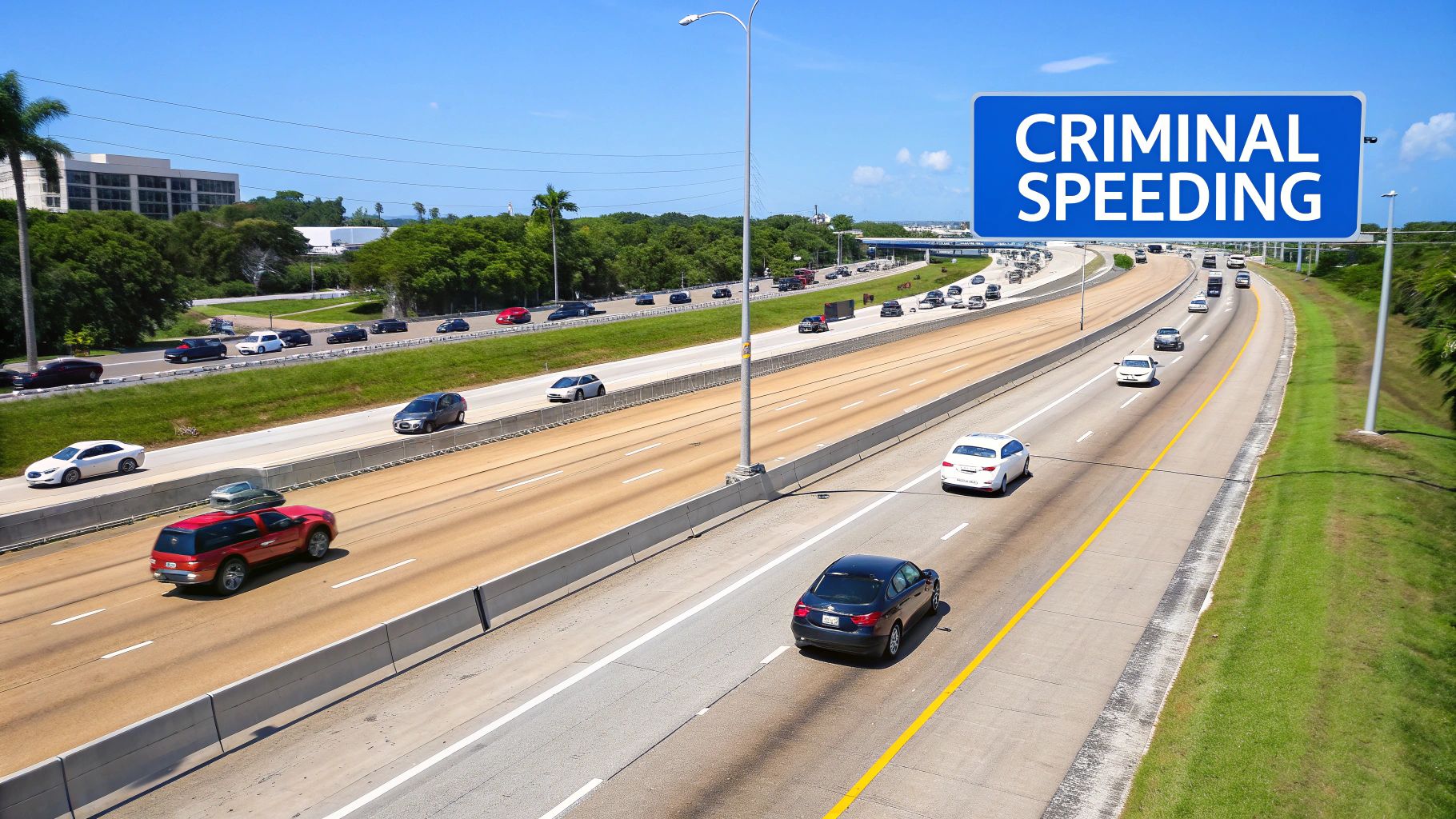
The single most important change is the new legal line in the sand that defines criminal speeding. Before, even ridiculously high speeds were still handled as civil traffic infractions. That's no longer the case.
The new law sets clear, non-negotiable thresholds that automatically trigger criminal charges. Knowing these numbers is absolutely essential, because crossing them puts you in a completely different legal world.
These new rules are designed to target driving that is considered a severe threat to public safety. Starting in the summer of 2024, going 50 mph or more over the posted speed limit is a criminal offense, not a routine ticket you can just pay by mail. On top of that, driving 100 mph or more anywhere is now specifically defined as an egregious public safety threat. It comes with a mandatory court appearance, and courts can impose fines up to $1,000, jail time up to 90 days for repeat offenders, and a permanent criminal record.
What a Criminal Charge Actually Means for You
The difference between a civil ticket and a criminal charge is night and day. A civil ticket is an inconvenience, usually fixed by writing a check. A criminal charge, however, kicks off a formal legal process with potentially life-altering outcomes.
If you are faced with a criminal speeding charge in Miami-Dade, here's what you can expect:
A Mandatory Court Appearance: You can't just pay this online. You are legally required to show up in front of a judge to answer for the charge.
Potential Jail Time: A conviction can mean time behind bars, especially if you have prior offenses. A second offense within five years could lead to jail time for up to 90 days.
Serious Fines: The fines are way higher than for a normal speeding ticket, potentially hitting $1,000 for subsequent offenses.
A Permanent Criminal Record: This is the most damaging consequence. A criminal conviction shows up on background checks, which can impact your chances at getting a job, renting an apartment, or keeping a professional license.
This new reality makes addressing the charge more critical than ever before. We're not just talking about points on your license anymore; we're talking about your freedom and your future. For a deeper dive into local defense tactics, check out our guide on getting a dismissed speeding ticket in Miami-Dade County, FL.
A criminal speeding charge is not something to handle on your own. The potential for a permanent record that follows you for life means that seeking experienced legal guidance is essential. Our goal is to protect your license and record.
Why Challenging the Evidence Is So Important
With criminal speeding charges, the state has to prove its case "beyond a reasonable doubt." This much higher standard of proof is exactly where a strong legal defense can make all the difference. An attorney who focuses on traffic law can scrutinize every piece of the case against you.
Key areas to challenge include:
Speed Measurement Accuracy: Was the officer’s radar or laser gun properly calibrated? Was the officer even certified to use it?
The Officer's Visual Guess: How did the officer first decide you were speeding, and can that initial estimate be called into question?
Evidence Chain of Custody: Was every piece of evidence, especially calibration records, handled and stored according to strict legal standards?
And in a place as crowded as Miami-Dade, things like misidentifying which car was actually speeding are a very real possibility. An attorney can file motions to get all the evidence, find the weak spots in the state's case, and build a defense designed to achieve the best possible outcome. While past results do not guarantee future outcomes, a proactive defense is always your strongest move.
Understanding Stricter Distracted Driving Rules
We’ve all seen it: the driver in the next lane, head down, eyes on a screen instead of the road. Distracted driving is a massive safety problem on Florida’s roads, causing thousands of preventable crashes every year. Lawmakers are finally getting more aggressive in their push to get drivers to put their phones down and focus.
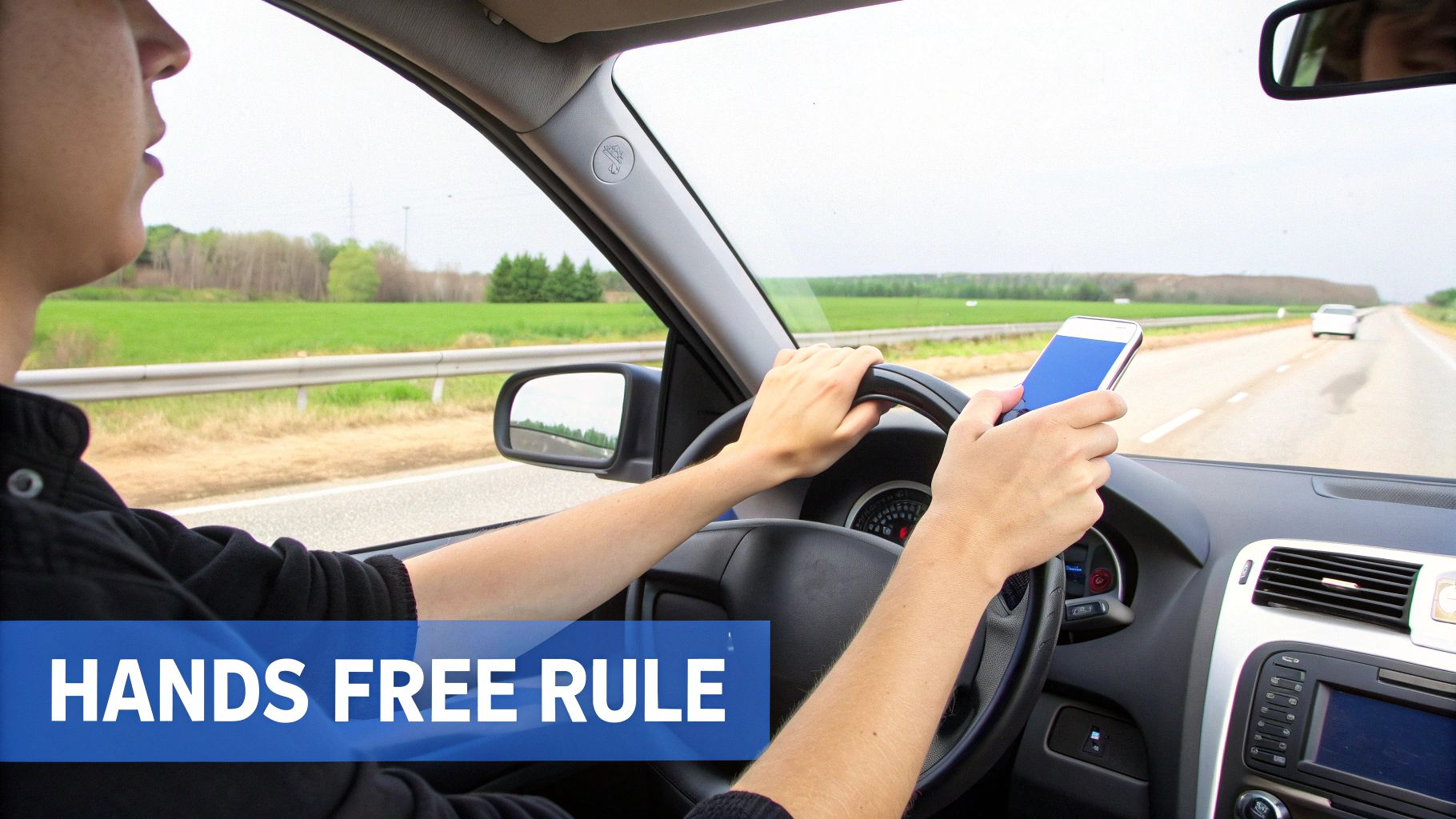
The next major step on the horizon is a true hands-free law. If passed, it would make holding a mobile device for almost any reason while driving illegal. This isn’t just a small tweak to the current rules—it’s a fundamental shift designed to curb the habit of texting, calling, or scrolling behind the wheel. The goal is simple: get the phone out of the driver's hand and make our roads safer for everyone.
What the Proposed Hands-Free Law Means for You
The idea behind a "hands-free" law is dead simple: if your car is moving, your phone shouldn't be in your hands. Period. This is a huge leap from the current law, which mainly targets texting and is only a primary offense in school and work zones.
This new proposal would make holding a device a primary offense everywhere. That means an officer could pull you over just for seeing a phone in your hand—no other reason needed. The numbers show why this is so urgent. In 2023 alone, distracted drivers were involved in crashes that killed nearly 300 people and left over 2,200 with serious bodily injuries in Florida.
This statistic is a driving force behind a new hands-free bill (SB 1152) filed for the 2025 session. It would ban holding a phone for pretty much any reason, even when you’re stopped at a red light. You can see the full scope of the problem in the state's official report on distracted driving threats.
A true hands-free law closes loopholes. It shifts the focus from what you were doing on your phone to the simple, observable act of holding it. That makes the rule much easier for law enforcement to enforce and for drivers to follow.
Permitted vs. Prohibited Actions Under a Hands-Free Rule
Knowing what you can and can’t do is everything. While the final text is still up for debate, most hands-free laws follow a clear framework.
Actions that would likely be PROHIBITED:
Holding your phone to your ear to talk.
Typing, sending, or reading texts or emails while holding the device.
Holding the phone to use your GPS navigation.
Scrolling through social media or browsing the internet.
Holding your phone to take pictures or record video.
Actions that are generally PERMITTED:
Using a dashboard or windshield mount for your phone.
Activating GPS or voice commands with a single tap or swipe on a mounted device.
Making or receiving calls via Bluetooth or other hands-free tech.
Using your phone while legally parked.
The key distinction is physical contact. If you’re holding the device, it’s a violation. If you’re interacting with it through a mount or your car’s built-in system, it's generally allowed. A ticket for this would likely be treated like any other moving violation, adding points to your license. It’s crucial to understand how even a minor ticket can snowball; you can learn more in our guide on what to do about a careless driving ticket in Florida.
The Enforcement Perspective
For law enforcement, a hands-free law makes their job much simpler. Under the current texting-while-driving rules, an officer often has to prove you were actively typing—something that’s incredibly difficult to see from another moving car.
A hands-free rule gets rid of that gray area. The violation is the simple act of holding the phone. With a lower burden of proof, officers can issue citations they believe will stand up in court. The intent is to create a much stronger deterrent, making it clear to every driver that just having a phone in hand is enough to get a ticket. The ultimate goal is to change behavior on a massive scale and make Florida’s roads safer by finally getting a handle on distractions.
New Florida Driving Laws for Teen Drivers
Getting a driver's license is a huge milestone, a rite of passage that marks a teenager's first real taste of independence. But as any parent knows, that first year behind the wheel is also the most dangerous. Florida lawmakers are tackling this head-on with new, more rigorous requirements designed to build a solid foundation of skill and experience before a young driver goes solo.
These changes are a significant update to Florida's graduated driver licensing (GDL) program. The GDL system is all about easing teens into the driver's seat by slowly granting more privileges as they prove their abilities. The latest rules make this process more thorough, demanding more supervised practice time and a deeper level of education. For parents and teens, this means planning ahead is more critical than ever.
A Deeper Dive into Driver Education
The first major shift beefs up the education needed just to get a learner's permit. The old drug and alcohol course is still required, but it's no longer the main educational hurdle. Now, teens must complete a much more in-depth, state-approved driver education course.
This isn't about memorizing a handbook anymore. The new courses are built to teach defensive driving, hazard recognition, and the kind of critical thinking skills needed for real-world situations. The idea is to move past simple rules and arm new drivers with the ability to anticipate and react to danger before it happens.
Expanded Curriculum: Courses now cover complex topics like managing distractions, understanding how a vehicle handles, and navigating tricky traffic scenarios.
Safety Focus: There’s a laser focus on the top causes of teen accidents, including speeding, distracted driving, and impairment.
State Approval: Only courses that meet the tough new standards set by the Florida Department of Highway Safety and Motor Vehicles will count.
Increased Supervised Driving Hours
This is probably the biggest change: a serious increase in the number of required supervised driving hours. There's no substitute for real-world experience, and the state now demands more of it before a teen can get their intermediate license. The total hours are up, with a special, non-negotiable focus on driving at night.
Driving after dark is a completely different ballgame. You’re dealing with reduced visibility, headlight glare, and a higher chance of encountering impaired drivers. National data is clear on this: the fatal crash rate for teen drivers is about three times higher at night than during the day. Florida’s new laws directly address this risk by mandating a significant chunk of practice time happens after sunset.
This emphasis on nighttime driving isn't just a random rule. It's a data-driven strategy to expose new drivers to tougher conditions while a licensed adult is right there in the passenger seat. Mastering these skills in a controlled setting is crucial to building a safer generation of drivers.
Practical Tips for Parents and Teens
Navigating these new rules might feel like a lot, but a little organization makes it manageable. For parents, your role as a coach and supervisor is now more important than ever.
Create a Driving Log: Keep a detailed log of every single practice drive. Note the date, how long you were out, the weather, and the types of roads you drove on (neighborhood, highway, city traffic). This is the best way to track your progress toward the required hours.
Vary the Practice Scenarios: Don't just circle the block. Make a point to practice in different conditions: bumper-to-bumper traffic, pouring rain, on the interstate, and, of course, at night.
Talk Through Decisions: While you're driving, verbalize what you're seeing. Point out potential hazards and explain the decisions you're making as an experienced driver. Then, have your teen do the same. This is how you build true situational awareness.
These tougher standards aren't meant to be a punishment. They're a proactive step to make sure that when a teenager finally earns that license, they are not just legally allowed to drive, but truly prepared for the responsibility that comes with it. By investing more time in education and supervised practice, Florida is aiming to reduce tragic accidents and make the roads safer for all of us.
How These New Laws Affect Your Driving Record and Insurance
Getting a traffic ticket under Florida's new laws is about much more than just paying a one-time fine. Think of it as the start of a long-lasting ripple effect, one that can hit your wallet, jeopardize your driving privileges, and even complicate your career. The link between a new violation and your long-term financial health is direct and powerful.
Your driving record is like a financial report card that insurance companies are constantly grading. Every ticket adds a negative mark, telling your insurer that you're a higher risk to cover. With the much tougher penalties now in place, especially for violations like criminal speeding, the consequences are more severe than they've ever been.
The Lasting Impact on Your Driving Record
Your driving record is the official story of your life behind the wheel. When you're convicted of a traffic violation, the Florida Highway Safety and Motor Vehicles (FLHSMV) adds points to that story. Pile up too many points in a short time, and you're looking at an automatic license suspension.
These new laws make it frighteningly easy to rack up points fast. A criminal speeding conviction, for instance, carries a massive point penalty that puts your license in immediate danger.
Point Accumulation: Violations like criminal speeding or distracted driving will now add a significant number of points to your license.
License Suspension: Hitting 12 points in 12 months triggers a 30-day suspension. The thresholds only get stricter from there.
Long-Term Consequences: A criminal traffic conviction, such as for extreme speeding, becomes a permanent part of your record. This can show up on background checks for jobs, housing, and professional licenses for years.
The first step in protecting your license is knowing exactly how the points system works. For a complete breakdown, it’s worth reviewing our detailed guide on navigating Florida’s points system and its effect on your license and insurance.
How Insurance Premiums Spike After a Violation
Insurance companies set their rates based on one thing: risk. After a ticket under one of the new laws, your insurer will almost certainly re-evaluate your policy and classify you as a higher-risk driver. The result is a steep increase in your premiums that can stick around for years.
A single serious violation can make your rates jump by 20% to 40% or more, depending on the offense and your driving history. For someone with a criminal speeding conviction, the increase could be even more shocking—and some insurers might just decide to drop your coverage completely.
A traffic ticket isn't just a fine you pay once; it's an expense that you could end up paying every month for the next three to five years in the form of higher insurance costs. Our goal is to protect your license and record from these long-term financial penalties.
The visual below breaks down the core principles of the new rules for teen drivers, which are built to instill safer habits right from the beginning.
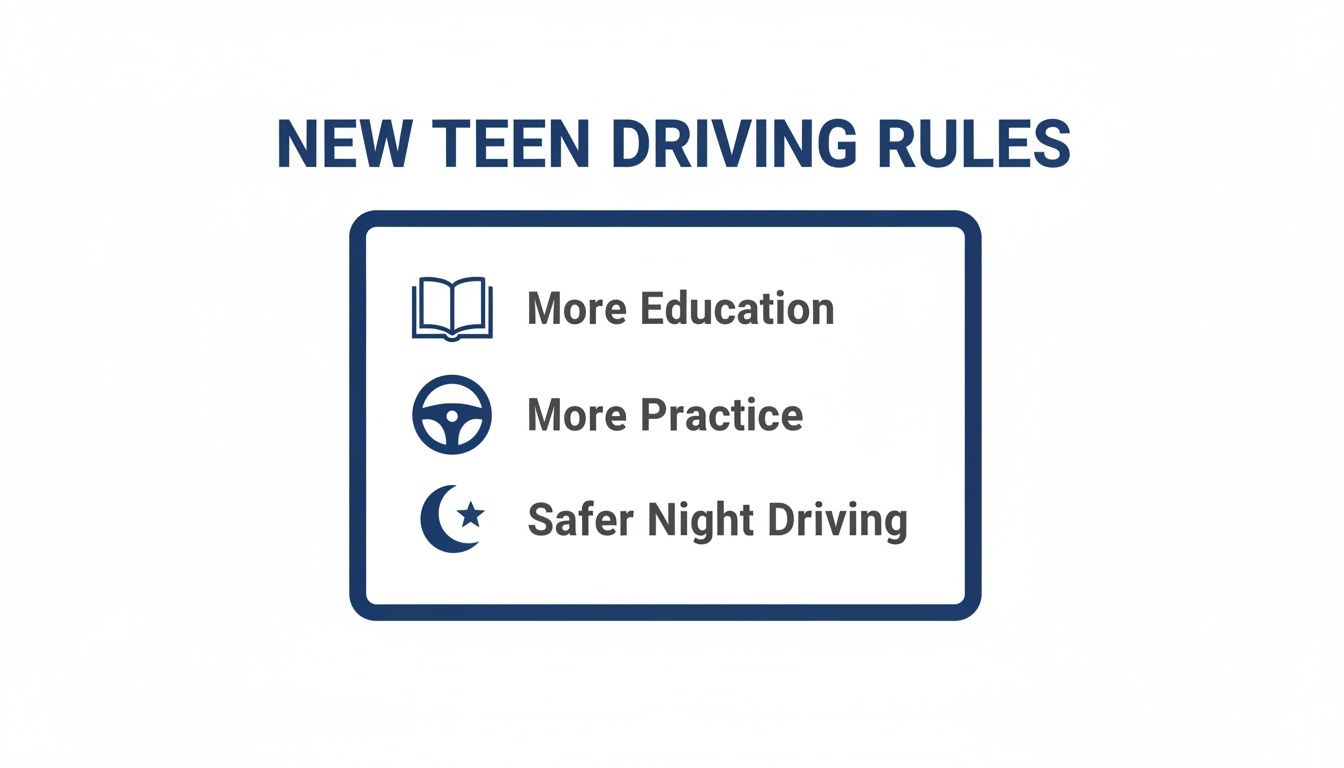
This graphic really shows the state's focus on building a strong foundation through better education, more real-world practice, and specific training for tough nighttime driving conditions.
Violation Impact Comparison Old Law vs New Law
To really see how much things have changed, the table below compares what would happen for a common violation under the old rules versus the new legislation. The difference is stark.
Violation | Consequence Under Old Law | Consequence Under New Law | Potential Insurance Impact |
|---|---|---|---|
Speeding 50+ MPH Over Limit | Civil infraction, high fine, 4 points. | Criminal offense, mandatory court, potential jail time, high fine, 4+ points. | Major increase; potential policy cancellation. |
Distracted Driving (Holding Phone) | Secondary offense (texting only). | Proposed: Primary offense, ticketable just for holding the device. | Moderate to significant premium increase. |
Teen Driver Permit Violation | Fine, potential license delay. | Fine, extended permit phase, stricter penalties for repeat offenses. | Substantial rate increase for the family policy. |
The takeaway here is crystal clear: the stakes are significantly higher now. What was once just an expensive hassle can now become a life-altering event with serious and lasting financial and legal consequences.
What to Do If You Get a Ticket Under a New Florida Law
The flashing lights in your rearview mirror, the paperwork, the uncertainty—getting a traffic ticket is always stressful. When it’s for one of Florida's tough new laws, that feeling can be overwhelming. But the first move you make after getting that citation is the most important one.
A lot of drivers think the easiest path is to just pay the fine and put it behind them. This is almost always a mistake. Paying the fine is an admission of guilt. It guarantees points on your license, a conviction on your driving record, and a likely spike in your insurance premiums that could last for years.
Your Immediate Action Plan
Before you do anything else, take a breath. The steps you take in the moments after getting a ticket can set the stage for your entire case. Handling it correctly from the start gives you the best chance to protect your driving record.
Your first moves should be simple but critical:
Review the Citation Carefully: Check every detail. Is your name, license number, and vehicle info 100% correct? Make a note of the specific statute you're accused of violating and read any notes the officer wrote.
Know Your Deadline: Your ticket has a strict deadline for you to respond. Missing it can trigger a license suspension and extra fees.
Don't Admit Guilt: Fight the urge to just pay the ticket online. Paying it slams the door shut on your ability to contest the charge.
Why You Should Consider Legal Help
With the introduction of new criminal offenses like extreme speeding, the consequences of a traffic ticket are more severe than ever. What used to be a simple fine can now mean mandatory court appearances and even a criminal record. This is not something you should try to handle alone.
Speaking with a law firm that focuses on traffic defense is a crucial step. An experienced attorney can break down the details of your ticket, spot potential weaknesses in the officer's case, and represent you in court. The process can be intimidating, so getting a sense of what to expect in traffic court beforehand is always a good idea.
Our goal is to protect your license and record. An attorney can handle the legal complexities, from filing paperwork to negotiating with prosecutors, often without you ever needing to step inside a courtroom.
Deciding to fight your ticket is a decision to protect your future. These new laws carry heavy penalties, and an admission of guilt can have long-lasting effects on your finances and your freedom to drive. By making an informed choice and getting professional guidance, you give yourself the power to achieve the best possible outcome. Past results do not guarantee future outcomes.
Common Questions About Florida’s New Driving Laws
When traffic laws change, it’s normal to have a lot of questions. Let’s cut through the confusion and get straight to what these new rules mean for you on the road every day.
Does the New 50 Mph Over Speeding Law Apply Everywhere in Florida?
Yes, absolutely. This isn’t a local ordinance—it’s a statewide law. Whether you’re on a major highway in Miami-Dade or a quiet backroad in a small town, driving 50 mph or more over the speed limit is now a potential criminal offense.
The charge is handled in criminal court, not traffic court. That means a mandatory court appearance and much more severe penalties are on the table, no matter which of Florida's 67 counties you were ticketed in.
Can I Still Use My Phone for GPS Under the Proposed Hands-Free Law?
The whole point of the proposed hands-free law is to stop drivers from physically holding their phones. Generally, you can still use your phone for GPS, but only if it’s mounted in a proper cradle on your dashboard or windshield.
What you can't do is hold the phone or tap in an address while you're driving. The best and safest practice is to always set your destination before you put the car in gear. It’s a simple habit that can keep you from getting a ticket.
What Happens If My Teen Driver Gets a Ticket Under the New Rules?
A ticket is a much bigger deal for a young driver. Under Florida’s graduated licensing system, even a single ticket can rack up points that delay them from getting their full, unrestricted license. On top of that, you can almost guarantee a significant hike in your family’s insurance premiums.
Your best move is to speak with a law firm that focuses on traffic defense to see what your options are. Our goal is always to protect your teen’s driving record. Past results do not guarantee future outcomes.
Does Contacting You Create an Attorney-Client Relationship?
No, it does not. Submitting information via a form on our website or calling for a free consultation does not create an attorney-client relationship. It is a confidential way for us to hear about your situation and for you to understand your options.
A formal attorney-client relationship only begins after you’ve reviewed and signed a retainer agreement with our firm. Our office is in Broward, and we handle traffic matters all across Florida.
Attorney Advertisement. If you’ve been handed a ticket under one of Florida's tough new driving laws, don't just pay it and accept the consequences. At Ticket Shield, PLLC, our practice is focused on traffic and DUI defense. Our goal is to protect your license and keep your record clean. Get a free, confidential consultation to understand your options. Visit us at https://www.ticketshield.com to get started. Office in Broward.
