
How to Beat a DUI in Florida: A Broward County Guide
Facing a DUI in Florida? Learn actionable legal strategies on how to beat a DUI charge with insights into Broward County procedures, evidence, and defenses.
Attorney Advertisement. Office in Broward.
Getting charged with a DUI in Florida can be an overwhelming experience, leaving you feeling like your world has been turned upside down. The key to building a strong defense is to understand the process and challenge every detail of the case, from the initial traffic stop to the administration of any chemical tests.
The first 24 hours after an arrest are critical. The actions you take immediately can set the foundation for your entire case.
Your First 24 Hours After a Broward County DUI Arrest
The moments after a DUI arrest in Broward County are often confusing and stressful, making it easy to make mistakes. However, this is when clear-headed, prompt action is most needed to lay the groundwork for your defense.
Your first and most important move is to exercise your right to remain silent. You must provide basic identification, but you are not obligated to answer questions about where you were, what you were doing, or whether you consumed alcohol. Anything you say can be used against you.
The Booking Process and Your First Call
After an arrest in Broward County, you will be taken to a local station or the county jail for booking. This involves taking your fingerprints, photograph, and processing your personal belongings. While standard procedure, it can be intimidating.
Once processed, you will have the opportunity to make a phone call. The most strategic call you can make is to a defense firm with a practice focused on DUI cases. An attorney can provide immediate advice, explain the bond process, and begin protecting your rights from the very start.
Key Takeaway: Your right to remain silent is your most powerful tool in this situation. Politely inform the officer that you will not answer questions until you have spoken with a lawyer. This is not an admission of guilt; it is a smart step to protect your legal position.
To simplify this, here is a checklist of the essential actions to take immediately after a DUI arrest.
Immediate Action Checklist After a DUI Arrest
This table summarizes the most critical steps to take immediately following a DUI arrest in Broward County to protect your rights.
Action Item | Why It Matters | Our Recommendation |
|---|---|---|
Remain Silent | Anything you say can be used against you. Do not attempt to explain or argue. | Politely state that you are exercising your right to remain silent until you speak with counsel. |
Contact a DUI Attorney | You have a 10-day deadline to protect your license. An attorney can start this process immediately. | Make this your first call. A lawyer can provide guidance on the bond process and next steps. |
Document Everything | Details about the stop, tests, and officer's conduct can be crucial for your defense. | As soon as possible, write down every detail you remember. No detail is too small. |
Do Not Discuss the Case | Conversations with anyone other than your lawyer are not privileged and can be used against you. | Avoid posting on social media or discussing details with friends or family. Speak only with your attorney. |
Taking these steps helps ensure you do not inadvertently harm your own case while events are still fresh.
Documenting Every Detail You Can Remember
As soon as you are able, write down everything you remember about the arrest. Your memory is sharpest immediately following an event, and details that seem insignificant can become important elements of your defense. Your legal team will use this detailed account to identify potential weaknesses in the case against you.
Focus on these specific points:
The Traffic Stop: Why did the officer pull you over? What reason did they provide? Note the time, location, and road conditions.
The Officer’s Conduct: What was their demeanor? What did they say? Were they professional? Crucially, did they read you your Miranda rights?
Field Sobriety Tests: Recall any physical tests you were asked to perform. Did you have any injuries or physical conditions that could have made them difficult?
Chemical Tests: Did you take a breath, blood, or urine test? Recall any details about how the test was administered.
This information is valuable. For example, if a Fort Lauderdale officer lacked a valid legal reason for the initial traffic stop, any evidence collected afterward could potentially be suppressed. You can learn more about what happens after a DUI arrest in our detailed guide.
Understanding the Two Fronts of a DUI Case
Most people do not realize that a DUI charge in Florida involves two separate legal battles.
The Administrative Case (DHSMV): This is a civil case with the Florida Department of Highway Safety and Motor Vehicles concerning your driver's license. You have only 10 days from the arrest to formally challenge the automatic suspension of your license.
The Criminal Case: This is the court case where the state prosecutes you. This is where you face potential penalties such as fines, probation, and jail time.
These two cases proceed on different timelines and have separate rules. If you miss the 10-day DHSMV deadline, you could lose your license, even if you are ultimately successful in your criminal case. This is why your first call should be to a firm that handles criminal traffic defense across Florida. Our goal is to protect both your license and your record. Past results do not guarantee future outcomes, but a proactive start is always the best approach.
Navigating the 10-Day Rule to Protect Your License
After a DUI arrest in Florida, the clock starts ticking. You have exactly 10 calendar days from the date of your arrest to take action to protect your license from being automatically suspended by the Florida Department of Highway Safety and Motor Vehicles (DHSMV). This is a strict deadline.
If you miss this 10-day window, your license will be suspended on the 11th day, regardless of the outcome of your criminal case. This is the first critical battle in a DUI case, and the choices made here will affect everything that follows.
This visualization illustrates the immediate decisions you face after an arrest.
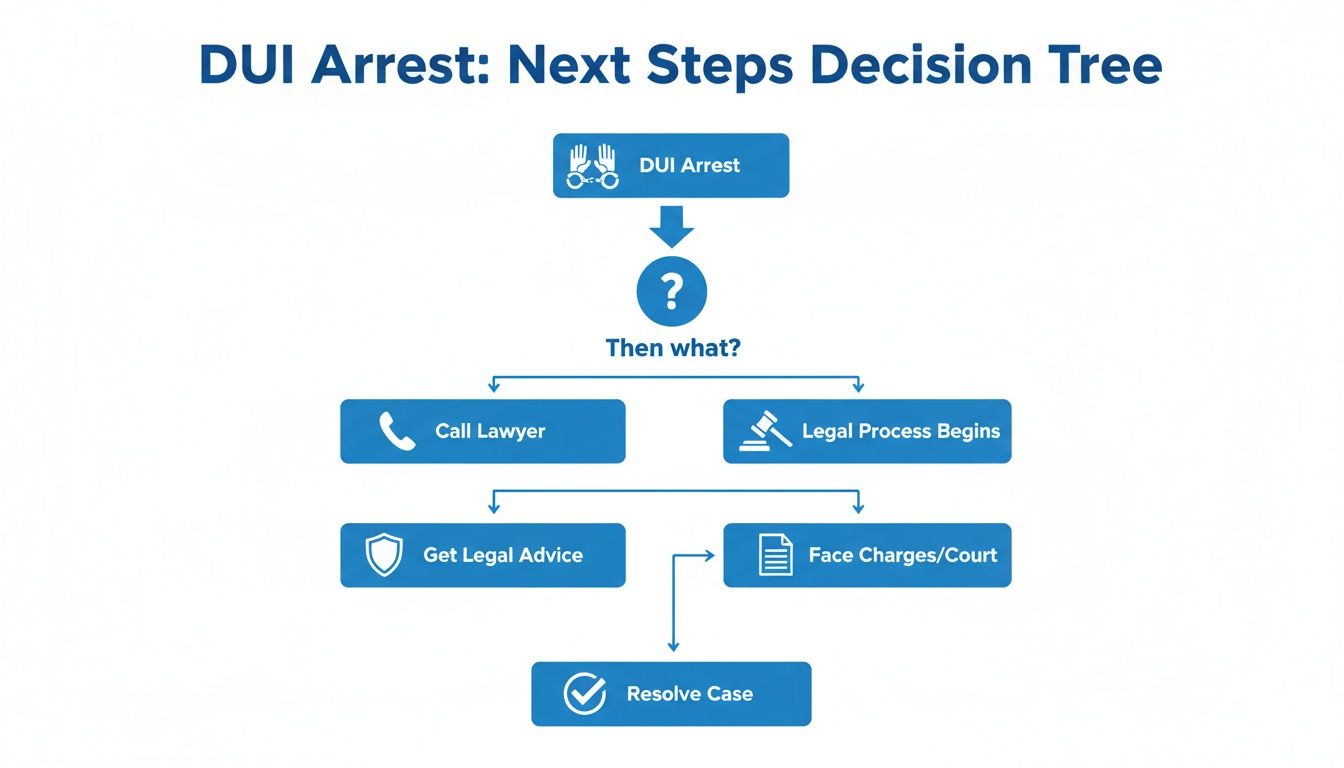
As the flowchart shows, the first move should be to consult with an experienced attorney to navigate these complex, time-sensitive options.
Two Paths for Your License
Within these crucial 10 days, you and your attorney must choose one of two strategic paths. Each has its own pros and cons, and the correct choice depends on the specifics of your case.
Option 1: Request a Formal Review Hearing. This path involves formally challenging the license suspension. Your lawyer files a request with the DHSMV, which pauses the suspension and allows you to drive on a temporary permit until the hearing date.
Option 2: Waive the Hearing for a Hardship License. In certain situations, you may be eligible to skip the formal hearing and obtain an immediate hardship license. This allows you to drive for essential purposes—such as work, school, or medical appointments—right away.
The best choice is not always obvious and requires a strategic review of the evidence against you.
Deciding Between a Formal Hearing and a Hardship Waiver
Choosing the right path is a critical strategic decision. A Formal Review Hearing provides an opportunity to fight the suspension directly. Your attorney can subpoena the arresting officer and any breath test technicians, questioning them under oath about the traffic stop, field sobriety exercises, and chemical test procedures. This hearing is an invaluable tool for locking in testimony and gathering evidence that can be beneficial for your criminal case.
For instance, if the officer fails to appear or their testimony reveals procedural errors, the DHSMV hearing officer could invalidate the suspension, and you would get your full license back.
On the other hand, waiving the hearing and taking the hardship license offers certainty. If you are eligible—typically for first-time DUIs where you did not refuse a test—this option removes the risk of losing the hearing and facing a long "hard" suspension with no driving privileges. Suspension periods can be significant: six months for a first-time BAC over .08, and a full year for a first-time refusal.
Factors That Influence Your Decision
Several key factors will help determine the best course of action for your license:
Your Criminal History: Prior DUI offenses can impact your eligibility for a hardship license and increase suspension periods.
Refusal vs. BAC Level: A breath test refusal triggers a longer and more stringent suspension than a first-time charge with a BAC over the legal limit.
The Strength of the Evidence: If there are clear procedural flaws—such as an unlawful traffic stop in a Fort Lauderdale neighborhood—challenging the suspension at a formal hearing becomes a more attractive option.
Ultimately, this decision is the first step in addressing a DUI charge. It is a complex choice that should only be made after a thorough case review with an experienced attorney. You can learn more about this process in our detailed guide to the administrative license suspension hearing. Our goal is to protect your license and your record by carefully analyzing every detail from the outset.
Building Your DUI Defense Strategy
A DUI arrest is not a conviction. It is the beginning of a legal process, and a strong defense is built by examining every piece of evidence and procedure the state intends to use against you. The objective is to find weaknesses—procedural mistakes or constitutional issues—that can be challenged in court.
A common mistake is assuming there are no options. In reality, a successful DUI defense often hinges on technical details that can dismantle the prosecution's case. These details range from the legality of the initial traffic stop to the scientific reliability of chemical tests.
Questioning the Initial Traffic Stop
The entire DUI case rests on the foundation of the initial traffic stop. A police officer cannot pull you over on a mere hunch; they need reasonable suspicion that you have committed a traffic violation or are engaged in criminal activity. If the stop was unlawful, any evidence gathered afterward—from field sobriety tests to breathalyzer results—can often be suppressed, meaning it cannot be used against you.
Reasonable suspicion must be more than a guess but is a lower standard than the probable cause required for an arrest. Officers typically justify a stop based on:
Observed Traffic Violations: Speeding, running a red light, swerving, or driving with a broken taillight.
Erratic Driving Patterns: Driving unusually slow, making wide turns, or braking frequently without clear reason.
An experienced defense attorney will obtain the officer’s report and any available dashcam or bodycam footage to scrutinize whether the stated reason for the stop is legally sufficient. For example, a minor weave within your own lane may not be enough to justify a stop in Broward County. Challenging this first step is a powerful way to question the entire case.
Dissecting Field Sobriety Tests
Field Sobriety Tests (FSTs) are physical and mental exercises used by officers to look for signs of impairment. These tests are subjective and can be unreliable. Their results can be affected by numerous factors unrelated to alcohol consumption.
Important Note: FSTs are voluntary in Florida. You are not legally required to perform them. Politely declining these tests prevents you from providing subjective evidence that will likely be used against you.
Common ways we challenge the results of FSTs include:
Improper Instructions: Officers must give instructions and demonstrate the tests according to strict, standardized national guidelines. Any deviation can invalidate the results.
Environmental Factors: Darkness, an uneven road surface, or poor weather can make it difficult for a sober person to perform these tests perfectly.
Personal Health Conditions: Your age, weight, past injuries, medical conditions, or even nervousness can affect your performance and be mistaken for impairment.
These are not scientific measures of intoxication; they are divided-attention tasks. A skilled defense involves highlighting every factor that could have reasonably impacted your performance, thereby casting doubt on the officer’s conclusions.
Challenging Breath and Blood Test Results
The results from a breath or blood test may seem conclusive, but this evidence is far from infallible. The machines used for these tests are complex and require precise calibration, regular maintenance, and proper operation to produce a reliable result.
A classic example involves the Intoxilyzer 8000, the breathalyzer device used throughout Florida. If it is discovered that the specific machine used in your case had a history of malfunctions or incomplete maintenance logs, such a finding could be sufficient to have the breath test results excluded from evidence.
Key challenges to chemical tests often include:
Improper Calibration: The machines must be regularly inspected and calibrated. If the state cannot produce complete records, the results are questionable.
Operator Error: The officer administering the test must be certified and follow a strict procedure, including a 20-minute observation period to ensure you do not burp, vomit, or place anything in your mouth that could contaminate the sample.
Medical Conditions: Health issues like acid reflux (GERD) or diabetes can create "mouth alcohol," which may contaminate a breath sample and produce a falsely high reading.
Chain of Custody: For blood tests, the prosecution must prove the sample was collected, stored, and transported correctly without any chance of contamination. A break in this chain can compromise the evidence.
These technical and scientific defenses are critical. They shift the focus from you to the state's procedures, asking the court to consider whether the evidence presented is accurate.
Even if the evidence is not completely thrown out, raising these doubts can be pivotal during plea negotiations. In many cases, a well-argued defense can lead to a more favorable outcome, such as exploring whether a DUI can be reduced to reckless driving, which carries less severe penalties. Our practice focuses on these criminal traffic matters, and our goal is to protect your license and your record by examining every detail. Past results do not guarantee future outcomes, but a thorough defense is always your best option.
The Broward County Court Process and Potential Outcomes
Navigating the Broward County criminal court system after a DUI arrest can be daunting. There are multiple stages, each with its own procedures and strategic decisions. Understanding the path ahead is the first step in building an effective defense.
Your case in the criminal justice system begins with an arraignment. This is your first official court appearance, where the charges are formally read. At this stage, a "not guilty" plea is almost always entered. This is a necessary legal step that gives your attorney the time needed to review the evidence and develop a defense strategy.
From Arraignment to Pre-Trial Conferences
After the arraignment, your case moves into the pre-trial phase. Your attorney will initiate the "discovery" process, a formal demand for all evidence the prosecutor has against you—police reports, bodycam footage, dashcam videos, breathalyzer maintenance logs, and witness statements.
This is where the foundation of your defense is constructed. Once the evidence is received, your case will be set for one or more pre-trial conferences. These are meetings where your lawyer, the prosecutor, and the judge discuss the case. During these conferences, your attorney will file legal motions to challenge evidence and begin negotiations with the prosecutor.
The Role of Plea Negotiations
Not every DUI case proceeds to a full trial. Many are resolved through negotiations. An experienced DUI attorney knows how to identify weaknesses in the State's case—such as a questionable reason for the traffic stop or improperly administered field sobriety tests—and use them as leverage.
The goal is often to have the charge reduced. A common objective is to have the DUI reduced to a "wet reckless," which is a reckless driving charge involving alcohol. While still a serious charge, the penalties are typically less severe than a DUI conviction and may help you avoid an ignition interlock device requirement.
Our Goal: The objective is always to protect your license and your record. While past results do not guarantee future outcomes, a thorough and proactive defense strategy provides the best opportunity to achieve a favorable resolution, whether through negotiation or at trial.
It helps to know the history here. Between 1970 and 1986, drunk driving arrests in the U.S. increased by 223%, while the number of licensed drivers only grew by 42%. That aggressive enforcement continues today, but so do the opportunities to build a solid defense. Research indicates that a significant percentage of defendants with legal counsel manage to have their charges reduced or dismissed by challenging factors like the legality of the stop or the calibration of testing equipment.
Understanding Potential First-Time DUI Penalties
If a case results in a conviction, Florida law specifies minimum mandatory penalties, even for a first offense. It is important to have a realistic understanding of the potential consequences. The exact penalties will depend on the details of your case, particularly your Blood Alcohol Concentration (BAC) level.
Here is a summary of what a first-time DUI conviction in Broward County might involve:
Fines: Typically between $500 and $1,000.
Probation: Up to one year.
Community Service: A mandatory 50 hours.
Vehicle Impoundment: Your vehicle could be impounded for 10 days.
License Suspension: Your driver's license could be revoked for 180 days to one year.
Ignition Interlock Device (IID): If your BAC was .15 or higher, or if a minor was in the vehicle, you may be required to install an IID for at least six months.
This is not an exhaustive list; mandatory DUI school is also a requirement. For a more detailed breakdown, you can learn more about first-time DUI penalties in our guide.
Facing this process alone can be overwhelming. A firm whose practice focuses on traffic and DUI defense understands the Broward County court system, the prosecutors, and effective defense strategies. Our role is to guide you through every step, protecting your rights and positioning you for the best possible outcome.
Why You Need an Experienced DUI Defense Firm on Your Side
Attempting to handle a DUI case on your own is a significant risk. From the strict 10-day deadline to protect your license to the technical details of breathalyzer evidence and the procedures of the Broward County courts, the system is complex. An arrest is not a conviction, but the time in between is when a strong defense is built.

Here is a critical insight for Florida drivers: even with stringent DUI laws, prosecutors can and do lose cases. This often occurs when evidence is weak, improperly collected, or poorly documented. In Florida, where .08 BAC is the legal limit, a sharp defense can expose weaknesses in breath or blood tests, question the reason for the traffic stop, and scrutinize the officer's training. These details can mean the difference between a conviction and a more favorable result.
A Practice Focused on Florida DUI Defense
At Ticket Shield, our practice is centered on Florida traffic and DUI defense. From our office in Broward, we handle criminal traffic matters across the state. This focus means we are deeply familiar with the specific laws, court procedures, and scientific defenses most effective in fighting DUI charges. We understand the local court systems and how to engage with prosecutors.
Our approach is client-focused. You will have a direct line to your attorney because we believe in keeping you informed every step of the way. You need to understand your options and the strategy we are employing in your defense.
Attorney Advertisement: This content is for informational purposes and does not constitute legal advice. Submitting information via our forms does not create an attorney-client relationship.
Protecting Your License and Your Future
Our primary goal is to protect your license and your record. We dedicate our efforts to achieving the best possible result for your specific situation. Understanding how a professional law firm handles its initial consultation with a new client can be insightful; for a detailed look, check out this complete guide to law firm client intake.
While past results cannot guarantee a future outcome, a proactive and knowledgeable defense is your strongest tool. We also understand that cost is a primary concern. To provide clarity on this, we have created a guide on the https://www.ticketshield.com/insights/average-dui-lawyer-fees.
If you are facing a DUI charge, you do not have to go through it alone. Call us for a free, confidential consultation to review your case and discuss how we can assist you.
Your Top Florida DUI Questions, Answered
When facing a DUI charge, it's natural to have urgent questions. Here are straightforward answers to some of the most common concerns we hear from drivers across Florida.
Should I Refuse the Breathalyzer in Florida?
This is a difficult situation with no single perfect answer. Florida's implied consent law states that by having a driver's license, you have already consented to a chemical test if lawfully arrested for DUI.
Refusing to provide a breath sample triggers an immediate, automatic license suspension from the DHSMV. A first refusal results in a one-year license suspension. A second or subsequent refusal leads to an 18-month suspension and may result in a separate misdemeanor charge for the refusal itself.
On the other hand, refusing means the prosecutor will not have a BAC number to use as evidence against you. However, they can and will argue that your refusal is evidence of guilt. This is a high-stakes decision that should be discussed with an attorney.
Can a First DUI Be Dismissed in Broward County?
Yes, it is possible, but never guaranteed. A dismissal is not a matter of luck; it is the result of identifying critical flaws in the State's case.
We examine every detail to determine if a case has grounds for dismissal. For example, a case might be dismissed if:
The officer lacked a legal reason for the initial traffic stop.
The field sobriety exercises were administered incorrectly or under poor conditions.
The breathalyzer machine has a history of errors or was not properly calibrated.
Key evidence was mishandled, violating your constitutional rights.
Our first goal is always to protect your record. We do this by searching for any weakness that could lead to a dismissal or a reduction in charges. It is important to remember that every case is unique, and past results do not guarantee future outcomes.
How Much Does a DUI Defense Attorney Cost?
The cost of a DUI defense attorney depends on the complexity of your case. A straightforward first-offense DUI will generally cost less than a case involving an accident, a high BAC, or one requiring expert witnesses for trial.
We believe in transparency regarding legal fees. The best way to get a clear picture is to schedule a free consultation. We will review the details of your arrest and provide a realistic understanding of the costs involved in a proper defense.
Will I Have to Appear in Court for My DUI?
While we handle many traffic tickets where our clients do not need to appear in court, a criminal charge like a DUI is different. You will almost certainly be required to appear for key hearings, such as your arraignment and pre-trial conferences.
However, you will not have to go through this alone. A significant advantage of having an experienced lawyer is that we will be with you at every step, handling legal proceedings and ensuring you understand what is happening.
A DUI charge is a serious matter that should not be faced without experienced legal representation. The team at Ticket Shield, PLLC focuses its practice on Florida traffic and DUI defense and is ready to protect your rights. Contact us for a free, confidential case review to understand your options. Visit us at https://www.ticketshield.com.
