
Practical Guide to careless driving ticket florida: Penalties and Defenses
Facing a careless driving ticket florida? Learn penalties, options, and effective defenses to protect your record and insurance rates.
Attorney Advertisement. Office in Broward.
Getting a careless driving ticket in Florida is more than just an inconvenient fine. It’s a citation under Florida Statute § 316.1925 that can add points to your license, trigger an insurance hike, and leave a lasting mark on your driving record.
Because it’s a broad, "catch-all" violation for driving without the caution a situation demands, it's a ticket that may be worth contesting.
Understanding What a Florida Careless Driving Ticket Really Means
A careless driving ticket is one of the most common citations handed out in the state, but its vague definition is a major source of confusion for drivers. Unlike something specific like speeding, a careless driving charge is based entirely on an officer’s subjective judgment call.
In plain English, it means the officer believes you failed to drive your vehicle in a "careful and prudent manner," taking into account the traffic, road conditions, and everything else happening around you at that moment.
This can cover a whole host of behaviors that an officer thinks put people or property at risk. The key thing to understand is you don't have to break another specific traffic law to get this ticket. The officer just needs to decide your driving wasn't cautious enough for the circumstances.
The Broad Scope of Florida Statute § 316.1925
The vague wording of the law gives police a significant amount of discretion. This means actions that might seem relatively minor could still result in a citation if an officer decides they were unsafe in that particular context.
It's exactly why careless driving tickets are so frequently issued after minor traffic accidents where it’s not immediately obvious who was at fault based on other violations.
Common situations that can trigger a careless driving ticket include:
Following the car in front of you too closely (tailgating).
Failing to yield the right-of-way, forcing another driver to take evasive action.
Getting into a minor fender-bender at a stoplight.
Making a sudden lane change without using your turn signal.
Getting familiar with the specific actions defined as careless driving in Florida can make it clearer why you received the ticket and what a potential defense might look like.
Why This Citation Is More Serious Than It Appears
The consequences of just paying that fine go far beyond the dollar amount on the ticket. When you pay a careless driving ticket Florida, you are legally admitting guilt. That guilty plea automatically triggers penalties that can follow you for years. To see the bigger picture, it helps to understand the general Florida driving regulations that all drivers must follow.
A conviction for careless driving adds 3 points to your Florida driver's license. If you accumulate just 12 points in a 12-month period, you could be facing a license suspension.
These tickets have been a constant on Florida's roads for a long time. In 2018, for example, law enforcement wrote nearly 200,000 careless driving citations statewide. That averages out to more than 547 tickets every single day.
This high volume highlights why it’s so critical to understand what's at stake and carefully consider your options instead of just mailing in a check. Our goal is to protect your license and record from unnecessary penalties.
The True Cost of Points, Fines, and Insurance Hikes
That dollar amount printed on your careless driving ticket? Think of it as just the down payment. It’s a misleading figure that represents only the immediate sting, not the total financial and personal cost a conviction really triggers. Many drivers make the mistake of just paying it to move on, not realizing that simple act is a legal admission of guilt.
This one action can set off a chain reaction of consequences that may cost you far more in the long run.
And these tickets are everywhere. The sheer volume of citations in Florida shows just how common—and aggressively enforced—they are.
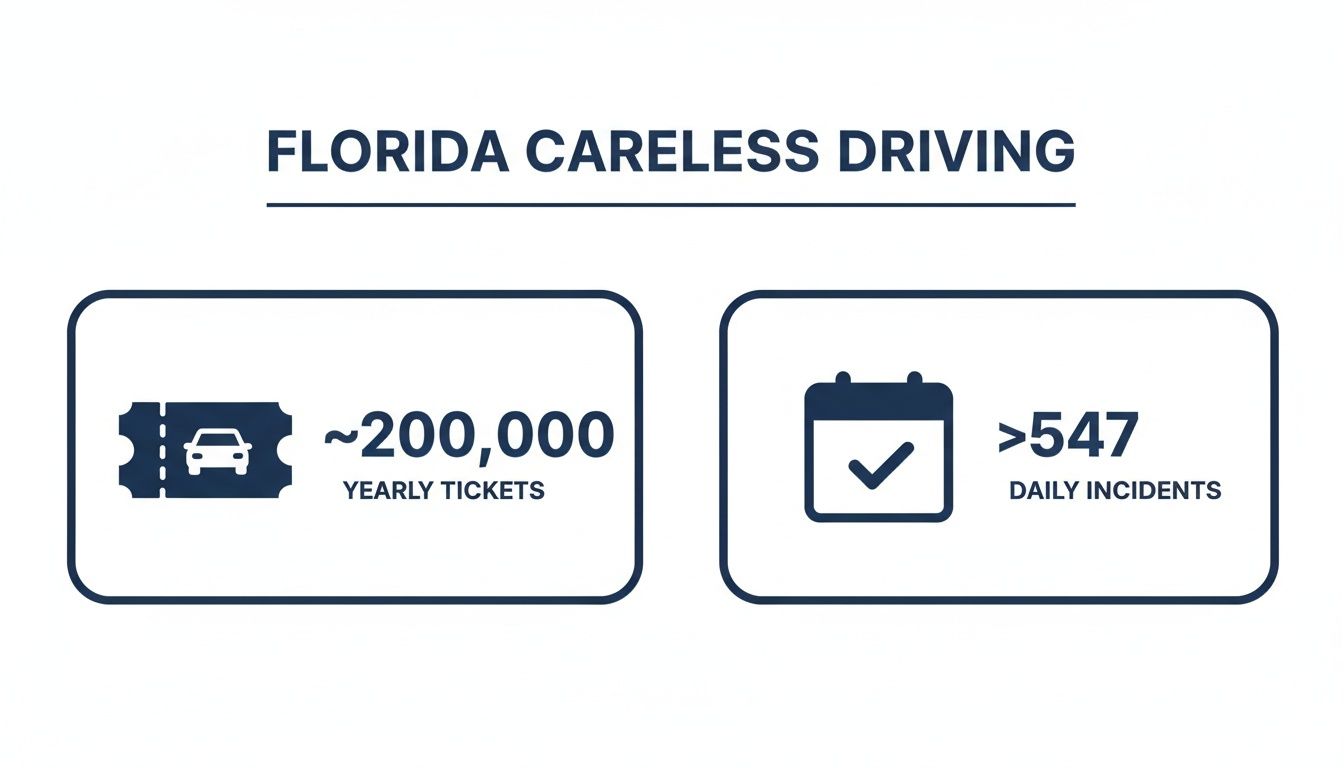
This isn't just trivia. With hundreds of these handed out every single day, it underscores a critical point: this is a constant risk for every Florida driver, and law enforcement is always watching.
Understanding Florida's Driver's License Point System
Florida uses a point system to keep track of driving infractions, and a careless driving conviction adds three points to your license. While that might not sound like a lot on its own, these points can accumulate quickly.
Think of your driver's license as having a clean slate. Every conviction adds points that stain that record, pushing you closer to a potential suspension.
12 points within a 12-month period leads to a 30-day suspension.
18 points within an 18-month period leads to a 3-month suspension.
24 points within a 36-month period leads to a 1-year suspension.
Suddenly, that single careless driving ticket puts you a quarter of the way toward losing your license. That’s why contesting the charge is so important for protecting your driving privileges. You can get a more detailed breakdown in our guide to the Florida traffic ticket point system.
Beyond the Fine: The Hidden Financial Penalties
The initial fine is just the beginning. A conviction often drags mandatory court costs and administrative fees along with it, which can easily inflate the amount you owe. But the real financial gut punch, in many cases, is the long-term spike in your auto insurance premiums.
A conviction for a moving violation sends a clear signal to your insurance provider: you are a higher-risk driver. To offset that perceived risk, they may raise your rates—an increase that can stick around for years.
Studies show that a single moving violation can hike your annual premiums by 25% on average. That "small" ticket can quickly become a very expensive problem that you pay for over and over again.
A Real-World Example of Compounding Costs
Let's put some real numbers on this. Imagine your current annual insurance premium is $2,000. After a careless driving conviction hits your record, your insurer might raise your rate by 25%.
Here’s how that plays out:
Year 1: Your premium jumps to $2,500 (an extra $500 out of your pocket).
Year 2: You’re paying another $2,500 (now you're at $1,000 extra).
Year 3: You pay another $2,500 (a grand total of $1,500 extra).
In this scenario, a ticket with an initial fine of around $160 has now cost you an additional $1,500 in insurance hikes alone over three years—and that’s before we even add in court costs.
When you step back and look at the total financial picture, the decision to "just pay the ticket" becomes a much more expensive choice over time. Our goal is to protect your license and your record from exactly these kinds of cascading effects.
Careless vs. Reckless Driving: What’s the Real Difference?
On the street, "careless" and "reckless" driving might sound like the same thing, but in a Florida courtroom, they are worlds apart. Understanding this distinction is an important first step after getting a ticket, because it shapes everything that comes next—the penalties, the legal process, and the approach to protecting your record.
At its core, the difference is simple: a careless driving ticket in Florida is a civil traffic infraction, like a speeding ticket. Reckless driving, however, is a criminal offense.
Think of it this way: careless driving is a momentary mistake, a brief lapse in attention. Reckless driving is a conscious choice to ignore the rules and endanger others.
The Critical Difference in Legal Standards
The heart of the matter comes down to your state of mind as a driver. To write a careless driving ticket, an officer only needs to believe you failed to drive in a “careful and prudent manner.” It’s a fairly subjective call based on a perceived lack of caution at that moment.
Reckless driving is a much more serious charge for the state to prove. Under Florida Statute § 316.192, a prosecutor has to show you drove with a “willful or wanton disregard for the safety of persons or property.” This isn't just a simple error; it's behavior that demonstrates indifference to the harm you could cause.
Key Takeaway: Careless driving is about a failure to pay proper attention. Reckless driving is about a deliberate choice to be dangerous. This one distinction changes everything in the eyes of the law.
Careless vs Reckless Driving a Side-by-Side Comparison
That split between a civil ticket and a criminal charge creates a massive gap in the potential outcomes. A criminal charge puts jail time and a permanent criminal record on the table—consequences you just don't face with a standard traffic ticket. This table breaks down the essential differences.
Aspect | Careless Driving (Civil Infraction) | Reckless Driving (Criminal Offense) |
|---|---|---|
Legal Status | Non-criminal traffic violation. Similar to a speeding ticket. | Misdemeanor criminal charge. Creates a permanent criminal record if convicted. |
Common Examples | A minor rear-end collision, failing to yield, or making an improper lane change. | Excessive speeding while weaving through traffic, street racing, or fleeing from law enforcement. |
Penalties | Fines, court costs, and points on your driver's license. No jail time. | Potential jail time (up to 90 days for a first offense), significant fines, and a criminal record. |
License Impact | 3 points added to your license, contributing to a potential suspension. | 4 points added to your license and a possible immediate license suspension by the court. |
To see an even more in-depth breakdown, check out our guide on the difference between careless and reckless driving.
Because the legal bar for reckless driving is so high, officers sometimes issue a careless driving ticket after an accident when no other specific violation really fits, even if the driving was aggressive. Knowing which charge you’re up against is step one. Our goal is always to build the right defense for your specific citation to protect your license and your record.
Navigating Your Options After Getting a Ticket
Getting a careless driving ticket in Florida is one of those gut-sinking moments. Staring at that piece of paper, it’s easy to feel overwhelmed and unsure of what to do next. But the decision you make within the first 30 days is absolutely critical—it will directly impact your driving record, insurance rates, and wallet for years.
You essentially have three paths to choose from.

Understanding what's really at stake with each option is the only way to make a smart choice. Let's break them down.
Option 1: Pay the Ticket
This seems like the easiest way out. Just pay the fine online, put it behind you, and move on, right? Wrong. This path of least resistance comes with a significant, long-term cost.
Paying the ticket is a legal admission of guilt. Simple as that.
By paying, you’re officially accepting a conviction. That means the three points for careless driving are guaranteed to be added to your license. Your insurance company gets notified, and as we covered, that almost always leads to a painful jump in your premiums.
Option 2: Elect Traffic School
Florida lets some drivers take a driver improvement course—traffic school—to keep points off their license. This often feels like a responsible middle ground, but you have to look at the whole picture before jumping in.
Even if you go to traffic school, you are still required to:
Pay the full fine for the ticket, plus court administrative fees.
Pay for the traffic school course itself, which is a separate expense.
Spend several hours of your own time completing the course.
The most critical part people miss is this: electing traffic school still results in a "withhold of adjudication" on your record. While you don't get the points, the violation is still there. It's visible to law enforcement and the courts, and it uses up one of your limited chances to take traffic school.
You can only elect traffic school once every 12 months and just five times in your entire life. Burning one of those precious elections on a ticket that could have been dismissed means it won't be there when you get a citation you truly need it for.
Option 3: Contest the Ticket in Court
Your third option is to plead not guilty and contest the ticket. For many drivers, this is the path that offers the best chance at a truly positive outcome. Contesting the citation is the only way you can seek a complete dismissal.
When you contest a ticket, you're making the state prove its case. The burden is on them to show you were actually driving carelessly. A traffic defense attorney can go to court for you, question the officer who wrote the ticket, and use legal arguments to challenge the state's case.
Here’s what this approach opens up:
The chance for a full dismissal, meaning no fine, no points, and nothing on your record.
The opportunity to negotiate a reduced charge to a non-moving violation, which carries no points.
The ability to protect your insurance rates by preventing a moving violation conviction.
While no outcome is ever guaranteed, contesting the ticket is the only option that gives you a shot at avoiding every single penalty. Our practice focuses on traffic defense, and our goal is always to protect your license and your record. Past results do not guarantee future outcomes, but challenging the ticket gives you the best odds for a clean slate.
Effective Defenses Against a Careless Driving Ticket
Getting a careless driving ticket in Florida can feel like you’ve already been found guilty. But it’s critical to remember one thing: a citation is just an officer's opinion, not a final verdict from a judge. The law gives every driver the right to contest a ticket, and there are several powerful strategies an attorney can use to challenge the state's case.
The entire burden of proof falls on the prosecution. They have to prove, with actual evidence, that your driving failed to be "careful and prudent" under the specific circumstances. This requirement is exactly where the door opens for a strong defense.
Questioning the Officer's Subjective View
A careless driving charge is almost always built on the subjective interpretation of a single law enforcement officer. Unlike a speeding ticket verified by a radar gun, there's often no objective, measurable evidence to back it up. A good attorney can immediately start questioning the officer's perspective and observations.
Was their view of the incident obstructed? Were they really in a position to see everything that happened from start to finish? Asking these simple questions can introduce reasonable doubt.
For example, an officer might see a car swerve and immediately assume the driver was distracted by their phone. But a solid defense can argue that the driver was actually making a necessary defensive maneuver to avoid a pothole or some other hazard the officer never even saw.
The Sudden Emergency Doctrine
Florida law recognizes that sometimes, unpredictable situations pop up out of nowhere and force a driver to react instantly. This is what’s known as the "sudden emergency" doctrine. If an unexpected hazard appears and you have to react in a way that might otherwise look careless, this can be a perfectly valid defense.
Common examples we see include:
Swerving abruptly to avoid a deer or other animal that darted into the road.
Braking hard because the car in front of you slammed on its brakes without warning.
Quickly changing lanes to dodge debris that just fell off a truck.
To use this defense effectively, we have to show that the emergency was not something you created and that your reaction was reasonable for the split-second decision you had to make.
Challenging the Evidence Presented
The state's case is only as strong as the evidence they bring to court. A core defense strategy is to scrutinize every single piece of information the officer presents.
If the ticket was written after an accident that the officer did not personally witness, their entire report is based on hearsay—what other drivers or witnesses told them happened. This kind of second-hand information is notoriously unreliable and can often be challenged in court.
Important Takeaway: An accident does not automatically equal careless driving. The state still has to prove that a specific action you took was legally careless and directly caused the incident. The mere fact that a collision occurred is not enough proof to convict you.
Ultimately, contesting a ticket is all about holding the state to its own legal standard. By identifying weaknesses in the officer's report, challenging their subjective conclusions, or presenting valid reasons for your driving actions, an experienced attorney can work toward a positive outcome. Our goal is to protect your license and record by making sure your side of the story is heard loud and clear. For a deeper dive, you can learn more about how to get a careless driving ticket dismissed in our related guide.
How a Traffic Attorney Can Defend Your Case
That careless driving ticket in Florida might seem like a simple fine, but navigating the court system on your own can be a surprisingly stressful and confusing ordeal. The good news is, you don't have to go it alone. Bringing in legal help can make a significant difference in how your case plays out.
Our practice focuses on defending Florida drivers against traffic tickets and DUI. We handle traffic matters across Florida, and we understand the local court procedures. Getting our help starts with one simple, no-pressure conversation.

Our Straightforward Process
We've designed our process to be as clear and stress-free as possible. The goal is to give you peace of mind while we handle all the legal heavy lifting for you.
Step 1: Free Consultation: It all starts with a free, confidential case review. You tell us what happened, and we’ll give you an honest take on your situation and walk you through your options.
Step 2: Building Your Defense: If you decide to hire us, we get to work immediately. We start by digging into the specifics of your citation, reviewing the officer's report and any other evidence we can find to build a defense strategy.
Step 3: Handling Court for You: This is a huge relief for most of our clients. We handle the court appearances for you. In the vast majority of our cases, our clients never have to step foot in a courtroom, which saves them a ton of time and anxiety.
Step 4: Keeping You in the Loop: We make sure you know what's going on every step of the way. You'll have direct access to your attorney to ask questions and get updates as your case moves forward.
Having a streamlined system like this is essential in Florida. Data from the Florida Highway Safety and Motor Vehicles (FLHSMV) shows just how common these tickets are, with nearly 200,000 careless driving citations issued in 2018 alone—a huge number of which weren't even related to a crash. An experienced attorney knows how to manage these tickets efficiently, from careless driving to speeding, all while keeping you informed. You can explore more about statewide traffic ticket trends and insights.
What We Aim to Achieve
When we take on your careless driving ticket, our goals are squarely focused on protecting your best interests. While no attorney can ever promise a specific outcome, we are dedicated to pursuing the best possible result for every single client.
Our Primary Goals: Our entire focus is on protecting your license and your record. We work to seek a complete dismissal, negotiate for a lesser penalty like a non-moving violation (which means no points), and ultimately keep your driving record clean.
Hitting these goals helps you avoid the long-term consequences of a conviction, like points piling up on your license and your insurance premiums going through the roof. We understand what's at stake, and we’re ready to seek a favorable outcome for you. Past results do not guarantee future outcomes.
Common Questions About Florida Careless Driving
Getting a careless driving ticket in Florida kicks off a wave of questions and uncertainty. Here are some straight answers to the things drivers ask us most often, designed to give you a clear picture of what you're up against.
Do I Have to Go to Court if I Hire an Attorney?
This is one of the biggest sources of relief for our clients: in the vast majority of cases, the answer is no. An attorney can handle all the required court hearings and legal steps for you.
This means you don't have to take time off work, deal with the stress of finding the courthouse, or stand in front of a judge alone. We manage the legal side of things so you can keep your focus on your life.
How Long Does a Careless Driving Ticket Stay on Your Record?
If you're convicted of careless driving, that ticket and the points that come with it can stay on your official Florida driving record for three to five years. That’s a long time for insurance companies, law enforcement, and the courts to see it.
This is exactly why our primary goal is to protect your license and keep your record clean. We work to get the ticket dismissed or avoid a conviction entirely, because a clean record is your best defense against future insurance hikes and the risk of a license suspension.
Is It Worth Fighting a Ticket if There Was an Accident?
Absolutely. It’s a huge misconception that a ticket from an accident is a lost cause. Even when a crash is involved, the state still has to prove that your driving met the legal definition of "careless"—and that’s often harder than it sounds.
The fact that an accident happened isn't automatic proof of carelessness. There are plenty of solid defenses an attorney can use, like challenging an officer’s conclusions (especially if they didn't actually see the crash) or arguing that a sudden, unexpected emergency was the real cause. An experienced lawyer knows how to dig into the details of the accident to build a strong case.
This content is for informational purposes only and does not constitute legal advice. Submitting information through our website does not create an attorney-client relationship. Office in Broward.
If you've received a careless driving ticket, don't just pay it and accept the consequences. Ticket Shield, PLLC is here to defend your rights and protect your driving record. Contact us 24/7 for a free, no-obligation consultation to discuss your case. Let our experience work for you. Learn more at https://www.ticketshield.com.
