What happens if you get a dui in florida: Penalties and next steps
Discover what happens if you get a dui in florida, including license suspension, court dates, costs, and next steps.

So, you’ve been arrested for a DUI in Florida. It’s a disorienting experience, and the first thing you need to know is that you're now facing two separate legal battles at the same time.
One is the criminal case that will wind its way through the court system. The other is an administrative action from the Department of Highway Safety and Motor Vehicles (DHSMV) that deals exclusively with your driver's license. A critical deadline for the license issue hits almost immediately, and missing it can be a costly mistake.
Your Guide to Navigating a Florida DUI Charge
From the moment you're arrested in a place like Broward County, a clock starts ticking. The citation the officer hands you isn't just a ticket; it's also a temporary 10-day driving permit. This 10-day period is arguably the most critical timeframe in your entire DUI case.
Understanding what happens next is the first step toward protecting yourself. The choices you make in these first few days will set the stage for both your criminal case and the fight to keep your driving privileges.
Attorney Advertisement: This article is for informational purposes only and does not constitute legal advice. Submitting information through any forms on this website does not create an attorney-client relationship. Our practice focuses on traffic and DUI defense. Office in Broward.
The Critical 10-Day Window
You have exactly 10 calendar days from the date of your arrest to formally request a review hearing with the DHSMV to challenge the automatic suspension of your license.
If you fail to act within this window, your license will be suspended. The length of that suspension depends on your prior record and whether you agreed to a breath, blood, or urine test.
Here’s a quick rundown of what’s happening simultaneously:
Administrative Suspension: The DHSMV is moving to suspend your license unless you formally challenge it within those first 10 days.
Criminal Charges: At the same time, the State Attorney's Office is reviewing the police report to decide on the formal criminal charges to file against you.
Dual Consequences: This is a crucial point many people miss—you could win your criminal case in court but still lose your license through the DHSMV administrative process, or the other way around.
To put it simply, two separate government bodies have a say in your future, and you have to address them both. The following table breaks down these immediate consequences to give you a clearer picture.
Immediate Consequences of a Florida DUI Arrest
This table summarizes the initial administrative and criminal actions triggered by a DUI arrest in Florida, highlighting the critical timelines and potential outcomes.
Action or Consequence | Governing Body | Critical Timeline | What You Need to Know |
|---|---|---|---|
Administrative License Suspension | DHSMV | 10 days from arrest | You must request a hearing to challenge this. If you don't, the suspension is automatic. |
Temporary Driving Permit | DHSMV | Expires after 10 days | Your DUI citation acts as a permit, but only for business purposes. |
Formal Criminal Charges | State Attorney's Office | Varies (weeks to months) | The prosecutor reviews evidence and formally files charges like misdemeanor or felony DUI. |
First Court Appearance (Arraignment) | County Criminal Court | Varies (typically within 30 days) | This is your first official court date where you will enter a plea of "not guilty." |
These timelines show just how quickly things start moving. The administrative track is especially unforgiving if you miss that initial deadline.
Understanding the Initial Penalties and Factors
The severity of the penalties you're facing isn't random. Both the court and the DHSMV look at a specific set of factors to determine everything from fines and potential jail time to how long your license will be suspended.
Key factors that will shape your case include:
Blood Alcohol Content (BAC): While 0.08 is the legal limit, a BAC of 0.15 or higher triggers what are known as "enhanced penalties," meaning everything gets more serious.
Prior Offenses: The consequences for a second, third, or subsequent DUI are significantly harsher than for a first offense.
Presence of a Minor: If a passenger under the age of 18 was in the vehicle, the penalties are automatically increased.
Accident or Injury: A DUI that involves property damage or, more seriously, an injury to someone else, can quickly elevate the charge from a misdemeanor to a felony.
Navigating this requires a clear-eyed view of both the administrative and criminal tracks. Our goal here is to give you a practical map of the road ahead so you can take the right first steps. Past results do not guarantee future outcomes, but a proactive defense is an important part of the process. Our firm handles criminal traffic matters across Florida with the objective of protecting your license and your record.
The Two Battles You Face: The Criminal Case and The DHSMV Hearing
When you get arrested for a DUI in Florida, you’re suddenly fighting a war on two fronts. This is probably the most critical thing to understand right from the start. You're not just dealing with one case; you're dealing with two completely separate legal battles that happen at the same time.
Winning one doesn't mean you automatically win the other. You have to fight the criminal charges in court, and you also have to fight the administrative action that the state is taking against your driver's license.
The first battle is the one most people think of: the criminal case. This is where the State Attorney's office tries to convict you of the crime of Driving Under the Influence. A conviction here can lead to fines, probation, community service, and even jail time.
But while that's just getting started, a second, much faster-moving battle is already underway with the Florida Department of Highway Safety and Motor Vehicles (DHSMV). This administrative process is all about one thing and one thing only: your privilege to drive.
The Criminal Court Proceedings
The criminal case moves at a more deliberate pace. It officially kicks off when the prosecutor formally files charges against you. From there, it follows a pretty standard legal path.
Arraignment: This is your first time in front of the judge. The charges against you will be read, and you'll enter a plea—almost always "not guilty" at this stage to give your attorney time to dig into the evidence.
Discovery and Pre-Trial Motions: This is the fact-finding phase. Your legal team will demand all the evidence the state has, like the police report, any bodycam or dashcam video, and the maintenance records for the breathalyzer. They might file motions to challenge the legality of the traffic stop or to get certain evidence thrown out.
Plea Negotiations or Trial: Many DUI cases get resolved through a plea bargain, maybe to a lesser charge like reckless driving. If you can’t reach an agreement with the prosecutor, your case will be set for trial, where a judge or jury will decide your fate.
This entire process can take months. But the other battle—the one for your driver's license—is on a much tighter schedule.
The Administrative DHSMV Hearing
While the criminal case is slowly making its way through the system, the DHSMV is already moving to suspend your license. This happens because of Florida's "implied consent" law. In a nutshell, the law says that by simply having a Florida driver's license, you’ve already agreed to take a chemical test (breath, blood, or urine) if an officer lawfully arrests you for DUI.
If you refuse that test, or if you take it and blow a 0.08 BAC or higher, the officer takes your license right there and gives you a citation. That citation actually serves as a 10-day temporary driving permit.
And that's when the clock starts ticking.
You have only 10 calendar days from the date of your arrest to request a Formal Review Hearing with the DHSMV to challenge this automatic license suspension. If you miss this deadline, you lose your right to fight it. Period.
The infographic below paints a clear picture of what happens the moment you're pulled over. It shows how the path immediately splits into two, highlighting that critical 10-day window.
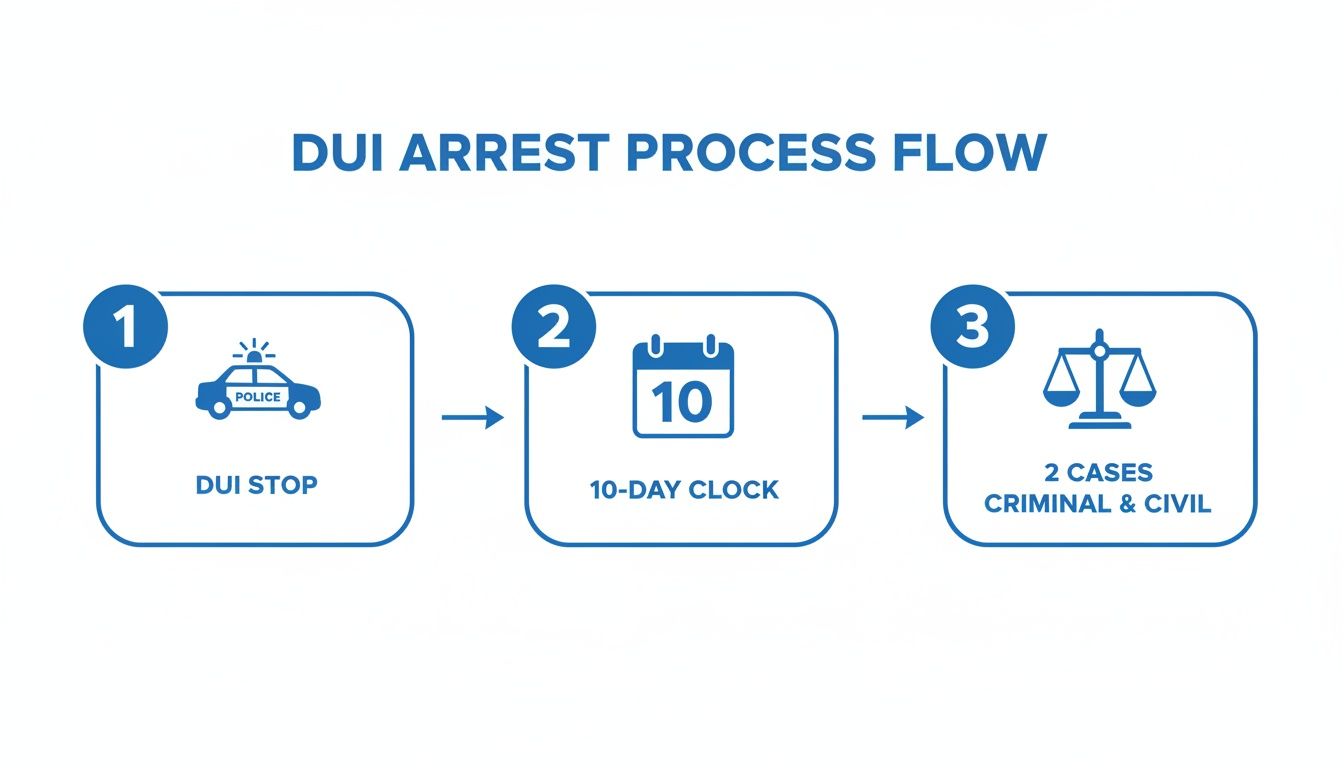
As you can see, from the second you're stopped, your case branches into two separate tracks, each with its own deadlines and rules. Getting a handle on this dual-track system is absolutely fundamental. To get into the weeds on this specific hearing, check out our guide on the administrative license suspension hearing.
Where you get arrested can make a big difference. Law enforcement agencies in counties like Broward are particularly vigilant. With over 3,300 DUI arrests in Broward County alone last year—a 20% increase—it’s clear that being in a high-enforcement zone reinforces how important it is to understand the two-front war you're facing. Our goal is to protect your license and record. Remember, past results do not guarantee future outcomes.
What Happens If You're Convicted of a DUI in Florida?
Not all DUI charges in Florida carry the same weight. The state uses a tiered system where the penalties get significantly tougher with each offense, especially in high-enforcement areas like Broward County. What starts as a serious but manageable situation for a first-time offense can quickly spiral into a life-altering event with a second or third charge.
It's crucial to understand these differences because the consequences go far beyond a simple fine. We're talking about potential jail time, lengthy license suspensions, mandatory DUI school, and expensive requirements like an ignition interlock device. The stakes get higher with every conviction, which is why a proactive defense is essential from day one.
First-Time DUI Penalties
For most people, a first-time DUI is their only brush with the criminal justice system. And while it's the least severe category, the penalties are still substantial and designed to be a wake-up call. A standard first offense is a misdemeanor, but the exact penalties hinge on the specifics of your case.
Here’s what a first DUI conviction in Florida typically involves:
Fines: A fine ranging from $500 to $1,000.
Jail Time: Up to six months in county jail, though many first-time offenders receive probation instead.
License Revocation: A mandatory driver's license revocation for 180 days to one year.
DUI School: You'll have to complete a Level I DUI school program.
Community Service: A mandatory 50 hours of community service is required.
These penalties are just the starting point. Certain factors can immediately crank up the severity, even for a first-time offender. You can get a more detailed breakdown in our guide on first-time DUI penalties in Florida.
Enhanced Penalties for "Aggravating Factors"
The standard penalties change in a big way if certain "aggravating factors" are involved. These factors signal to the court that the situation was more dangerous, triggering harsher mandatory minimums.
Two of the most common aggravating factors are:
High Blood Alcohol Content (BAC): If your BAC was .15 or higher, the penalties are automatically enhanced. Fines jump to a range of $1,000 to $2,000, and the potential jail sentence increases to nine months.
Minor in the Vehicle: Driving under the influence with a passenger under the age of 18 triggers the same enhanced penalties.
A conviction with either of these factors also comes with a non-negotiable requirement: the mandatory installation of an Ignition Interlock Device (IID) on your vehicle for at least six straight months—all at your own expense.
Second and Subsequent DUI Offenses
The consequences for a second DUI are dramatically more severe, especially if it happens within a certain timeframe. Florida uses a "lookback period" to determine just how harshly to penalize repeat offenders.
If a second DUI conviction happens within five years of a prior one, it triggers a mandatory jail sentence of at least 10 days. The fines climb to between $1,000 and $2,000, and your driver's license will be revoked for a minimum of five years.
Things get even more serious with a third offense. A third DUI conviction within 10 years of a prior conviction is automatically classified as a third-degree felony. This is a critical line to cross. A felony conviction can mean up to five years in state prison and a fine of up to $5,000. It also results in a minimum 10-year driver's license revocation and leaves you with a permanent criminal record that can haunt your employment, housing, and civil rights for the rest of your life.
The following table breaks down just how quickly the penalties escalate. Our goal is to protect your license and record. Please remember that past results do not guarantee future outcomes.
Comparing Florida DUI Penalties by Offense Level
This table compares the mandatory minimum and maximum penalties for first, second, and third DUI offenses in Florida, highlighting the escalating consequences.
Penalty Type | First Offense | Second Offense (within 5 years) | Third Offense (within 10 years - Felony) |
|---|---|---|---|
Fine | $500 - $1,000 | $1,000 - $2,000 | Up to $5,000 |
Jail/Prison Time | Up to 6 months jail | 10 days to 9 months jail | Up to 5 years prison |
License Revocation | 180 days to 1 year | Minimum 5 years | Minimum 10 years |
Ignition Interlock | Mandatory if BAC ≥ .15 | Mandatory for at least 1 year | Mandatory for at least 2 years |
The Financial Aftermath: Unpacking the True Cost of a Florida DUI
When you hear about a DUI, the first thing that comes to mind is usually court fines and maybe license suspension. But what most people don't realize is that the official fine is just the tip of the iceberg. A DUI conviction in Florida sets off a financial chain reaction, a cascade of mandatory expenses that can drain your bank account for years to come.
The first hit comes straight from the court. For a standard first-time DUI, you're looking at fines between $500 and $1,000. But if your Blood Alcohol Content (BAC) was 0.15% or higher, or if a minor was in the car, that fine immediately doubles to $1,000 to $2,000. On top of that, you'll have court costs, which usually run another $400 to $600. Right out of the gate, you're looking at a bill that can easily top $2,000.
And that's before we even talk about your license or your insurance.

Beyond the Fines: The Hidden Expenses Pile Up
That initial fine is just the down payment. To satisfy the court and get your driving privileges back, you'll face a laundry list of other required expenses. These aren't suggestions; they're mandatory steps on the path to putting this behind you.
Here’s a quick rundown of the other costs you can expect:
DUI School: You’ll have to enroll in and complete a state-approved DUI program, which typically costs between $200 and $500.
License Reinstatement Fees: After your suspension is over, getting your license back isn't free. The DHSMV will charge you a reinstatement fee, often over $150.
Impound Fees: Your car was almost certainly towed and impounded when you were arrested. You're on the hook for those towing and daily storage fees, which can quickly climb into the hundreds.
These are just the administrative costs. The real long-term financial pain comes from two other major requirements.
The Long-Term Squeeze: Insurance Hikes and Ignition Interlocks
Two of the most punishing and long-lasting financial hits from a DUI are the cost of an Ignition Interlock Device (IID) and the massive spike in your car insurance premiums. These expenses will follow you for years, long after your court case is officially closed.
An IID is a breathalyzer for your car, preventing it from starting if it detects alcohol. It's mandatory for certain convictions, especially for high BAC cases. The costs break down like this:
Installation Fee: Usually $70 to $150 just to get it put in.
Monthly Monitoring Fee: Expect to pay $60 to $90 every single month.
Removal Fee: Another charge when your required time is up.
For a six-month IID requirement, you're easily looking at an extra $500 to $700. If you need it for a year or more, that cost will soar past $1,000.
But the single most damaging long-term cost is what happens to your auto insurance. A DUI conviction instantly labels you a high-risk driver. As a result, you’ll be required to get an SR-22 certificate from your insurance company, which proves to the state you have liability coverage. This requirement can last for three years or more, and during that time, your premiums could easily double or even triple. We're talking about thousands of extra dollars.
When you add it all up—court costs, program fees, IID expenses, and the insurance nightmare—the true cost of a first-time DUI in Florida can easily hit $8,000 to $10,000 over several years. And that number doesn't even factor in what you might lose in wages or the cost of hiring an attorney to defend you. To get a better handle on what a defense might cost, you can explore our insights on the average DUI lawyer fees. Our goal is to protect your license and record. Remember, past results do not guarantee future outcomes.
Beyond the Courtroom: The Collateral Consequences of a DUI
A DUI conviction in Florida doesn't just end when you walk out of the courtroom. The penalties everyone thinks about—the fines, potential jail time, and license suspension—are really just the start. That conviction creates a permanent criminal record that follows you around, casting a long shadow over almost every part of your personal and professional life.
These are what we call collateral consequences, and they can impact your career, your housing, and even your basic civil rights long after you’ve paid the fines and finished probation. Understanding these lasting effects is key to grasping the true stakes of a Florida DUI.
Professional and Employment Impact
For a lot of Floridians, a DUI conviction becomes a huge wall to climb in their career. That criminal record is a major red flag for employers running background checks, often getting your application tossed in the trash before you even land an interview.
The hit is especially hard for people in licensed professions. A DUI has to be reported to state licensing boards, which can set off disciplinary action for professionals like:
Nurses and Healthcare Providers: A conviction could easily lead to a license suspension or even revocation by the Florida Board of Nursing.
Real Estate Agents: The Florida Real Estate Commission might see a DUI as a failure to meet the character standards required to hold a license.
Teachers and Educators: A criminal record can put teaching certificates and jobs in schools in serious jeopardy.
For commercial drivers (CDL holders), the consequences are immediate and brutal. A first-time DUI conviction brings a one-year disqualification of their CDL. A second one? A lifetime disqualification. That's a career-ending event, plain and simple.
Broader Life-Altering Consequences
The ripple effects of a DUI conviction spread far beyond your job. Having a permanent criminal record creates hurdles in areas of life most people don't even think about.
Landlords almost always run background checks, and a DUI conviction can make it incredibly difficult to find a decent place to rent. In the same way, some banks and lenders might look at a recent conviction as a sign of instability when you're applying for a personal loan or a mortgage. A DUI conviction can also come with requirements for substance abuse education or treatment, and some individuals find it helpful to explore various recovery resources.
A Note for Non-U.S. Citizens: If you're not a U.S. citizen, a DUI conviction can have devastating immigration consequences. It can be classified as a "crime involving moral turpitude," which could threaten your visa status, green card application, or your ability to re-enter the country.
Felony DUI and the Loss of Civil Rights
If a DUI gets charged as a felony—which usually happens for a third offense within ten years or a DUI that causes serious bodily injury—the consequences get even heavier. A felony conviction in Florida means you lose certain civil rights. This includes your right to vote (until it's fully restored) and, under both state and federal law, a lifetime ban on owning or possessing a firearm.
The gravity of these outcomes shows just how important a strong defense is. A DUI arrest doesn’t just put your freedom at risk; it’s a reflection of a serious public safety issue. Florida averages about 5,168 drunk driving accidents yearly, which injure 3,061 people and kill another 398. For the drivers charged, the consequences pile up, with felony status leading to prison time and a permanent record that torpedoes job and housing opportunities.
The whole point of a defense is to protect your license and your record from these far-reaching effects. For a deeper look into these lasting impacts, you can read our guide on the consequences of a DUI in Florida. Our practice focuses on traffic and DUI defense across Florida. Past results do not guarantee future outcomes.
Protecting Your Future: The First Steps After a DUI Arrest
The moments and days after a DUI arrest in Florida are a blur of confusion and anxiety. While it's natural to feel overwhelmed, the moves you make right now are absolutely vital to protecting your rights, your driver's license, and your future. This isn't the time to wait and see what happens; it's the time to launch a strategic, proactive defense.
The single most critical step you can take is to get guidance from an attorney whose practice is focused on DUI defense. Time is ticking, mainly because of the strict 10-day rule from the Florida Department of Highway Safety and Motor Vehicles (DHSMV). If you miss this deadline to challenge the automatic suspension of your license, you could lose your ability to drive before you even step into a criminal courtroom.

Why Immediate Legal Counsel is Crucial
An experienced DUI defense lawyer does a lot more than just show up for you in court. In these first critical days, their job is to seize control of the situation and preserve every possible option for your defense.
Here’s what they often do immediately:
File for the DHSMV Hearing: An attorney will immediately file the paperwork to challenge your administrative license suspension, making sure you don't miss that 10-day window. This is the very first move to protect your driving privileges.
Analyze the Arrest: They will pick apart every detail of the traffic stop and arrest—from the reason you were pulled over to how field sobriety exercises and chemical tests were conducted—searching for procedural mistakes or violations of your rights.
Preserve Evidence: Key evidence like dashcam and bodycam footage can be erased if it's not requested right away. An attorney sends a formal demand to preserve all evidence before it disappears.
Your Initial Action Plan
While your attorney gets the legal gears turning, there are a few things you should do to get organized. First, gather every piece of paper you received during the arrest, including the citation, bond paperwork, and the vehicle impound report. These documents contain essential information for your case.
Important Advisory: From the second you're arrested, it is critical that you do not discuss the details of your case with anyone—not law enforcement, friends, or family—without your lawyer present. Anything you say can be twisted and used against you.
Our goal is to protect your license and your record. The initial consultation is a vital first step in understanding your rights and options. To see a detailed timeline of events, you can review our article about what happens after a DUI arrest. Remember, contacting our firm does not create an attorney-client relationship, and past results do not guarantee future outcomes.
Attorney Advertisement. Office in Broward. Our practice focuses on traffic and DUI defense.
Questions We Hear All the Time About Florida DUI Cases
When you're facing a DUI arrest in Florida, questions start piling up fast. We've put together some straightforward answers to the most common ones we hear from our clients. Keep in mind, this is for educational purposes and isn't a substitute for legal advice from a licensed attorney about your specific case. Past results do not guarantee future outcomes.
Can a Florida DUI Charge Be Knocked Down to Reckless Driving?
Yes, sometimes it's possible to negotiate a plea down to a lesser charge like reckless driving, which is often called a "wet reckless" in these situations. Whether this is a real possibility boils down to the hard facts of your case—your Blood Alcohol Content (BAC), your prior record, and how strong the state's evidence is against you.
An experienced DUI attorney can look at everything the prosecutor has and tell you if this is a realistic strategy. A reckless driving conviction is almost always preferable to a DUI, especially when it comes to avoiding a lengthy license suspension and significant insurance rate hikes.
Will I Have to Get an Ignition Interlock Device for a First DUI?
For a standard first-time DUI, an Ignition Interlock Device (IID) isn't automatically required, but the judge can still order one at their discretion.
However, an IID becomes mandatory for a first offense if:
Your BAC was .15 or higher.
There was a minor in the car when you were arrested.
In those situations, the law requires the device to be installed for at least six consecutive months, and you have to pay for it out of your own pocket. For second and subsequent offenses, the IID requirements get much stricter and the installation periods are a lot longer.
I Was Just Visiting Florida. What Happens with My Out-of-State License?
If you're an out-of-state driver arrested for DUI in Florida, you're now fighting a battle on two fronts. Florida will report the DUI to your home state's DMV through the Driver License Compact, which is basically an information-sharing agreement between most states.
Your home state will then likely hit you with its own penalties, like suspending your license. At the same time, you still have to deal with the criminal charges right here in the Florida county where you were arrested, whether that's Miami-Dade, Broward, or anywhere else. A local attorney can often appear in court for you, which can save you from flying back and forth for every court date and help you manage the headache of a dual-state case.
Facing a DUI charge is a serious matter with lasting consequences. At Ticket Shield, PLLC, our practice is focused on DUI and traffic defense across all 67 Florida counties. Our goal is to protect your license and record. Get a free, confidential consultation to understand your options. Visit us at https://www.ticketshield.com to learn more.