
Texting Driving Ticket in Florida: What To Do If You Get a Citation
A Florida texting driving ticket starts at a $30 base fine, but costs rise fast. See first and second violation penalties, points, and deadlines.
So you got pulled over for texting and driving in Miami-Dade County. The flashing lights on the Dolphin Expressway or Biscayne Boulevard are jarring, and now you’re holding a ticket that feels like a major problem. It’s easy to get stressed out, but what you do in the moments and days that follow is critical.
A texting driving ticket in Florida is often smaller on paper than people expect, but the details matter. Under Florida Statute 316.305, a first texting violation is a noncriminal traffic infraction treated as a non-moving violation with a $30 base fine and no points. A second violation within five years becomes a moving violation with a $60 base fine and 3 points, and school or work zone handheld violations can also bring a $60 base fine and 3 points under FLHSMV distracted-driving guidance. Court costs usually push the amount you pay above those base numbers.
How We Reviewed Florida Texting Driving Ticket Rules for This Guide
We built this guide by reviewing the current Florida texting-while-driving statute, statewide driver-license points rules, clerk and county payment guidance, and official distracted-driving explanations from state agencies. The main sources were Florida Statute 316.305, the Florida Highway Safety and Motor Vehicles distracted-driving page, the FLHSMV points and suspensions overview, and county clerk guidance on civil traffic deadlines such as the Miami-Dade Clerk traffic citations page.
Key issues in Florida guidance that change outcomes for drivers include the response deadline, whether the violation is moving or non-moving, whether points apply, and what happens if you pay. Common sources of confusion include the gap between the statute’s base fine and the higher total that appears after court costs and local assessments.
We are not promising a result here. This article is meant to help you understand the rules, the likely consequences, and the options you may want to discuss with counsel.
What To Do After a Texting and Driving Stop in Miami-Dade County
The first thing to do is take a breath. It’s natural to feel frustrated, but arguing with the officer on the side of the road will not help your situation. Stay polite, accept the citation, and sign it if asked—remember, signing is not an admission of guilt.
Once you’ve pulled away safely, that little piece of paper becomes your top priority.
Your Immediate Post-Ticket Checklist
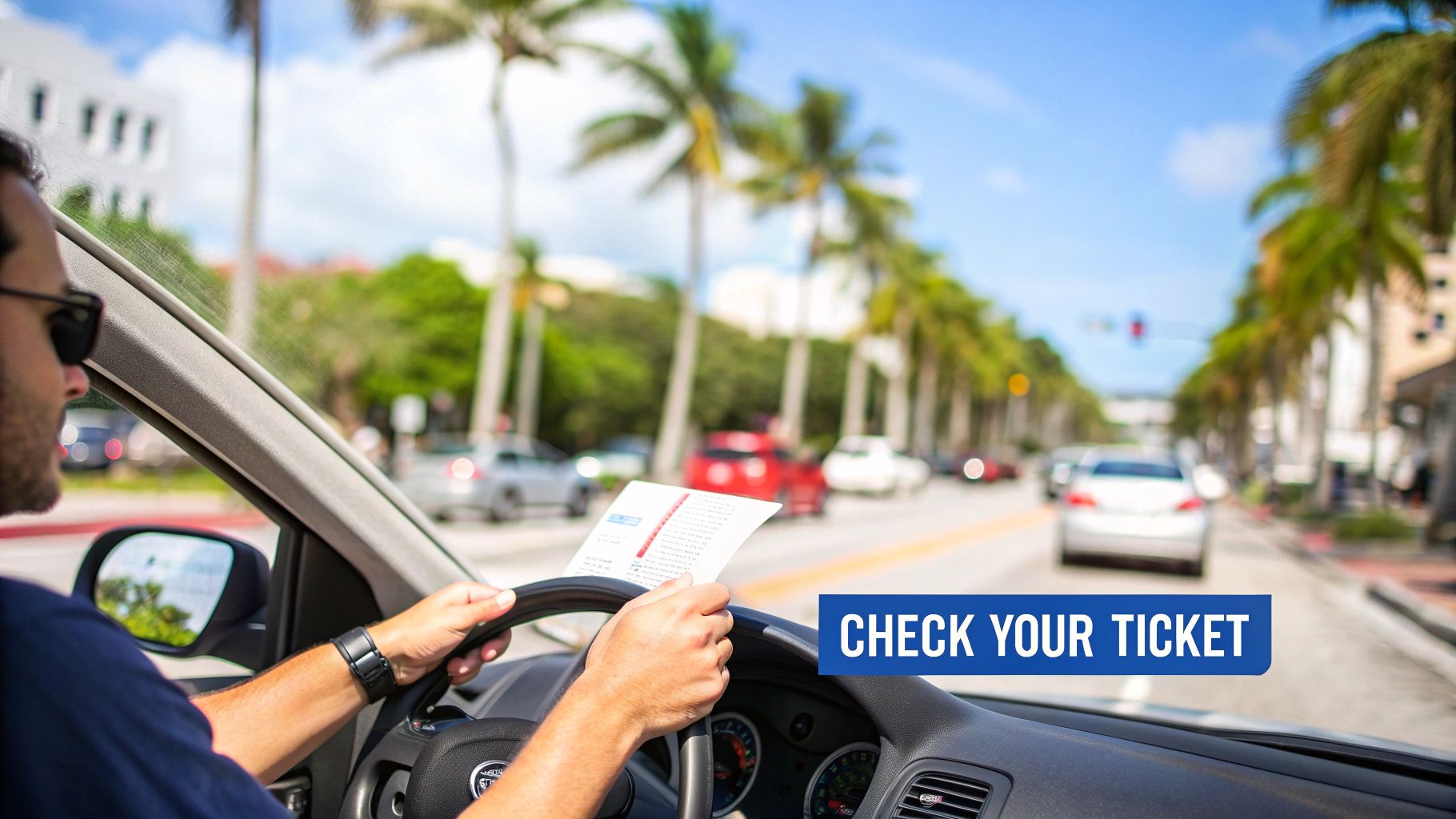
Park somewhere safe and take a hard look at the citation. Law enforcement officers are human, and they can make mistakes. A simple clerical error could be a key part of your defense later on.
Check Your Info: Is your name spelled right? Is your address and driver's license number correct?
Confirm Vehicle Details: Make sure the make, model, and tag number for your car are accurate.
Review the Violation: Look at the exact statute number the officer wrote down. Does their description of what happened match reality?
Note the Time and Location: Is the street or intersection listed correctly? A mistake here can sometimes be significant.
This isn’t about finding a simple technicality. It’s about making sure the facts are straight from the get-go. After you’ve reviewed it, stash the ticket somewhere safe where you won’t lose it.
Key Takeaway: The single most important detail on your ticket is the deadline. Florida drivers generally have 30 days to respond to a civil traffic citation through payment, election of an eligible course, or a court challenge, as reflected in county clerk traffic instructions such as Miami-Dade Clerk guidance. If you miss the response window, your license can be suspended.
Understanding Your Initial Situation
Right after a stop, most drivers want to know two things: how serious this is and what they have to do next. Statewide, those answers are more consistent than many people think. The core rules come from Florida law, not from one county. What changes from place to place is usually the clerk’s portal, hearing logistics, and the exact local cost added onto the ticket.
If you were cited in Miami-Dade, Broward, or elsewhere, the practical first step is the same: preserve details while they are fresh. Write down what the officer said you were doing, whether the vehicle was moving, where your phone was located, and whether you were using navigation, reporting an emergency, or making a permitted one-touch interaction. In our experience reviewing ticket defenses, drivers often remember the stop clearly that same day and far less clearly a week later.
Even when the fine for a first violation of texting while driving is only a $30 base fine and there are no points, the question is whether paying quickly is the best move for your record, costs, and future exposure if another stop happens later. If you are weighing that decision in South Florida, this guide on when it is worth hiring a lawyer vs. paying the traffic ticket in Miami-Dade provides a helpful local framework.
If you want broader safety context before deciding how to change your driving habits, this short 3rd-i case story is a practical example of why distraction prevention tools get attention in South Florida.
Past results do not guarantee future outcomes.
Attorney Advertisement. Office in Broward.
Violation Type | Base Fine | Points on License | Potential Insurance Impact |
|---|---|---|---|
First Offense (Non-Moving Violation) | $30 + court costs | 3 Points | Rate increase for 3-5 years |
Second Offense (Within 5 years) | $60 + court costs | 3 Points | Significant rate increase |
Violation in School/Work Zone | $60 + court costs | 3 Points + 2 additional points | Major rate increase likely |
What Happens if You Are Caught Texting and Driving in Florida?
If an officer stops you for texting while driving in Florida, the immediate consequence is usually a noncriminal traffic citation under section 316.305. Since the law was strengthened in 2019, texting while driving is a primary offense, which means an officer can stop a driver for that conduct itself rather than waiting for a separate violation.
For a first violation, the offense is treated as a non-moving violation with a $30 base fine and no points. For a second violation within five years, it becomes a moving violation with a $60 base fine and 3 points. A handheld wireless-communications-device violation in a school crossing, school zone, or work zone can also bring a $60 base fine and 3 points under FLHSMV’s distracted-driving summary.
What confuses drivers most is that the statutory fine is not usually the amount they end up paying. Counties and courts add costs and assessments, so the total is commonly higher than the base amount listed in the statute. If you just pay, you are resolving the citation rather than preserving every defense.
The safety reason behind these laws is not abstract. Distracted driving was linked to 3,275 deaths and 289,310 injuries in 2023, according to a 2026 roundup using federal data from Mercury Insurance’s distracted-driving statistics summary. That does not tell you what your exact case outcome will be, but it does explain why enforcement has become more direct.
Understanding the True Cost of a Florida Distracted Driving Citation
For most Florida drivers, the answer starts with the statute. A first texting violation carries a $30 base fine, is treated as a non-moving violation, and does not add license points under Florida Statute 316.305. A second texting violation within five years carries a $60 base fine, becomes a moving violation, and adds 3 points. In school zones, school crossings, and work zones, handheld device violations are also punished more seriously, with a $60 base fine and 3 points under FLHSMV.
That means the fine for a first violation of texting while driving is $30 before court costs, and the fine for a second violation committed within five years of a first violation is $60 before court costs. Those are base amounts set by law. They are not a promise that your out-of-pocket total will stop there.
In our review of clerk and state materials, this is the biggest money mistake drivers make: they compare the statute’s base fine to the amount on the citation as if they should match exactly. They often do not. Local court costs, administrative fees, and required assessments can increase the actual amount due above the base fine, even when the violation itself is relatively minor.
Florida texting-ticket penalties at a glance
Offense level | Classification | Base fine | Points | Practical consequences |
|---|---|---|---|---|
First texting violation | Noncriminal, non-moving infraction | $30 | 0 | Ticket resolves for more than $30 after added costs; paying closes the case but may still affect your record history |
Second texting violation within 5 years | Noncriminal, moving infraction | $60 | 3 | Higher total after costs; points can affect eligibility for clean-record pricing and move you toward suspension thresholds |
Handheld violation in school/work zone | Moving violation | $60 | 3 | Treated more seriously because of location; higher-risk setting and license-point exposure |
The point side matters because Florida’s driver-improvement rules allow suspensions once a driver accumulates too many points in a set period. FLHSMV states that 12 points in 12 months can trigger a 30-day suspension, 18 in 18 months can bring a 3-month suspension, and 24 in 36 months can bring a 1-year suspension under its points and suspensions guidance.
Base fine vs. total amount due
The statute tells you the legal starting point. The clerk notice or payment portal tells you what the case will cost to close. Those are different numbers for a reason. Civil traffic cases can include court costs and local add-ons, so a first-offense citation with a $30 base fine often ends up noticeably higher once processed. The same is true for a $60 repeat-offense or zone-based citation.
Why the “cheap ticket” assumption can backfire
A first offense is less severe than a repeat offense, but it is still a state traffic citation that requires a response. If you qualify for an election like a driver-improvement course, that can change the practical outcome in some cases; if you pay, that may be the end of the matter financially but not always the smartest choice for your record. We see many drivers focus only on the base fine and ignore the deadline, the classification, and whether the ticket is one step away from becoming a point-carrying repeat offense.
Past results do not guarantee future outcomes.
Attorney Advertisement. Office in Broward.
What to Expect When You Get a Ticket in Broward County
A texting ticket may be issued in Broward County, but the basic rules come from statewide Florida law. The most important statewide rule is the response deadline: traffic citations generally require action within 30 days, and failing to respond can lead to additional penalties, including a license suspension through the clerk and DHSMV process reflected in county traffic instructions such as the Broward Clerk traffic page. What changes by county is usually the filing method, online system, scheduling process, and hearing location.
Your three Florida-wide response options
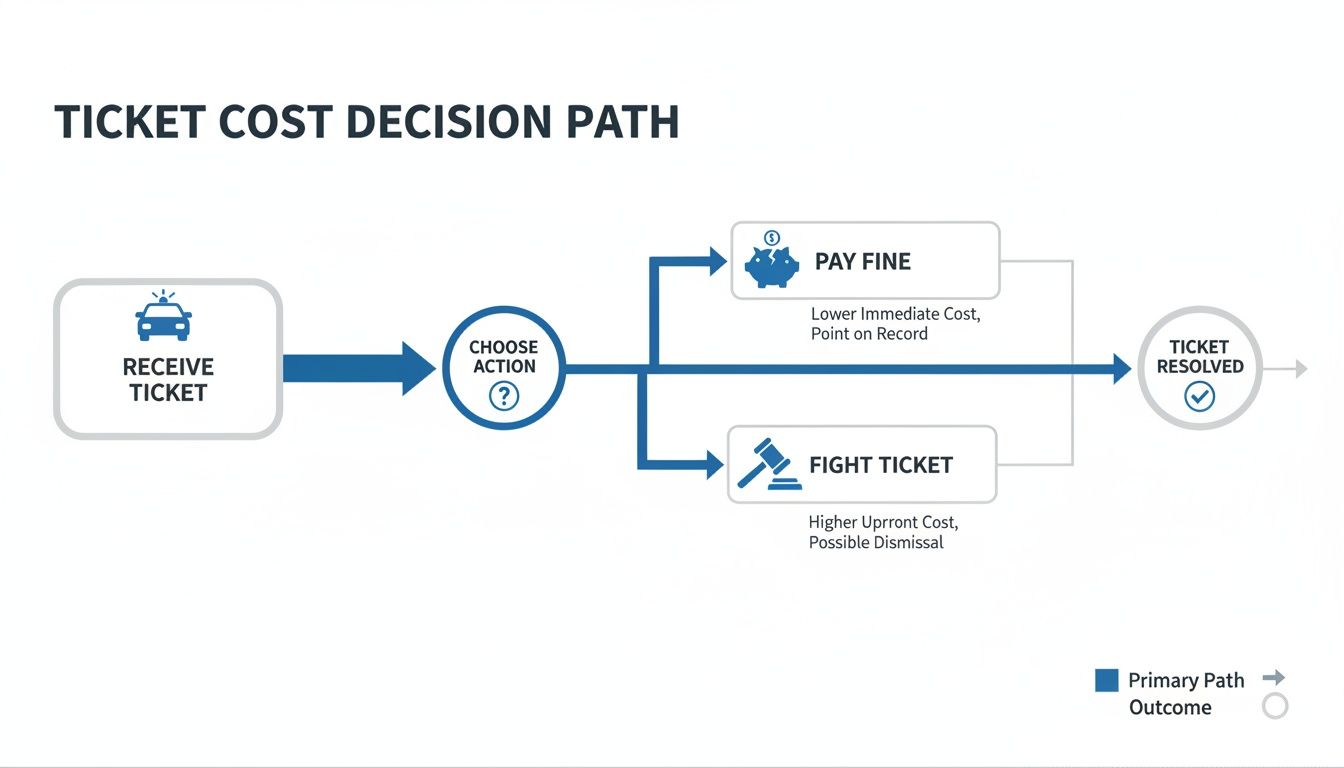
Most drivers have three possible paths after a texting ticket:
Pay the citation: This resolves the case quickly, but it also means you are not contesting the officer’s version of events.
Elect an eligible course: Some drivers may qualify for a driver-improvement option that changes the points impact, but eligibility rules matter and not every case or driving history supports it.
Contest the ticket: You can plead not guilty and request a hearing, where the officer’s observations and your evidence can be tested.
This decision chart breaks down the financial reality of your choice.
What stays the same statewide, and what changes locally
Statewide, the offense definitions, points rules, and statutory base fines come from the same Florida sources. Local variation usually shows up in procedure: how you request a hearing, where you submit documents, whether a county uses a hearing officer, and how fast a case gets scheduled. That is why Broward should be treated as one example, not the whole rulebook.
If your stop happened in Broward, the county-specific clerk process still matters. But the legal questions remain the same ones that matter anywhere in Florida: Was the vehicle in motion? Was the conduct prohibited by statute? Was the phone being used for navigation or another permitted purpose? One example of local ticket litigation is the Broward-specific post about a dismissed speeding ticket in Broward County, FL.
What a contest usually looks like
Once a not-guilty plea is entered, the court or hearing officer process begins. The officer may be required to appear and explain what they observed. You or your lawyer can present documents, photos, logs, or testimony that challenge whether the conduct met the statute. In our review of these cases, the strongest hearings are usually built around specifics rather than general fairness arguments: exact timing, exact phone activity, exact line of sight, and exact statutory exception.
Editorial standard: We intentionally focus on deadlines, points, and defenses that are grounded in the statute and clerk procedure. We do not promise dismissals, and we avoid treating one county’s administrative process as if it changes the statewide law.
Attorney Advertisement. Office in Broward.
Building a Defense Strategy for Your Case
A good defense to a Florida texting citation starts with the statute, not with broad claims that the stop was “unfair.” Under Florida Statute 316.305, the state still needs facts showing prohibited use of a wireless communications device while driving. That means the details of what the officer says they saw can matter a lot.
What the officer must usually be able to describe
In practical terms, an officer’s case is stronger when the citation and testimony clearly identify conduct consistent with texting or another prohibited manual use while the vehicle was in motion. A weaker case is one built on a vague observation like “driver looked down at phone” without a clear explanation of the hand position, screen interaction, duration, traffic conditions, or viewing angle.
From a case-review perspective, one of the biggest weaknesses we see is overgeneralization. A driver touching a phone is not automatically the same as a driver unlawfully texting. Florida’s law includes specific carve-outs and limitations, and the facts have to fit the prohibited conduct.
Statute-driven defense angles that often matter
Navigation use: The statute allows a device to be used for navigation. If your phone was running maps and your interaction matched route guidance rather than messaging, that can matter.
Emergency reporting: Reporting an emergency, criminal activity, or a safety threat is treated differently under the statute.
Whether the vehicle was in motion: The law targets conduct while driving. If the officer’s observation happened when the vehicle was not moving, that factual detail deserves close attention.
Texting versus another permitted interaction: Brief activation, deactivation, or a limited touch associated with a lawful function may be different from manual text entry.
Visibility and observation limits: Tinted glass, traffic position, nighttime conditions, lane placement, and the officer’s angle can all affect whether the observation was reliable.
Red-light and stopped-traffic issues
A lot of drivers assume that being stopped at a red light automatically makes phone use lawful. The statute’s wording and real enforcement practice do not always line up that neatly in the field. A driver may still receive a citation and then have to challenge whether the vehicle was "in motion" for statutory purposes or whether the officer’s observation captured prohibited conduct. That is why factual precision matters more than assumptions.
Evidence that tends to help in practice
The most persuasive evidence is usually simple and time-specific:
Phone logs showing no text, call, or data activity at the relevant time
photos of the mounted phone showing how the device was positioned in the vehicle
timestamped navigation history supporting lawful GPS use
contemporaneous notes describing traffic conditions, the stop, and what the officer said
location photos showing whether the officer had a clear line of sight
In our experience, drivers strengthen their challenge when their evidence answers the exact allegation instead of offering general character evidence. “I am usually careful” helps very little. “My map app was active at 8:14 p.m., the phone was mounted, and there is no outgoing text or app keyboard use at that time” is far more useful.
The broader safety rationale behind enforcement is real. AAA’s annual traffic-safety research continues to show strong public concern about handheld distraction, and the AAA Foundation Traffic Safety Culture Index is a useful snapshot of how drivers view the risk. But in court, the issue is not whether distracted driving is dangerous in general. It is whether the state can prove your specific violation under the statute.
For more ideas on how to approach your case, check out our guide on how to beat a traffic ticket in Florida.
Attorney Advertisement. Office in Broward.
How a Traffic Ticket Attorney Can Protect Your Record
It's tempting to just pay that texting and driving ticket and be done with it. A lot of people do. But what they don't realize is that paying the fine is the same as pleading guilty. It's an automatic conviction on your record, points on your license, and a surefire way to watch your insurance rates climb for years to come.
Working with a law firm that focuses on traffic defense changes everything. Instead of just accepting a conviction, you get a dedicated advocate who knows the system inside and out. Our job is to dig into every detail of that ticket, find the weaknesses in the state's case, and fight to protect your record.

Experience Navigating the Florida Court System
An experienced traffic attorney knows the local court procedures, the prosecutors, and the judges. That kind of on-the-ground familiarity is something you just can't get from a book. It’s what allows us to effectively negotiate your case or argue it at a hearing.
For most drivers, a court appearance is stressful and confusing. For us, it’s where we work.
This is exactly why many of our clients never have to step foot in a courtroom. We handle the appearances, the paperwork, and all the back-and-forth for you. No taking a day off work, no trying to find parking at the courthouse, no stress.
Our approach is always laser-focused on a few key goals:
Seek a Dismissal: We start by scrutinizing the ticket itself. Was there an error? Was the traffic stop even lawful? Procedural mistakes can be grounds for getting the entire ticket thrown out.
Negotiate a Reduction: If a dismissal isn't on the table, we work to get the charge amended to a less serious, non-moving violation that carries zero points.
Avoid Points on Your License: This is the big one. Our primary mission is to prevent a conviction that adds points to your driving record, because that's what triggers the painful insurance rate hikes.
Our goal is to protect your license and record. A flat-fee service provides you with a clear, upfront cost to have a dedicated legal professional work towards the best possible outcome for your situation. Past results do not guarantee future outcomes.
The Ticket Shield Process: Simple and Direct
We believe fighting a ticket shouldn't be complicated. Our entire process is built to be as simple and stress-free as possible, so you can get professional help without the hassle.
Send Us Your Ticket: You can snap a picture and upload your ticket information on our site in just a couple of minutes.
Get a Free Consultation: We'll review the details of your texting and driving ticket and give you a straightforward assessment of how we can help. No obligation.
Work Directly With Your Attorney: Once you hire us, you'll communicate directly with your lawyer via phone, text, or email. No call centers, no middlemen, just direct answers when you need them.
This direct line of communication means you're always in the loop and your questions get answered quickly by the person handling your case.
Why Professional Help Matters
It's a strange reality on the road today. Almost everyone agrees that texting and driving is dangerous, yet so many people still do it. A AAA survey found that while most drivers see handheld phone use as a threat, a significant percentage admit they've read texts or sent them while driving.
This behavior has pushed law enforcement to crack down, and Florida's laws reflect that. You can learn more about these distracted driving research findings.
Hiring an attorney levels the playing field. It tells the court that you're taking this charge seriously and are ready to defend your rights. Think of it as an investment—an investment in protecting your driving record, keeping your insurance rates from spiraling, and avoiding the long-term financial hit of a conviction.
Attorney Advertisement. Office in Broward.
Frequently Asked Questions About Florida Texting and Driving Tickets
How much is a texting while driving ticket in Florida?
For a first violation, the base fine is $30 and the offense is treated as a non-moving violation with no points under Florida Statute 316.305. For a second violation within five years, the base fine is $60 and the offense becomes a moving violation with 3 points. In school or work zones, a handheld violation can also carry a $60 base fine and 3 points under FLHSMV guidance. The amount you pay is often higher because court costs are added.
What happens if you are caught texting and driving?
Usually, you receive a noncriminal traffic citation. You then need to respond within the required deadline, often 30 days through the county clerk process. A first offense usually means a $30 base fine and no points; a second within five years means a $60 base fine and 3 points; and zone-based handheld violations can also bring 3 points. If you pay, you are resolving the ticket rather than forcing the state to prove the charge. If you contest it, you can present evidence and challenge whether the conduct fit the statute.
Can I contest my texting ticket if I was using GPS?
Yes. Florida law allows device use for navigation, so GPS use can be a meaningful defense issue under section 316.305. The important question is not just whether a map app was open, but what the officer claims you were doing with the phone and what your records show at that time.
What happens if I get a second texting ticket?
A second texting violation within five years is more serious than a first. It becomes a moving violation, carries a $60 base fine, and adds 3 points to your license under Florida Statute 316.305. Those points matter because FLHSMV’s driver-improvement rules can lead to suspensions when enough points accumulate.
Do I have to go to court if I hire an attorney?
In many traffic cases, an attorney can handle much of the process for you. Whether you personally need to appear depends on the court, the case posture, and the judge or hearing officer. One reason drivers hire counsel is to reduce the burden of hearings, filings, and negotiations.
Is it a violation to use my phone at a red light?
Florida’s texting statute focuses on prohibited use while driving, and the “in motion” issue often becomes important. In practice, a driver can still be cited at or near a red light and then have to challenge whether the officer observed conduct covered by the statute. So the short answer is: a red light is not a free pass, and if a ticket is issued, the exact facts will matter. See frequently asked questions about traffic tickets for more answers.
Dealing with a texting driving ticket can be overwhelming, but you do not have to face it alone. The team at Ticket Shield, PLLC is here to help protect your driving record and keep your insurance rates down. Contact us 24/7 for a free, no-obligation consultation to understand your options. https://www.ticketshield.com
Attorney Advertisement. Office in Broward. Past results do not guarantee future outcomes. Submitting information via our website does not create an attorney-client relationship.

