Protecting Your Safe Driver Florida License After a Ticket in Miami-Dade County
Learn how to protect your safe driver Florida license. This guide explains the points system, your options after a ticket, and how to keep your record clean.
Getting a traffic ticket in Miami-Dade County is unsettling, but understanding what it means to be a safe driver in Florida is your first step toward protecting your license. This isn't some formal award the state hands out. Think of it more as a practical status you earn by keeping your driving record clean and free of violations.
It's the difference between affordable insurance and peace of mind versus skyrocketing costs and a potential license suspension.
What It Really Means to Be a Safe Florida Driver
When you hold a Florida driver's license, you're not just carrying a piece of plastic; you're managing a privilege. The whole concept of being a "safe driver" is a direct reflection of your history as tracked by the Florida Department of Highway Safety and Motor Vehicles (DHSMV). A clean record tells the state and your insurance company that you consistently follow traffic laws.
But a single mistake—especially on the packed roads of Miami-Dade County—can put that status in jeopardy. A speeding ticket, a red-light violation, or a careless driving citation introduces the biggest threat to your record: the DHSMV points system.
The Real-World Impact of a Clean Record
Keeping your driving record clean is about more than just avoiding fines. The long-term consequences of even one conviction can hit you hard. Here’s what having a safe driver status actually protects:
Lower Insurance Premiums: Insurance companies favor safe drivers and often provide them with better rates. A single moving violation can lead to premium hikes that stick around for three to five years, often costing you hundreds or thousands more than the original fine.
Avoiding License Suspension: The DHSMV will suspend licenses for drivers who accumulate too many points in a set time. Protecting your record means protecting your freedom to drive to work, school, and everywhere else you need to go.
Preserving Your Driving Privileges: Think of your license as something you have to actively defend. Every time you get behind the wheel, the choices you make either reinforce your good standing or put your safe driver status at risk.
The DHSMV Points System: How It Works
The Florida points system is the state's official way of tracking drivers who repeatedly break traffic laws. Each moving violation carries a specific point value, and hitting certain thresholds triggers automatic penalties. This system is the number one reason why just paying a ticket is often a detrimental choice.
When you pay a fine, you are admitting guilt. This results in a conviction on your record, the assignment of points against your license, and a notification sent directly to your insurance company.
This is why understanding your options is so critical. A single ticket can kick off a domino effect of negative consequences, turning a minor hassle into a major financial and logistical headache. The key is to handle the citation strategically from the start, with the goal of keeping those points off your license entirely.
Our practice focuses on traffic and DUI defense, and we handle these matters across Florida. Our goal is to protect your license and record. Past results do not guarantee future outcomes.
How the Florida DHSMV Points System Works
To keep a safe driver Florida license, you have to understand how the state keeps tabs on your driving. The best way to think about the Florida Department of Highway Safety and Motor Vehicles (DHSMV) points system is as a running scorecard. Every time you're convicted of a moving violation, the DHSMV tacks on demerit points to your record, pushing you closer and closer to serious penalties.
This isn't just about one ticket. It’s about how a few seemingly minor incidents can stack up fast and create a real problem. For example, a conviction for running a red light in Miami-Dade County (4 points) and then later getting a speeding ticket for 16 mph over the limit (4 points) puts you two-thirds of the way to a license suspension.
Breaking Down the Suspension Thresholds
The DHSMV has a clear process for repeat offenders, and the consequences are automatic. Accumulate too many points within a certain timeframe, and your license will be suspended. These are the thresholds you need to know:
12 points within a 12-month period leads to a 30-day suspension.
18 points within an 18-month period results in a 3-month suspension.
24 points within a 36-month period means a full 1-year suspension.
These are mandatory penalties enforced by the state. This system is exactly why it's so important to contest every single ticket. Our goal is to protect your license and your record by seeking to prevent those points from ever hitting your license in the first place.
The stakes are high for every driver in the state. With millions of drivers on Florida roads, the DHSMV issues over a million traffic violation convictions every year. A recent state report revealed that in just one period, 15,944 licenses were suspended for hitting the 12-point mark, with thousands more suspended at the 18 and 24-point levels.
Common Violations and Their Point Values
Not all tickets are created equal. The number of points you receive depends entirely on the seriousness of the offense. Knowing these values helps you see the immediate risk tied to any citation you receive.
A single conviction brings you closer to a mandatory suspension. For instance, one careless driving ticket that causes an accident is worth 6 points—that's halfway to a 30-day suspension from just one incident.
Understanding how points are assigned for common moving violations is the first step in protecting your driving record. The table below breaks down some of the most frequent tickets and their impact.
Florida Traffic Violations and Their Point Values
This table gives you a detailed breakdown of common moving violations in Florida and the corresponding points assigned by the DHSMV, helping you understand the risk of each ticket.
Violation Type | Points Assigned by DHSMV | Potential Insurance Impact |
|---|---|---|
Speeding (15 mph or less over) | 3 Points | Moderate Rate Increase |
Speeding (16 mph or more over) | 4 Points | Significant Rate Increase |
Running a Red Light | 4 Points | Significant Rate Increase |
Careless Driving | 3 Points (4 if accident) | High Rate Increase |
Moving Violation Causing an Accident | 4 Points | High Rate Increase |
Leaving the Scene of an Accident | 6 Points | Very High Increase / Policy Drop |
Passing a Stopped School Bus | 4 Points | Significant Rate Increase |
As you can see, the points can add up alarmingly fast. Protecting your safe driver status means doing everything you can to avoid these convictions. For a more exhaustive look at how violations are categorized, check out our complete guide on the Florida traffic ticket point system.
The points system is designed to flag and penalize drivers who pose a risk on the road. By understanding how it works, you can see why having a smart defense for any ticket is so crucial. The best way to manage this system is to keep your record clean from the very start.
Attorney Advertisement. Office in Broward. Past results do not guarantee future outcomes.
Your Three Options After Getting a Florida Traffic Ticket
Once that ticket is in your hand, an official 30-day clock starts ticking. This is a critical window. The decision you make right now will directly impact your driving record, your insurance rates, and your ability to keep your safe driver Florida license. You basically have three choices, and each one leads down a completely different road.
Getting this right is essential. One wrong move can lock in points, trigger painful insurance hikes, and stain a perfectly clean driving record. The right choice, on the other hand, can lead to a much better outcome.
Option 1: Pay the Ticket
This always seems like the easiest way out. Just pay the fine and move on, right? Unfortunately, this is one of the most common and costly mistakes a driver can make.
Here’s the hard truth: paying the ticket is an admission of guilt. The moment your payment goes through, that violation becomes a permanent conviction on your driving record. This guarantees two things will happen:
The Florida DHSMV will add points to your license.
Your insurance company will get notified of the conviction, which almost always leads to a rate increase for the next three to five years.
That "easy" option suddenly becomes the most expensive one in the long run. The few hundred dollars you might save by not hiring a lawyer can be completely wiped out by years of inflated insurance premiums.
Option 2: Elect Traffic School
Your second path is to elect to attend a Basic Driver Improvement (BDI) course, what most of us just call traffic school. Think of this as the middle-ground option. If you’re eligible and you complete the course, you can avoid having points added to your license for that ticket.
But traffic school isn't a guaranteed fix. It comes with some very strict limits. In Florida, you can only use this option once every 12 months and a maximum of five times in your entire lifetime. It’s a limited resource, and once you use it, it's gone for another year. Plus, while it keeps the points off, the citation still shows up as an "adjudication withheld" on your record—it’s not the same as a clean slate.
Option 3: Contest the Ticket
Your third, and usually most strategic, choice is to contest the ticket. This means you plead not guilty and challenge the citation in court. This is where having professional legal help can be a game-changer.
Contesting the ticket isn't about arguing with a judge. It's a formal legal process aimed at protecting your record. The ultimate goal is to get the ticket dismissed. A dismissal means:
No conviction on your record.
No points added to your license.
No report is sent to your insurance company.
This is the only option that gives you a chance at having the incident completely resolved in your favor. This decision tree shows just how fast a few tickets can put your license at risk.
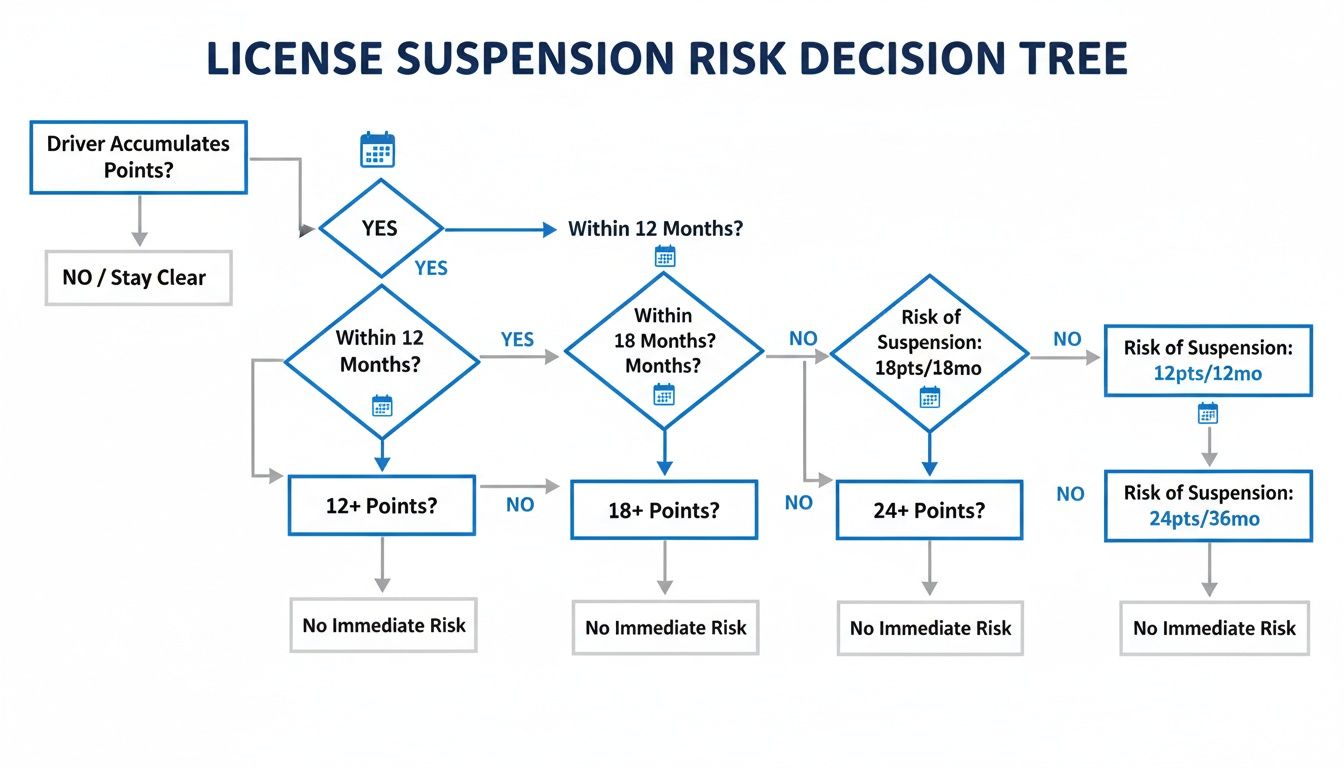
As you can see, just a handful of violations in a year or two can easily trigger a mandatory license suspension. It really highlights why contesting every single ticket is so important.
Contesting a ticket is a proactive investment in your driving future. Instead of just accepting the penalties, you’re actively working to preserve your clean record and keep your insurance rates from climbing.
Our practice focuses on traffic and DUI defense, and our entire focus is on protecting your license and your record. We handle all the legal complexities for you, aiming for the best possible outcome—which, in many cases, means our clients never even have to set foot in a courtroom. To see how this works, you can check out our detailed guide on how to beat a traffic ticket in Florida.
Attorney Advertisement. Office in Broward. Past results do not guarantee future outcomes.
Comparing Traffic School and Professional Legal Defense

So, you’ve got a traffic ticket. Now you're standing at a fork in the road with two very different ways to protect your safe driver Florida license: you can elect traffic school, or you can hire a professional to represent you. Both paths are designed to keep points off your record, but that’s where the similarities end.
The choice you make here really matters. One option is a temporary fix with some pretty strict limits, while the other is a legal strategy aimed at the best possible result: getting the ticket dismissed completely.
The Limits of Traffic School
At first glance, signing up for a Basic Driver Improvement (BDI) course—what everyone calls traffic school—seems like the simplest solution. You complete the course, and the DHSMV agrees not to put points on your license. Simple, right? Not exactly. This option comes with some hard-and-fast rules you can't bend.
The biggest catch is how often you can use it. Florida law is crystal clear: you can only elect traffic school once in any 12-month period and a maximum of five times in your entire life. It's a limited resource. Once you use it, that option is off the table for a full year.
Even more importantly, traffic school doesn't make the ticket vanish. Your record will show an "adjudication withheld" instead of a conviction. While that's better than being found guilty, the citation itself is still there, visible on your complete driving history for anyone who looks.
A Proactive Approach Through Legal Defense
Hiring a traffic ticket attorney changes the game from damage control to a strategic defense. Instead of just dodging the points, the goal is to challenge the ticket itself and get it completely dismissed.
A dismissal is the clean slate every driver wants because it means:
No Conviction: The ticket never becomes part of your public driving record.
No Points: Your license stays clean, keeping you safe from suspension thresholds.
No Insurance Notification: Your insurance company is never alerted, which prevents those dreaded rate hikes.
This approach treats the ticket as what it is: an accusation that has to be proven. Our firm, which focuses on traffic and DUI defense, digs into every detail of the citation—from the officer’s procedure to the equipment they used—to find a reason for dismissal. It's a level of defense you simply can't get by checking the box for traffic school.
Legal defense is a proactive strategy to keep your record clean. Traffic school is a reactive fix that prevents points but still leaves a mark on your driving history.
The Strategic Difference for a Clean Record
Think of traffic school as a bandage. It covers the wound (the points) but doesn't heal the injury (the citation that’s now on your record). A successful legal defense, on the other hand, is like preventing the injury from ever happening in the first place.
For drivers in busy areas like Miami-Dade County, where tickets are a part of life, saving your traffic school option can be a smart long-term play. Using it on a minor ticket today might leave you exposed if you get a more serious citation down the road.
Ultimately, it all comes down to what you’re trying to achieve. If your only goal is to avoid points on this one ticket and you can live with a permanent mark on your record, traffic school is there. But if you want to maintain a truly clean driving history and protect your safe driver Florida license, a legal defense gives you the best chance at that. For a deeper dive into this decision, you can explore our guide on when it's worth hiring a lawyer versus paying the ticket in Miami, FL.
Attorney Advertisement. Office in Broward. Past results do not guarantee future outcomes.
Higher Stakes for CDL Holders and DUI Accusations
While every driver should be focused on keeping their safe driver Florida license, the game changes completely for two groups: Commercial Driver’s License (CDL) holders and anyone accused of Driving Under the Influence (DUI).
For these drivers, a traffic stop is never just about points and a fine. It’s a direct threat to their livelihood, their freedom, and their future.
For a commercial driver, that CDL is their key to earning a living. For someone facing a DUI, the consequences are severe and life-altering, pushing far beyond the simple DHSMV points system. In these situations, the goal of legal representation shifts from just protecting a record to fighting off potentially serious outcomes.
The Unique Risks for Florida CDL Holders
If you drive for a living, you're held to a much higher standard, and the rules are far less forgiving. A moving violation that’s a minor headache for a regular driver can be a career-ending event for you. Even a ticket you get in your personal vehicle on your day off can trigger a disqualification of your CDL.
There is simply no room for error. The Federal Motor Carrier Safety Administration (FMCSA) and Florida law have strict rules for CDL holders for "serious traffic violations," which include:
Excessive Speeding: Clocked at 15 mph or more over the posted limit.
Reckless Driving: Operating any vehicle with a willful disregard for safety.
Improper Lane Changes: Making unsafe or erratic lane changes.
Following Too Closely: Tailgating another vehicle.
Just two of these serious violations within a three-year period can result in a 60-day CDL disqualification. A third violation in that same timeframe gets you a 120-day disqualification. For a professional driver, that's months without income—and a huge red flag that makes finding future work incredibly difficult.
When a DUI Charge Changes Everything
A DUI accusation is one of the most serious charges any driver can face in Florida. The focus immediately shifts from the standard points system into the world of criminal law and harsh administrative penalties. A conviction doesn't just add points; it creates a permanent criminal record.
The consequences of a DUI are swift and severe, often kicking in long before a case ever gets to a judge. They can include:
Immediate License Suspension: The state can trigger an administrative suspension right at the time of your arrest.
Hefty Fines and Court Costs: These can easily spiral into thousands of dollars.
Possible Jail Time: Even a first-time offense can carry a jail sentence.
Mandatory DUI School and Treatment: You'll have to complete this to get your license back.
Ignition Interlock Device (IID): You may be forced to install this device in your car at your own expense.
Florida's traffic enforcement is intense, with over 400 million vehicle miles traveled daily, creating endless opportunities for incidents. For serious charges like DUI or reckless driving, the stakes are magnified. The goal is to mount a strong defense to protect your freedom and future. You can learn more by reading about the consequences of a DUI in our detailed guide.
With a DUI, you are fighting two battles simultaneously: the criminal case in court and the administrative license suspension hearing with the DHSMV. Both have tight deadlines and require immediate, knowledgeable legal action.
For serious offenses like a DUI, where an arrest is possible, it's also helpful to have a general idea of the legal process that comes next. Getting a basic familiarity with these steps can be beneficial, and some resources offer a good overview for understanding arrest and bail procedures.
Because the consequences are so profound, handling these high-stakes cases demands a focused legal strategy. Our practice handles criminal traffic matters across Florida, and our goal is to protect your license and your record. We understand what's at stake and work to achieve the best possible outcome.
Attorney Advertisement. Office in Broward. Past results do not guarantee future outcomes. Submitting information via forms does not create an attorney-client relationship.
Common Questions About Florida Traffic Tickets
Getting a traffic ticket can leave your head spinning with questions. Protecting your safe driver Florida license status often comes down to getting clear, honest answers so you can make a smart decision. This is where we can help.
Our practice focuses on traffic and DUI defense. Our job is to bring clarity to a confusing process and, most importantly, protect your record. Here are some of the questions we hear every single day.
If I Get a Ticket in Miami but Live Elsewhere in Florida, Where Is My Case Handled?
Your case is always tied to the location of the violation, not where you live. If you got the ticket in Miami, your case falls under the jurisdiction of the Miami-Dade County Clerk of Courts.
This is a huge headache for most drivers. It means you’re stuck dealing with that specific court’s rules and deadlines, and you might even have to travel for a hearing. It’s a major reason people decide to hire a lawyer.
The biggest advantage of working with a law firm that handles cases in all 67 Florida counties is that an attorney can appear in court for you. For the vast majority of our clients, this means they never have to set foot in a courthouse. That saves a ton of time, travel costs, and stress.
Can I Just Elect Traffic School to Protect My Safe Driver Florida License Status?
You can, but it may not be the optimal solution many people think it is. Think of traffic school as a limited-use emergency tool in your glove box—you only want to use it when you absolutely have to.
Here’s the catch: you can only elect traffic school once every 12 months and a maximum of five times in your entire lifetime. If you burn that option on a minor ticket today, it’s gone for a full year. What happens if you get a more serious ticket a few months from now? You may be out of options.
Even then, traffic school doesn’t make the ticket disappear. It results in an "adjudication withheld," which is better than a conviction but it’s still on your record. The real goal when you contest a ticket is a full dismissal. A dismissal means no points, no conviction, and absolutely nothing on your record from that incident.
How Quickly Should I Contact an Attorney After Getting a Ticket?
As soon as you possibly can. The clock starts ticking the moment that ticket is in your hand. Florida law gives you a strict 30-day deadline to respond to a civil traffic ticket. If you let that window close, your options shrink dramatically, and you could be facing serious penalties like a driver's license suspension.
Waiting until day 29 puts you at a real disadvantage. When you reach out to a firm early, you give your legal team the time they need to:
Review the details of your ticket.
File all the right paperwork with the court.
Build a solid defense strategy designed to get you the best possible outcome.
We offer free consultations for this very reason—to help you figure out your next steps immediately. Keep in mind that submitting your information does not create an attorney-client relationship, but it's the first step toward getting the help you need.
Is Contesting a Ticket More Expensive Than Just Paying the Fine?
This is a common misconception. While hiring an attorney has an upfront cost, just paying the fine can end up costing you far more in the long run. Most drivers only see the dollar amount on the ticket, but that’s just the beginning.
When you pay that ticket, you’re officially pleading guilty. That guilty plea leads to a conviction and points on your license, which is a major red flag for your auto insurance company. The result is almost always a rate hike that sticks with you for the next three to five years.
Over that time, the increased insurance costs can easily add up to hundreds or even thousands of dollars—far more than the initial fine and the cost of legal representation combined.
Contesting the ticket is a strategic investment in avoiding those painful, recurring costs. Our goal is to secure an outcome that keeps your record clean and ultimately saves you a lot of money. While past results do not guarantee future outcomes, a proactive defense gives you the best chance at dodging the real financial sting of a ticket.
At Ticket Shield, PLLC, our practice is focused on defending drivers across Florida. If you've received a ticket and want to protect your record, our team is here to help. Get your free, no-obligation consultation today. Learn more at https://www.ticketshield.com.