Does a DUI Affect Security Clearance? Get Answers
Does a dui affect security clearance - Does a DUI affect security clearance? Yes, but it may not be a disqualifier. Learn how a Florida DUI impacts eligibility,
Yes. A DUI can affect your security clearance because it triggers a formal review. It does not automatically end your clearance, but your next moves matter. Report it correctly, protect the Florida case early, and build mitigation fast.
You were arrested. Your phone is buzzing. Your command, employer, or security office may find out soon. And now you're asking the right question: does a dui affect security clearance?
Yes, it does.
In Florida, a DUI under Florida Statute § 316.193 is never just a driving case if you hold or need a clearance. For a service member, contractor, or cleared employee, it becomes a judgment, reliability, and trust problem the moment it hits the system. That is why a sloppy response can hurt more than the arrest itself.
If you're in Tampa, this can start in a local courtroom like the Edgecomb Courthouse and then spread into a federal review that touches your job, your future assignments, and your standing with your security office. The legal case and the clearance issue move on separate tracks. You need to treat both seriously from day one.
Table of Contents
A DUI Arrest and Your Security Clearance Your First 24 Hours
Will I Lose My Security Clearance Immediately After a DUI Arrest?
A DUI Arrest and Your Security Clearance Your First 24 Hours
At 2:00 a.m., you get released from jail, your phone is blowing up, and your first instinct is to keep this quiet until you can think straight. That instinct can cost you. A Florida DUI arrest under § 316.193 is not just a criminal case if you hold a clearance. It is the start of a record that can follow you into your command, your Facility Security Officer, and your next review.
Act like every step from this point will be examined later, because it will.
A DUI can be managed. Sloppy first-day decisions are what turn a manageable case into a career problem. You need to protect the criminal case, protect your reporting position, and protect your credibility at the same time. If you were booked, released, or trying to sort out bond logistics in another state, Bail for DUI in Colorado gives useful general context on how fast these cases start affecting work and daily life.
What should you do first
Get organized before you say another word.
Protect the facts: Save every document you received. Citation, bond paperwork, notice of suspension, towing paperwork, court dates, and release terms.
Write down the timeline: Do it while it's fresh. Where you were, what you drank, what the officer said, whether there was a crash, and whether testing was requested.
Stop talking about the case: Do not explain it to coworkers, supervisors, or friends by text.
Get legal guidance immediately: Your DUI defense and your clearance strategy need to match from day one.
Practical rule: Your first explanation of the arrest should be prepared, accurate, and reviewed by counsel.
Why the first 24 hours are so dangerous
The biggest problems usually come from unforced errors. A service member or contractor says too much, reports too little, guesses about deadlines, or sends a text that later conflicts with the police report. Then the issue stops being only alcohol-related and starts looking like poor judgment or dishonesty.
You can still improve your position with fast, disciplined action. Delay gives the paperwork, the employer response, and the official version of events time to harden against you.
If you need a clear sequence of the criminal process, review this explanation of what happens after a DUI arrest.
What your mindset needs to be
You are dealing with two systems at once. One is the Florida court case. The other is the clearance review process. They overlap, but they do not operate by the same rules, and waiting for one to resolve before addressing the other is a mistake.
This is why direct attorney access matters. A ticket app or DUI mill can process forms. It cannot protect your job, shape your reporting strategy, or help you avoid statements that create a second problem on the clearance side. Our job is to contain the damage early, build a clean record, and give you a plan you can follow in the hours after the arrest.
Stay calm. Get precise. Get counsel involved fast.
Will I Lose My Security Clearance Immediately After a DUI Arrest?
No. Not immediately.
A DUI arrest does not cause automatic, instant revocation of your clearance. It starts a review. That distinction matters because review creates room to defend yourself, explain the facts, and present mitigation.
Under the Adjudicative Guidelines, a DUI is primarily reviewed under Guideline G, often with Guideline E and Guideline J. Data also shows that isolated DUIs with strong mitigation, including self-reporting to a Facility Security Officer within 72 hours, result in approval rates exceeding 80% for Secret and Top Secret levels, according to this analysis of DUI and security clearance reviews.
What happens after the arrest
Think of the process as a set of gates.
First, the arrest becomes an adverse event. Then the government or your employer looks at the surrounding facts. Then they decide whether the incident looks isolated and manageable, or whether it suggests a bigger reliability issue.
That means these details matter:
Whether this is your first incident
Whether anyone was injured
Whether there was an accident
Whether you complied with court requirements
Whether you reported the incident properly
Whether your behavior since the arrest shows control
Arrest, conviction, and case outcome are not the same thing
A lot of people confuse these.
An arrest creates the immediate clearance issue because it triggers review. A conviction can worsen the review. A favorable court result can help mitigate the concern. But security adjudicators can still examine the conduct behind the arrest even if the criminal case improves.
That is why your Florida defense matters from the start. If you need a clear overview of the criminal penalties and collateral risks, review these DUI consequences in Florida: https://www.ticketshield.com/insights/consequences-of-a-dui
Your clearance is usually not “gone” the day after a DUI. It is under scrutiny, and scrutiny can be managed if you respond correctly.
Why panic leads to bad decisions
People hurt themselves when they assume the case is already lost.
They stop communicating. They fail to report. They tell partial truths because they think the underlying DUI is fatal. It usually isn't. The review is trying to answer a narrower question: are you still trustworthy enough for access?
That answer depends heavily on your conduct after the arrest.
What matters right now
You need to act as if every document and every statement may be reviewed later.
That doesn't mean surrender. It means discipline. Protect the criminal case. Report properly. Build mitigation. Keep your story accurate and consistent.
The arrest is serious. It is not the end unless you handle it like the end.
How Does the Government Judge a DUI for Clearance?
The government doesn't look at a DUI the way a Florida traffic court does.
Adjudicators use a risk framework. They ask whether the incident reflects poor judgment, alcohol misuse, dishonesty, or a broader disregard for rules. They also look at whether the conduct is isolated or part of a pattern.
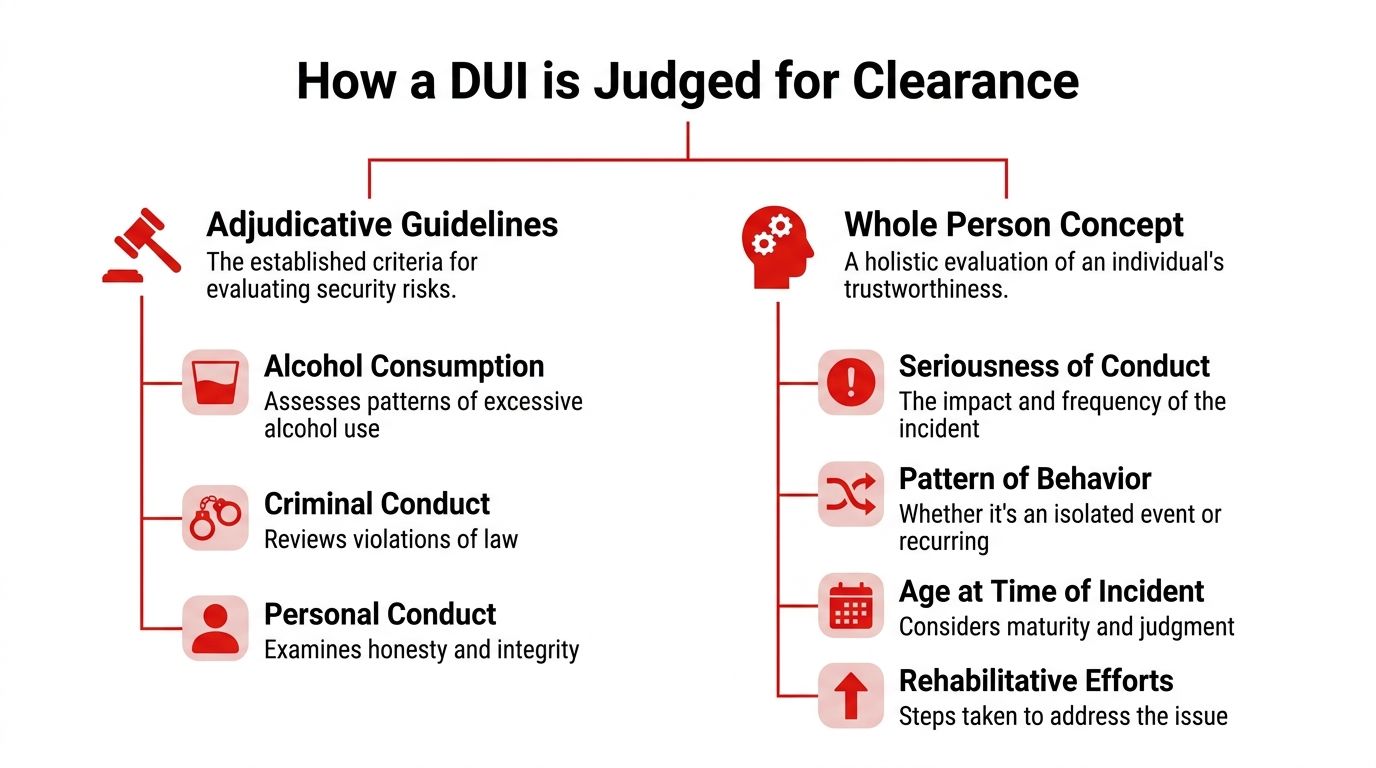
A single DUI conviction does not automatically revoke clearance, but it does trigger review under Guidelines G, E, and J. Reinvestigation cycles also matter. Confidential clears every 15 years, Secret every 10 years, and Top Secret every 5 years. Analyses cited by National Security Law Firm's discussion of DUI and security clearance state that properly addressed single DUIs rarely lead to denial, with some analyses suggesting over 99% of such cases do not result in clearance loss when mitigated transparently.
Which guidelines matter most
The review usually centers on three categories.
Guideline | What It Assesses | How to Mitigate It |
|---|---|---|
Guideline G | Alcohol use and whether the DUI suggests a pattern | Show the event was isolated and back it up with treatment, education, or sustained behavior change |
Guideline E | Honesty, candor, and personal reliability | Report accurately, correct mistakes fast, and avoid inconsistent statements |
Guideline J | Criminal conduct tied to the arrest itself | Fight the Florida case strategically and complete all court obligations |
What adjudicators want to see
They are not hunting for perfection. They are looking for risk.
A single bad decision can be survivable. A pattern of bad decisions is much harder. So is a cover-up.
These are the questions that usually matter most:
Was this isolated or repeated
Did you tell the truth
Did you take responsibility
Did you comply with court requirements
Have you shown credible rehabilitation
The government often cares less about one mistake than about whether you became a bigger problem after the mistake.
The whole person concept cuts both ways
This part helps disciplined people and hurts careless ones.
A DUI review is not just about the arrest report. It can include your work history, prior conduct, judgment under stress, and what you did after the incident. If your record is otherwise solid, that helps. If this event sits next to other integrity or alcohol issues, it gets harder.
That is why the phrase does a dui affect security clearance has a practical answer, not a yes-or-no answer. It affects clearance by forcing the government to measure your risk using the whole picture.
Why Florida case strategy still matters
Your court result doesn't fully control the clearance review, but it shapes the record the adjudicator sees.
If the Florida defense exposes weaknesses in the stop, testing, or arrest procedure, that can improve the final outcome and help your mitigation narrative. If the case ends in a cleaner result, that gives you stronger ground to argue that the event should not define your reliability going forward.
This also affects civilian employment. If you're worried about how alcohol-related charges can ripple into hiring and retention, this discussion of whether a DUI can prevent you from getting a job is worth reviewing: https://www.ticketshield.com/insights/can-a-dui-prevent-you-from-getting-a-job
What Are My Exact Reporting Requirements for a DUI?
People often wreck otherwise manageable cases.
If you hold a clearance, your instinct may be to keep the DUI quiet until the Florida case is over. That instinct is dangerous. In many clearance situations, not reporting the event creates the larger problem.

Historical data discussed in this review of DWI and security clearance reporting shows that over 90% of single-DUI cases survive review if handled responsibly through reporting and mitigation. The same source notes that expungement can reduce visibility on routine background checks, but SF-86 disclosure is still required, and non-reporting creates a greater integrity risk than the conviction itself.
Why hiding it is worse than the arrest
A DUI raises concern about judgment.
A failure to disclose raises concern about honesty. In the clearance world, honesty is often the issue that kills the case. Adjudicators can work with a bad night. They are far less forgiving about concealment.
If you want a useful baseline on how driving matters can appear in screening, this explanation of whether traffic tickets show up on background checks helps separate routine checks from deeper investigations: https://www.ticketshield.com/insights/do-traffic-tickets-show-up-on-background-checks
Hard truth: A reportable incident that you hide becomes two problems. The DUI and the dishonesty.
What you should report right away
Your exact obligation depends on your role, your employer, and your clearance structure. But the safe approach is early, accurate disclosure to the proper person.
That often means your:
Facility Security Officer
Security manager
Chain of command
Investigator or processing office if your clearance is pending
Keep the report factual.
Include the date, agency, charge, court location, and next known hearing date. Do not freelance. Do not argue the case in writing. Do not guess about facts you don't know yet.
A short, accurate disclosure is usually stronger than a long emotional one.
What about the SF-86
The SF-86 Questionnaire requires disclosure of arrests or convictions, even if they were expunged. That means you should assume the event belongs in your clearance paperwork and related updates if the process requires it.
This video gives a useful starting point on the broader issue of clearance concerns and disclosure:
What not to do
Do not minimize the incident with cute language. Do not say you were “barely over” or that it was “just a misunderstanding” unless the evidence later supports that. Those phrases often age badly.
Do this instead:
Be prompt: Delay makes intent look worse.
Be accurate: Stick to documented facts.
Be consistent: Your criminal defense position and your reporting should not collide.
Be organized: Save every filing, completion certificate, and court update.
A clean report, made on time, is often the first real mitigation in the clearance file.
What Steps Can I Take to Mitigate a DUI's Impact?
Mitigation is not spin. It is proof.
If the government is asking whether this DUI reflects a real security risk, your job is to build a record showing that it doesn't. That means action. Not promises.

Immediate steps to take
Enroll in alcohol counseling voluntarily: If alcohol played any role, proactive counseling shows judgment returning, not judgment collapsing.
Attend a victim impact panel: That can help demonstrate insight into the practical danger of impaired driving.
Gather support letters: A supervisor, commanding officer, coworker, or community leader can help establish that the incident does not reflect your normal conduct.
Document every court requirement: Keep proof of classes, probation compliance, testing, payment records, and attendance.
Create one organized file: Put every arrest document, court notice, and mitigation record in one place.
What strong mitigation looks like
Mitigation works when it feels objective.
A vague statement like “I've learned my lesson” doesn't carry much weight. Records do. Completed programs do. A consistent work history does. A favorable criminal outcome helps. So does a disciplined response from the day of arrest forward.
This is also why the Florida defense itself matters. If you're trying to improve the underlying case result, this explanation of how to get a DUI dismissed is a practical place to start: https://www.ticketshield.com/insights/how-to-get-dui-dismissed
What makes mitigation weak
Some people wait for the court to force every step. That looks reactive.
Others collect character letters from people who don't know the facts. That looks staged. Strong mitigation is honest, specific, and supported by records.
If you want the government to see this as an isolated event, your actions have to look isolated from the behavior that caused the arrest.
What to focus on first
Start with actions that show control and follow-through.
That means compliance, treatment if appropriate, and careful reporting. You do not need a dramatic story. You need a credible one. The adjudicator should be able to say, “This person had a serious lapse, responded responsibly, and no longer looks like a continuing risk.”
That is the standard you are trying to meet.
Why Do I Need a Lawyer and Not an Automated App?
You are not dealing with a speeding ticket. You are dealing with a DUI arrest that can affect your clearance, your command reputation, and your job at the same time.
That calls for judgment, not software.
A Florida DUI under Florida Statute § 316.193 creates two problems at once. One sits in state court. The other follows you into your security file, where wording, timing, and consistency matter. An automated app can collect facts and spit out prompts. It cannot build a defense strategy that protects both the criminal case and the clearance issue.
Our firm handles this the way service members and contractors need it handled. You get direct attorney access. You get a plan for court, reporting, documents, and mitigation. You do not get pushed through a ticket-mill system that treats your case like another file number.
What a real lawyer does that an app cannot do
A lawyer looks for weaknesses in the stop, the roadside investigation, the breath or blood testing, and the arrest procedure. A lawyer also helps you decide what to say, what not to say, and when to say it so you do not create an honesty problem on top of the DUI.
That work affects real outcomes in Florida courts, including places like the Edgecomb Courthouse, where local procedures, prosecutors, and timing can influence the result.
It also affects how your response reads later. A clearance reviewer will look for discipline, candor, and control. Sloppy disclosures, inconsistent explanations, and bad wording can make a manageable case look worse than it is.
Why generic advice is risky
Automated platforms are built to process routine cases fast. Your case is not routine if a DUI arrest can trigger employer review, command attention, or federal reporting duties.
You may need immediate advice on whether to self-report, how to describe the arrest without overexplaining, what records to preserve, and how to avoid statements that damage your defense. A canned answer can box you in before your lawyer ever gets a chance to fix the underlying case.
If alcohol use is becoming part of the concern, deal with it early and document it. For people trying to choose to control your drinking, credible outside support can strengthen the story you later have to tell.
You need a Florida defense lawyer who understands both the courthouse problem and the clearance problem, and who will give you direct advice before avoidable mistakes get locked into the record.
Cheap systems look efficient at the start. They get expensive when they create contradictions, miss deadlines, or leave you with a record that could have been managed correctly from day one.
Answering Your Urgent Questions About DUIs and Clearances
What if the DUI was years ago
Report it on the SF-86 if the form requires it.
Time helps when your record since then shows discipline, stable conduct, and no repeat alcohol issues. An old DUI can be managed. Hiding it creates a candor issue that can do more damage than the original arrest.
Does a wet reckless help
Yes. It usually puts you in a better position.
In Florida, reckless driving falls under Florida Statute § 316.192. A reduction from DUI to reckless driving improves the criminal record and gives your lawyer more room to present mitigation. Clearance reviewers may still look at the arrest facts, so your explanation still needs to be accurate, consistent, and brief.
What if my clearance is pending
Treat it like a live problem that needs immediate attention.
Tell the investigator or the office handling your file about the arrest right away if reporting rules apply. Delay turns a judgment issue into an honesty issue. That is a harder problem to fix.
What if the DUI gets dismissed
A dismissal helps a lot.
It strengthens your position because the case ended without a conviction, and that matters. You may still have to disclose the arrest if the form or your employer rules require it. Be ready to explain what happened, what the final result was, and what you did afterward.
Will expungement solve the problem
Expungement helps with public-facing background checks. It does not erase federal disclosure duties.
Security clearance forms can still require you to report the event. Use expungement for what it is. A record-cleanup tool, not a way to keep the government from seeing the case.
Is a single DUI automatically fatal to my career
Usually no.
What matters is the full picture. One isolated event, reported correctly and handled responsibly, reads very differently from a pattern of poor judgment or alcohol misuse. Service members and contractors keep clearances after a DUI every day, but they do it by taking control early and building a record that shows reliability.
What if I already made a reporting mistake
Fix it now.
Do it carefully, with records, dates, and a clean explanation that matches the case file. Waiting usually makes the correction look forced. Direct attorney guidance matters here because the wording of that correction can affect both your defense and your clearance review.
Does the location of my Florida case matter
Yes. It affects how the case gets handled on the ground.
Local prosecutors, hearing schedules, diversion options, and courthouse habits can change the result and the timeline. A case in the Edgecomb Courthouse, Orange County Courthouse, or Broward County Judicial Complex still feeds into the same federal question, but the local path to that final record is not identical. That is one reason automated ticket-mill apps fall short. They process cases. A Florida defense lawyer protects the record you may have to explain to command, an employer, or a clearance adjudicator.
If you're asking does a dui affect security clearance, the answer is yes. The critical issue is what you do next. Fast reporting, careful wording, and a defense strategy built around both the court case and your clearance can keep one arrest from turning into a career setback.
If your license, job, and clearance are all on the line, don't hand this to a chatbot or a ticket mill. Ticket Shield, PLLC is a Florida lawyer-led firm where you speak directly with your attorney by phone or text. Get a strategic defense built around your record, your reporting obligations, and your No Points goal. Visit TicketShield.com for a free consultation.