A Complete Guide to Florida Car Accidents
Involved in car accidents in Florida? Our guide covers immediate steps, insurance rules, and how to handle traffic tickets to protect your record.
The chaos and adrenaline rush in the moments after a car accident can make it tough to think straight. But what you do right then and there is critical. Your actions don't just protect you and others on the road—they set the stage for everything that follows, from insurance claims to potential legal issues. This is an attorney advertisement. Office in Broward.
Your First Steps After a Florida Car Accident
The minutes after a crash are a blur. It's confusing, stressful, and your first instinct might not be the right one. The key is to stay as calm as possible and follow a clear plan. Making the right moves at the scene can protect your health, your safety, and your legal rights down the line.
Your first job is to make sure everyone is safe. If it's a minor fender-bender and the cars are still drivable, Florida law actually requires you to move them. Get them off the main road and onto a shoulder or into a nearby parking lot. This is a huge step in preventing a second, potentially worse, collision.
Secure The Scene And Ensure Safety
Once you've moved your car to a safe spot, hit those hazard lights. It’s a simple flick of a switch, but it tells every other driver that something is wrong, helping prevent another crash. Before you even think about getting out, check your mirrors and look for oncoming traffic.
Next, do a quick check on yourself and anyone else in your car. Are you okay? Are they? It’s important to know that adrenaline can mask pain, and some injuries don’t show up for hours or even days. If anyone is hurt, call 911 immediately. Let the paramedics handle it. The only time you should ever move someone who is seriously injured is if they are in immediate danger, like from a fire.
Comply With Legal Reporting and Information Exchange
Florida has very specific rules about what you need to do after an accident. You are legally required to give the other driver your name, address, vehicle registration number, and show them your driver's license and proof of insurance.
It’s a two-way street, so make sure you get the exact same information from them. Don't be shy about it. Pull out your phone and start taking notes or pictures. You’ll need:
Driver's Full Name and Contact Information: Get their address and phone number.
Insurance Company and Policy Number: The easiest way is to just snap a clear photo of their insurance card.
Driver's License Number: This confirms who you're dealing with.
Vehicle Information: Make, model, color, and license plate. Get it for every car involved.
Location of the Accident: Be specific. Note the street names, the nearest intersection, or the mile marker.
This quick visual breaks down the essential first moves after a crash.
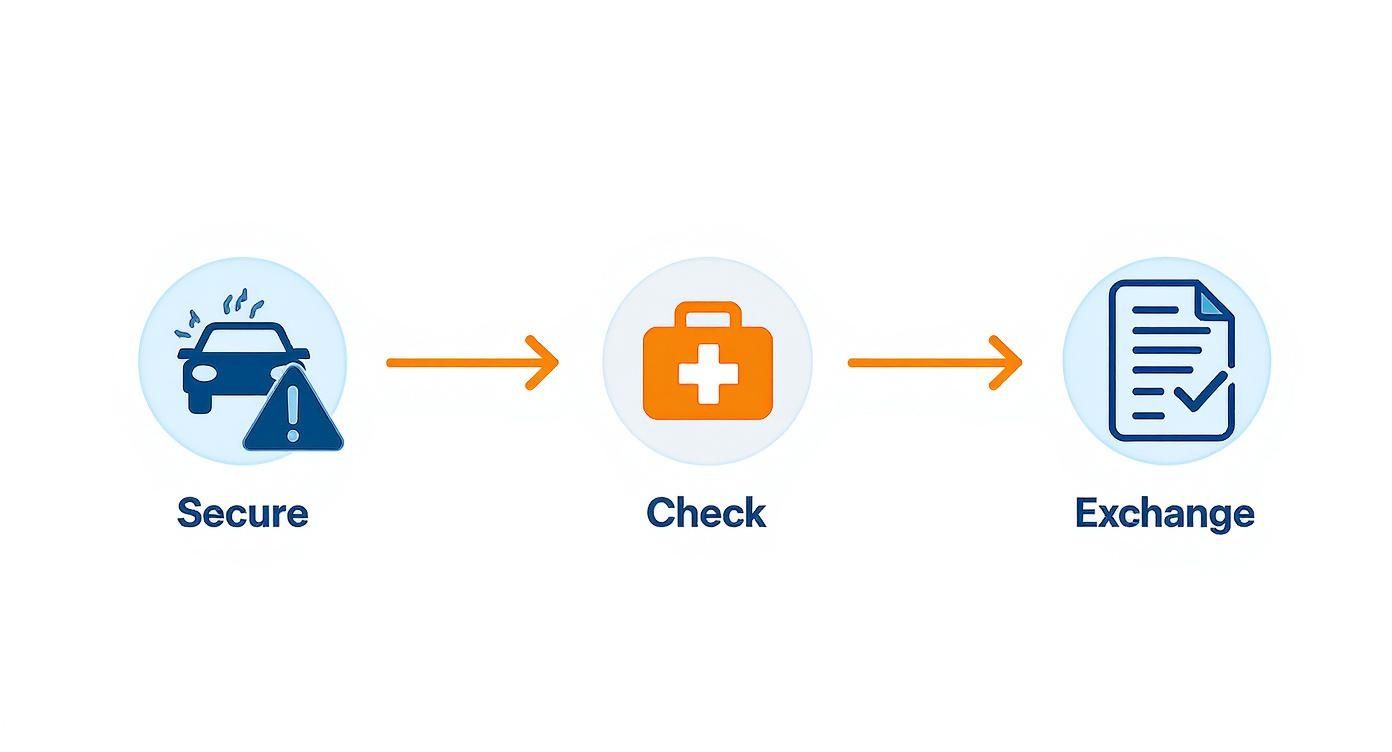
It boils down to a simple, three-part response: secure the area, check for injuries, and then exchange all the necessary information as required by law.
To help you stay focused during a stressful time, here's a quick checklist of what to do at the scene.
Immediate Actions Checklist for Florida Drivers
Priority Action | Why It's Important | Key Details to Note |
|---|---|---|
Move to Safety | Prevents secondary accidents and complies with Florida law for minor crashes. | Move to a shoulder or nearby lot. Turn on hazard lights immediately. |
Check for Injuries & Call 911 | Health and safety are the top priority. A 911 call summons medical and police aid. | Report any pain, even if minor. Don't move seriously injured people. |
Exchange Information | Legally required in Florida and essential for insurance claims. | Get name, address, phone, license #, registration, and insurance info. |
Document the Scene | Creates a visual record for insurance adjusters and legal proceedings. | Take photos of vehicle damage, positions, skid marks, and surroundings. |
Be Careful What You Say | Prevents accidental admission of fault that can be used against you later. | Avoid saying "I'm sorry" or "It was my fault." Stick to factual statements. |
Following these steps provides a solid foundation for handling the aftermath and protecting your interests.
What To Say And What To Avoid
This is a big one. While you have to cooperate, you also have to be very careful with your words. Do not admit fault. Avoid saying things like "I'm so sorry," or "That was my fault," even if you think you made a mistake. Those simple words can be twisted and used against you when the insurance companies get involved.
Stick to the facts. When you talk to the other driver or the police officer, just describe what happened from your point of view. Don't guess, don't speculate, and don't blame anyone. Your only job at that moment is to exchange information and document what you see.
Knowing your responsibilities is half the battle. You can dive deeper into the specific legal obligations after a car accident in Florida in our complete guide. For a great overview of the entire process from start to finish, this resource on What To Do After a Car Accident is incredibly helpful. Being prepared can make all the difference in handling the situation correctly and avoiding costly mistakes.
Common Causes and Legal Consequences
Car accidents in Florida don't just happen. They’re almost always triggered by a specific action—or inaction—and every cause brings its own legal headache. It's crucial to understand how a simple mistake behind the wheel can quickly spiral into a serious legal problem.
Driver behavior is, without a doubt, the biggest factor in most crashes. Whether it's a momentary lapse in focus or a blatant disregard for safety, the choices we make on the road have real, lasting consequences. These aren't just abstract numbers; they are real-world events with very tangible legal outcomes.
This is a massive issue on a global scale. Shockingly, road accidents are a leading cause of death worldwide, claiming approximately 1.19 million lives every single year. That statistic from the World Health Organization really underscores just how important responsible driving is.
From Simple Tickets to Serious Charges
A lot of accidents stem from basic traffic violations. These might seem minor at first, but they can easily cause a collision, land you a citation, and start racking up points that hike your insurance rates.
Common mistakes that end with a ticket include:
Distracted Driving: This is so much more than just texting. Fiddling with the radio, grabbing a bite to eat, or getting deep into a conversation can take your attention off the road just long enough for a crash to happen. The ticket you get is usually for careless driving.
Speeding: Going over the speed limit cuts down your reaction time and makes any impact far more severe. And the penalties climb right along with your speedometer.
Failure to Yield: This is a classic cause of intersection T-bones and fender benders. Drivers who don't give the right-of-way at stop signs, lights, or when making a left turn are almost always found at fault.
Following Too Closely: Tailgating is the reason for nearly every rear-end collision. Florida law is clear: you have to leave a safe cushion of space between you and the car ahead.
Beyond driver error, things like poor vehicle maintenance can also play a role. For any company car, properly managing fleet maintenance expenses isn't just about the bottom line—it's a critical safety obligation.
When an Accident Becomes a Criminal Offense
Some actions are so dangerous they push a traffic incident over the line from a civil infraction into a serious criminal case. These charges come with the threat of huge fines, a revoked license, and even jail time.
A traffic violation turns criminal when a driver's actions show a willful and wanton disregard for the safety of others. It’s the difference between a mistake and a dangerous choice.
That legal line gets crossed in a few key situations:
Driving Under the Influence (DUI): If an accident happens and the driver is impaired by alcohol or drugs, they're facing criminal DUI charges on top of any traffic tickets. In Florida, a DUI that involves property damage or injury is a felony.
Reckless Driving: This is a big step up from careless driving. We're talking about operating a vehicle with a willful disregard for safety, like weaving through traffic at high speeds. When this behavior causes an accident, the penalties are severe. Our guide offers a closer look at what constitutes reckless driving in Florida and what's at stake.
Hit-and-Run (Leaving the Scene of an Accident): Florida law demands that you stop and help after any accident involving property damage, injury, or death. Fleeing the scene is a major crime, with penalties that range from a second-degree misdemeanor to a first-degree felony, all depending on how bad the crash was.
Understanding the potential legal fallout is the first step. The ticket you get from the officer at the scene is just the beginning. A strong defense aims to tackle that citation head-on. Our goal is to protect your license and record from the long-term financial and legal pain of a car accident. Past results do not guarantee future outcomes.
Navigating Florida's No-Fault Insurance System
Once the shock and chaos of a car accident scene fade, you're left with the often-baffling world of insurance claims and official reports. Florida has its own unique way of handling these things, and it can be a real headache to figure out, especially when you're already stressed. Getting these next steps right is absolutely critical to protect yourself and get the benefits you're owed.
Florida is a “No-Fault” insurance state, a concept that trips a lot of people up. All it really means is that your own car insurance is the first place you turn for your medical bills, no matter who actually caused the crash.
The whole point of this system is to get you paid for your injuries faster, without having to wait for a lengthy investigation to decide who was at fault.
Understanding Your Personal Injury Protection Coverage
The engine of Florida's no-fault system is something called Personal Injury Protection, or PIP. Every single driver in Florida is required by law to carry at least $10,000 in PIP coverage. This is the money you'll tap into first to cover your medical care and some of your lost income after an accident.
Here’s what PIP is designed to handle:
80% of your initial medical bills—think ambulance rides, ER visits, and the first round of follow-up appointments.
60% of your lost wages if you're too injured to go back to work.
A $5,000 death benefit in the worst-case scenario.
It’s crucial to know that PIP covers you, any relatives living with you, anyone you let drive your car, and even passengers in your vehicle who don’t have their own PIP. Again, this kicks in regardless of who was at fault.
The Critical 14-Day Rule for Medical Treatment
This is one of the most important, time-sensitive rules you need to know about Florida’s no-fault law: you must get initial medical treatment within 14 days of the accident. If you wait until day 15, your insurance company can legally refuse to pay your claim, sticking you with the entire bill.
This 14-day window isn't a suggestion; it's a hard deadline. Even if you think you’re fine, get checked out. Adrenaline is a powerful painkiller and can easily mask serious injuries right after a crash.
This rule shows just how important it is to act quickly. The financial fallout from an accident is about more than just a dented bumper. Globally, road crashes cost most countries around 3% of their GDP every year, a number that factors in medical expenses and lost productivity. Somewhere between 20 and 50 million people are injured in non-fatal accidents annually, with many suffering from long-term disabilities.
When You Must Report an Accident to the Police
Not every little tap in a parking lot needs a police report, but Florida law is crystal clear about when you have to call them. You are legally required to report a crash right away if it involves:
Any injuries or death, no matter how minor they seem at the time.
A hit-and-run, where the other driver takes off.
An impaired driver who seems to be on drugs or alcohol.
A commercial vehicle (like a semi-truck or delivery van).
Serious property damage that makes a vehicle undrivable.
When in doubt, just make the call. Having an official police report creates an unbiased, third-party account of what happened, and that document can be priceless when you file your insurance claim.
Talking to your own insurance company is the next vital step. Report the crash as soon as you can, but stick to the basic facts. Don't guess about who was at fault or offer up extra information they haven't asked for. It's also smart to understand how a ticket or being found at-fault can jack up your rates; you can learn more about insurance rate increases in our detailed guide. Handling these conversations carefully from the start helps make sure your claim goes through smoothly and you're treated fairly.
How Accident Tickets Impact Your Driving Record
After the initial shock of a car accident wears off, a different kind of worry often sets in: the traffic ticket. That little piece of paper an officer hands you is more than just an upfront fine—it's the first domino to fall in a chain that can affect your driving privileges and your bank account for years.
To protect your record, you first have to understand how that citation connects directly to Florida's points system.
Every moving violation in Florida has a point value, and they act like black marks on your license. The more serious the mistake, the more points you rack up. Tickets issued after an accident tend to carry a heavy weight.
The Florida Points System Explained
Think of your driving record as a clean slate. When you're convicted of a moving violation, the Florida Department of Highway Safety and Motor Vehicles (FLHSMV) adds points. Insurance companies watch these points closely and use them as a primary reason to hike your premiums, often for several years.
Here are a few common tickets handed out after a crash and the points they carry:
Careless Driving: This is probably the most common citation after an accident, and it will add 3 points to your license.
Failure to Yield the Right-of-Way: A frequent cause of intersection T-bones, this violation also adds 3 points.
Running a Red Light or Stop Sign: If the police determine this caused the wreck, you're looking at 4 points.
Leaving the Scene of an Accident (with property damage): Fleeing a crash is a huge mistake that comes with 6 points.
These points add up. If you hit a certain number in a specific timeframe, the state steps in and automatically suspends your license. For a complete breakdown of the system, check out our guide on the Florida points system on your license.
License Suspension Thresholds
The FLHSMV takes repeat offenses seriously. The system is designed to get drivers with a pattern of violations off the road, and it’s all based on simple math.
Here’s how the suspensions work:
12 points within 12 months = 30-day suspension.
18 points within 18 months = 3-month suspension.
24 points within 36 months = 1-year suspension.
A single ticket from one accident might not seem like a big deal, but if you've already got some points on your record, it could be the one that puts you over the limit. That's exactly why seeking a defense for every single citation can be so critical.
The Traffic School Option
For many common tickets, Florida law gives you an out: you can choose to attend a driver improvement course, what most people just call traffic school. Finish the course, and you can sidestep getting points on your license for that ticket. It’s a great way to keep your record clean and your insurance agent happy.
Important Limitation: Traffic school isn't a get-out-of-jail-free card you can play every time. You can only use this option once in any 12-month period and only five times in your entire life.
Deciding to use your traffic school election is a strategic move. You have to make the choice when you pay the fine. If your record is spotless and you got a minor ticket, it’s probably a good play. But if the accident was messy or the citation is serious, there may be better ways to defend yourself.
At the end of the day, a traffic ticket from a car accident is just the beginning. It kicks off a process that directly threatens your driving record through the points system, which in turn hits your insurance rates and your legal ability to drive. Our practice focuses on analyzing the situation and building a defense with the goal of protecting your license. Past results do not guarantee future outcomes.
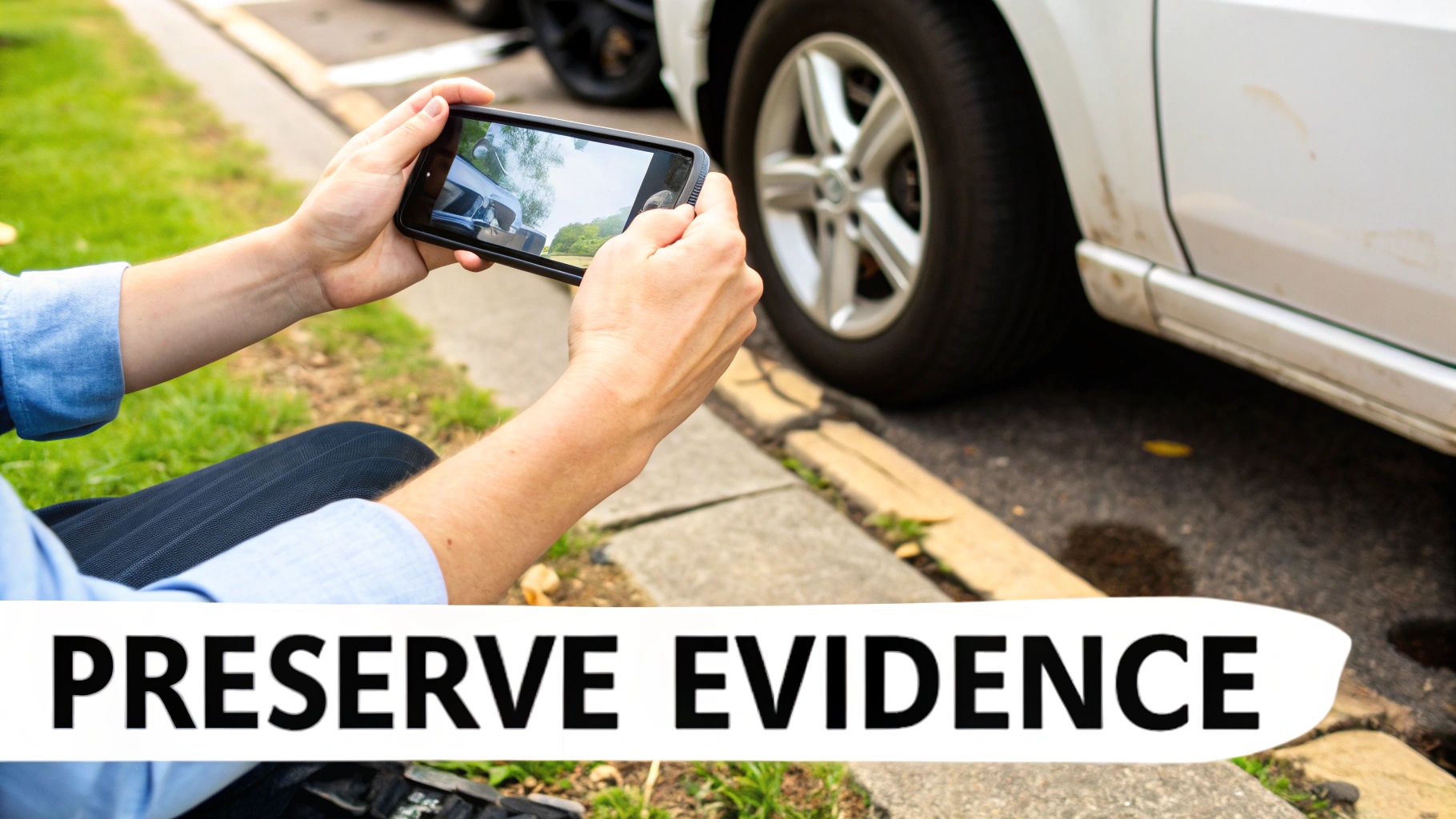
Preserving Evidence for Your Defense
If you get a traffic ticket after a car accident, the evidence you gather right there at the scene becomes the bedrock of your entire defense. What you do in those first chaotic moments can literally change the outcome of your case. Being proactive and thorough is the single most powerful thing you can do to protect yourself.
Think of yourself as the first investigator on the scene. Your smartphone is your best friend here. Take way more photos and videos than you think you need—you can never go back in time to get another shot. A well-documented scene provides the hard facts needed to challenge a citation.
Capturing the Scene with Your Camera
They say a picture is worth a thousand words, and in traffic court, that's an understatement. Photos give the judge an unbiased, visual record of what really happened, which is always more powerful than trying to remember details weeks later.
Here's what you need to capture:
Vehicle Positions: Before a single car is moved, snap pictures of where they came to a rest. Get every angle—front, back, and both sides of each vehicle.
Property Damage: Now get close. Take detailed shots of every dent, scratch, and broken part on your car and the other vehicles involved. No detail is too small.
The Big Picture: Step back and take wide shots of the entire intersection or road. This shows the context—traffic signs, stoplights, and lane markings are all crucial.
Road Conditions: Look down. Was the road wet from rain? Were there potholes, loose gravel, or fresh skid marks on the pavement? Document it.
These images create a visual timeline that can back up your side of the story and poke holes in any mistakes made in the official police report.
Documenting More Than Just Vehicle Damage
The scene is more than just twisted metal. Other bits of information that seem minor at the time can become the key to your defense down the road.
First, always look for witnesses. If anyone saw what happened, politely ask for their name and phone number. An impartial, third-party account can be incredibly persuasive in court. They might have noticed something you missed, like the other driver looking at their phone.
Next, write it all down. As soon as you can, jot down everything you remember.
Create a detailed, written account of the incident while it's still fresh in your mind. Note the time of day, the weather conditions, the direction you were traveling, and a step-by-step description of what occurred. Your immediate recollection is your most accurate one.
This personal statement is invaluable when you discuss the case with your attorney. For instance, if you were in a crash and the other driver took off, having this detailed account is critical. You can learn more about how to defend against a leaving the scene of an accident charge and see just how vital this evidence becomes.
The Role of the Police Report
The police report is a huge piece of the puzzle, but it’s not infallible. Remember, the officer usually shows up after everything is over and has to piece together the story from what people say and what they see. And sometimes, they get it wrong.
Your evidence—the photos, the witness info, and your own written notes—is what we use to cross-check that report for mistakes. If the officer's diagram doesn't match your photos, or if their narrative completely ignores a key detail a witness told you, those inconsistencies can be used to build a powerful defense. Our goal is to use your evidence to paint the most accurate picture of what happened and protect your driving record.
When to Contact a Traffic Defense Attorney
So, you've been in an accident and now you’re holding a ticket. The first question that pops into most people’s heads is, “Do I really need a lawyer for this?” It’s tempting to just pay the fine and move on, but that’s often a short-term fix with long-term consequences.
The real cost of a ticket isn't just the number printed on it. It’s the points on your license, the skyrocketing insurance premiums, and the risk to your driving privileges down the road. Deciding whether to fight it is a big deal, and knowing when to call in a professional can save you a lot of trouble.
Our practice focuses on traffic and DUI defense, and we handle criminal traffic matters across Florida. We've seen firsthand how a seemingly minor ticket can snowball. Our goal is to help good people navigate a complicated system.
Scenarios That Warrant a Legal Consultation
While any ticket can have an impact, some situations practically demand a call to a traffic defense attorney. These are the cases where the stakes are simply too high to go it alone.
You should seriously consider getting legal advice if the accident led to any of these citations:
Serious Moving Violations: We're talking about things like reckless driving or leaving the scene of an accident. These aren't just tickets; they can be criminal charges with severe penalties.
Driving Under the Influence (DUI): If a DUI is involved in your accident, stop what you’re doing and call an attorney. This is a serious criminal offense, and you need to understand your rights immediately.
Accidents Involving Injuries or Major Damage: When people get hurt or property is seriously damaged, the legal and financial liability can be enormous. A strong defense is critical to protect yourself.
Risk of License Suspension: Are you already close to the point limit? If this new ticket is the one that could push you over the edge and get your license suspended, fighting it is your top priority.
In these situations, the legal maze gets a lot more complex, and trying to find your way through it without a guide is a risky gamble.
Understanding the Free Consultation Process
We believe everyone deserves to know their options without having to open their wallet first. That’s why we offer a completely free consultation to go over the details of your case. It’s a straightforward conversation where you tell us what happened, and we give you an honest take on your situation.
During our chat, we’ll look at your ticket, listen to the circumstances of the crash, and talk through the defense strategies that might work for you. Our goal is to give you the clarity you need to decide what’s best for you.
It's a no-pressure way to get real information.
Confidentiality Notice: Submitting information through our online forms or engaging in an initial consultation does not create an attorney-client relationship. This confidential review is designed to give you the information you need to make a smart decision.
Our mission is simple: our goal is to protect your license and record. While no attorney can guarantee a specific outcome, having a solid defense gives you the best shot at avoiding the worst consequences. The first step is always the most important one—get informed.
Frequently Asked Questions About Florida Car Accidents
After a car accident, your head is probably swimming with questions. It's a stressful, confusing time for anyone. We've put together answers to some of the most common things we hear from Florida drivers. Keep in mind, this is for general guidance—for advice on your specific situation, it's always best to talk to a licensed attorney.
What Should I Do If I Am in a Minor Accident With No Injuries?
Even for a minor fender-bender, the first steps are always the same: pull over somewhere safe, swap information with the other driver, and snap pictures of the damage to both cars.
You might think you don't need to call the police if the damage looks like it's under $500 and no one's hurt. But getting an official police report is almost always a smart move. That report creates an unbiased record of what happened, which becomes incredibly valuable if the other driver suddenly changes their story or claims they were injured days later.
Do I Have to Report the Accident to My Insurance Company?
Yes, absolutely. No matter how small the accident seems, you should let your insurance provider know. Most policies actually require you to report any incident, and failing to do so could give them an excuse to deny your claim down the road.
When you make the call, just stick to the facts. Don't guess about what caused the crash or admit fault. Simply tell them an accident occurred and provide the basic details.
Can I Still Be Ticketed If the Other Driver Was At Fault?
It can be a frustrating surprise, but yes, you can get a ticket even if you're certain the other driver caused the crash. The officer at the scene has to make a judgment call based on what they see and hear right then and there. Sometimes, they might conclude that both drivers played a role in the accident.
Important Note: Getting a ticket doesn't automatically make you 100% at fault in the eyes of the insurance companies. The ticket is a separate legal issue, and you have every right to fight it in traffic court.
It's also interesting to see how risk plays out on a larger scale. Global traffic data shows some clear patterns—for instance, men account for three out of every four road traffic deaths worldwide. Statistics like these highlight how different groups can face very different levels of risk. You can learn more about these global road safety statistics.
If you were ticketed after a car accident in Florida, don't just accept the points and the insurance hike that comes with them. The team at Ticket Shield, PLLC is here to look at what happened and build a defense for you. Get in touch for a free, no-pressure consultation to learn about your options.