
Florida DUI Checkpoint Legality Explained
Understand Florida's DUI checkpoint legality. This guide explains your rights, the strict rules police must follow, and what to do if you're stopped.
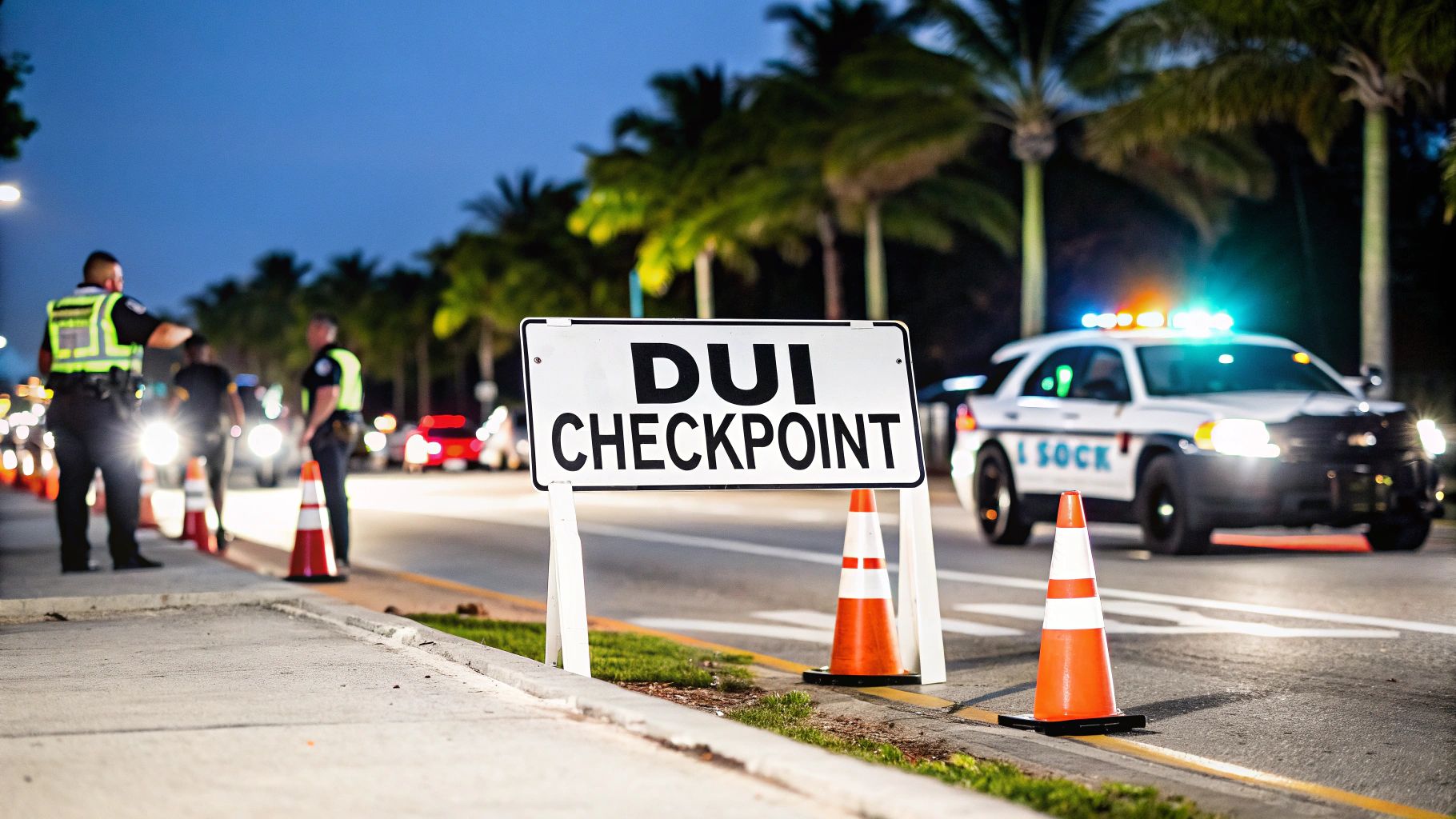
Yes, DUI checkpoints are legal in Florida, but there’s a significant caveat: law enforcement has to follow a very strict set of rules. Their legality isn't a given. It all comes down to whether the police stick to the court-mandated procedures designed to protect your constitutional rights.
Understanding DUI Checkpoint Legality in Florida
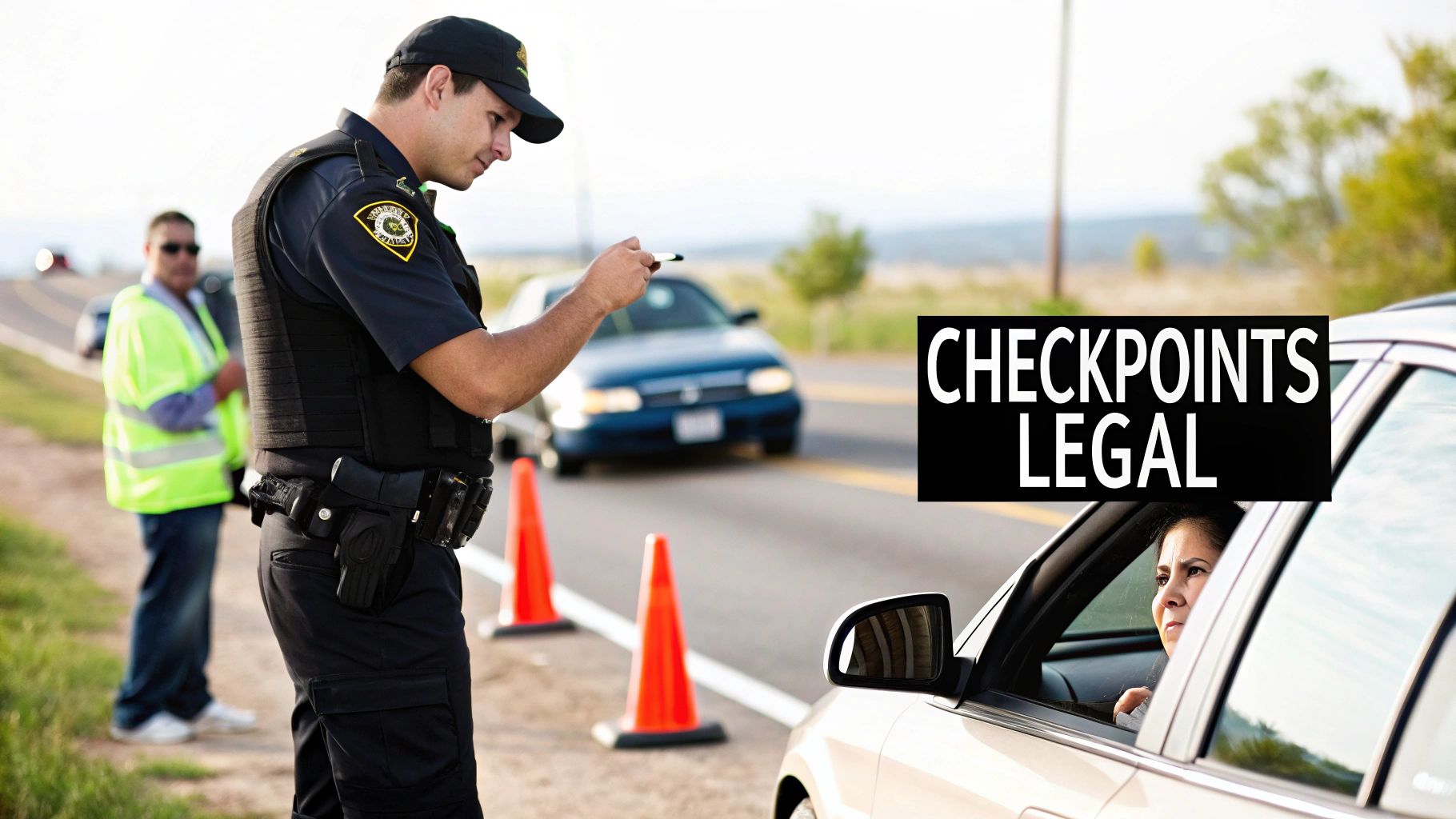
You’re driving down a Florida road at night, and suddenly you see flashing lights and a line of cars being waved through by officers. It’s a sobriety checkpoint, a unique and often confusing exception to the rights we usually take for granted. Understanding the legality of DUI checkpoints is something every Florida driver should know.
At its core, the issue pits two powerful forces against each other. The Fourth Amendment of the U.S. Constitution protects us from unreasonable searches and seizures. Normally, this means an officer needs a good reason—what the law calls "probable cause"—to pull you over.
But the U.S. Supreme Court has carved out a narrow exception. They’ve decided that the government's interest in getting drunk drivers off the road is so compelling that it can sometimes justify these brief, suspicionless stops. A DUI checkpoint is considered a seizure, but it can be found "reasonable" and therefore legal, but only if it meets very specific criteria.
The Ground Rules for a Legal Checkpoint
For a Florida DUI checkpoint to hold up in court, it can't just be a random idea from an officer on patrol. It must be conducted in a way that limits the inconvenience to drivers and, crucially, removes any opportunity for an officer to single someone out based on a whim.
The entire stop's legality rests on these key principles:
There Must Be a Written Plan: The checkpoint can't be set up on the fly. It has to follow a detailed, written plan that's been approved by a supervising officer ahead of time.
A Neutral Stopping Pattern is Required: Officers can’t just pick and choose which cars look suspicious. They must follow a fixed, neutral formula, like stopping every third car or every fifth car that comes through.
It Must Be Safe and Visible: The checkpoint needs to be clearly marked with signs and be well-lit. The goal is to warn drivers in advance and operate the stop safely to avoid causing accidents.
The Detention Must Be Brief: The initial stop should be quick. Officers can't hold you for a long time unless they develop a reasonable suspicion that you are actually impaired.
To give you a clearer picture, here’s a quick breakdown of what the police must do to keep a checkpoint on the right side of the law.
Quick Guide to Florida DUI Checkpoint Rules
Legal Requirement | What Police Must Do | Why It's Important for Your Rights |
|---|---|---|
Written Guidelines | Operate under a pre-approved, written plan from a supervisor. | Prevents random, arbitrary stops and ensures a standardized procedure. |
Neutral Formula | Stop vehicles using a non-discriminatory pattern (e.g., every 3rd car). | Removes individual officer discretion and the potential for profiling. |
High Visibility | Use clear signage, lights, and uniformed officers to warn drivers. | Ensures you know it's an official stop and can approach safely. |
Minimal Intrusion | Keep the stop as brief as possible to check for signs of impairment. | Balances public safety with your right to not be unreasonably delayed. |
Supervisory Oversight | Have a commanding officer on-site to ensure rules are followed. | Adds a layer of accountability and helps enforce the written plan. |
If law enforcement fails to check these boxes, any evidence they collect—from a breathalyzer result to their own observations—could be thrown out in court. An improperly run checkpoint is a violation of your rights, and it can become the cornerstone of a strong defense.
To learn more about how checkpoint procedures can impact a case, see how our firm approaches DUI defense in Florida. In this guide, we'll dive deeper into these rules so you know exactly what your rights are.
The Constitutional Basis for Sobriety Checkpoints
On the surface, a DUI checkpoint seems to fly in the face of our most basic rights. The Fourth Amendment is clear: it protects us from "unreasonable searches and seizures." Usually, that means law enforcement needs a specific reason—what we call reasonable suspicion or probable cause—to pull a driver over.
So, how is it legal for police to stop every car, or every third car, without any suspicion at all? It’s a significant question, and the answer involves a delicate balancing act between your individual freedom and the state's very real interest in keeping the roads safe.
The Fourth Amendment and the General Rule
Think of the Fourth Amendment as a shield. For an officer to get past that shield and stop you, they typically need to witness a clear traffic violation, like you speeding or blowing through a stop sign. That's the standard for almost every other police stop on the road.
A DUI checkpoint is a completely different animal. By its very nature, it's a "seizure" of every single driver who gets stopped, even if it’s just for 30 seconds. The whole legal debate boils down to one word: is that seizure reasonable? This is where the U.S. Supreme Court had to weigh in and draw some lines in the sand.
Michigan v. Sitz: A Landmark Decision
The legal framework for every sobriety checkpoint in America today was built on one pivotal case from 1990: Michigan Department of State Police v. Sitz. The U.S. Supreme Court handed down a decision that DUI checkpoints are, in fact, constitutional—but only if they follow a strict set of rules designed to minimize how much they interfere with drivers' lives.
This case gave states the green light to set up checkpoint programs, though not every state has. You can learn more about how this ruling has been applied nationwide from the CDC's analysis of checkpoint effectiveness.
The Court’s logic rested on a three-part balancing test:
The State's Interest: The Court recognized the government's massive and legitimate interest in preventing the devastation caused by drunk driving.
Effectiveness: It decided that checkpoints are a reasonably effective way to combat that danger.
The Level of Intrusion: Finally, the Court said that when a checkpoint is run correctly, the brief, standardized stop is only a "slight" intrusion on the driver.
In the end, the Court weighed the immense public danger of drunk driving against the minor inconvenience to motorists and found that the scales tipped in favor of public safety. That's what makes the "seizure" legally "reasonable."
What Makes a Checkpoint Different
This ruling created a very narrow exception to the Fourth Amendment. It absolutely does not give police free rein to set up roadblocks for any reason.
The most important takeaway is this: a checkpoint's legality hinges on removing an individual officer’s discretion. Unlike a routine traffic stop where an officer decides who to pull over, a checkpoint has to follow a pre-approved, neutral plan, like stopping every single car or every fifth car.
This isn't just a suggestion; it's a rigid requirement. The whole point is to prevent profiling or bias. Officers can't stop you based on a hunch, the kind of car you drive, or anything else. The entire operation is only legal if it strictly adheres to this structured, impartial process—a process that Florida courts have since taken and refined with their own set of non-negotiable state rules.
Florida's Mandatory Rules for DUI Checkpoints
For a DUI checkpoint to even be considered legal, it has to operate within a very tight, strictly defined framework. That balancing act the courts talk about isn't just some abstract legal theory; it translates into a concrete list of rules that law enforcement in Florida must follow to the letter.
Think of it this way: a checkpoint's legality isn't a given. It has to be earned through rigid compliance with these guidelines.
These rules aren't just helpful suggestions. They are non-negotiable requirements hammered out in Florida courtrooms to make sure checkpoints are used for public safety, not as a way for police to randomly exercise their power. If law enforcement breaks even one of these crucial rules, it can throw the legality of the entire operation into doubt—and that's often where a solid DUI defense begins.
The Blueprint for a Lawful Stop: The Written Plan
Long before the first cone hits the pavement, a legal DUI checkpoint has to start on paper. Police can't just decide to set up a roadblock on a whim. The entire operation must be guided by a comprehensive written plan or a clear set of operational guidelines.
This plan has to be signed off on by a supervisor—someone who isn't actually working the roadblock. This is a critical step because it takes the decision-making out of the hands of the officers on the scene. It ensures the checkpoint is serving a legitimate law enforcement goal, not just an individual officer's impulse.
The infographic below shows how this all connects, from the highest law in the land down to the practical rules police have to follow on the street.
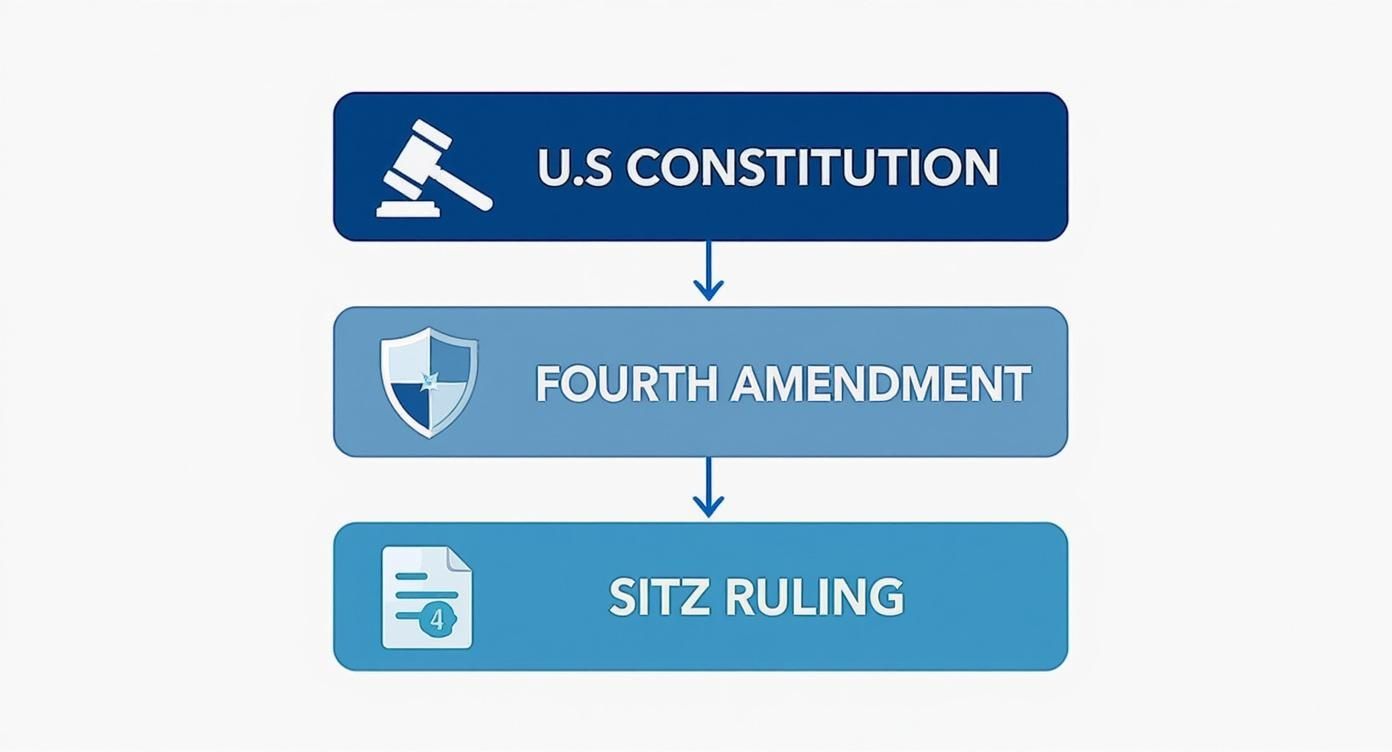
As you can see, every single rule—from having a written plan to using proper signage—is a direct result of the constitutional rights we all share.
Checklist for a Lawful Florida DUI Checkpoint
To make these requirements crystal clear, we've broken them down into a simple checklist. Florida courts look for these specific elements to determine if a checkpoint was conducted properly. If any of these were missing or ignored, it could be a major issue for the prosecution's case.
Requirement | Description | Why It Matters |
|---|---|---|
Written Plan | The entire operation must follow a detailed, pre-approved written plan. | Prevents on-the-spot, arbitrary decisions by officers in the field. |
Supervisor Approval | A high-level supervisor, not an officer working the checkpoint, must approve the plan. | Ensures oversight and accountability from law enforcement leadership. |
Neutral Stopping Formula | Cars must be stopped based on a neutral, mathematical pattern (e.g., every 3rd car). | Eliminates officer discretion, profiling, and bias in who gets stopped. |
Data-Driven Location | The checkpoint's location must be justified by data showing a history of DUI incidents there. | Proves the checkpoint serves a real public safety purpose, not just convenience. |
High Visibility | The area must be well-lit, with marked police cars and uniformed officers clearly visible. | Guarantees drivers aren't taken by surprise and ensures officer and public safety. |
Advance Warning/Signage | Clear signs must be posted far enough ahead to warn drivers of the upcoming checkpoint. | Gives motorists fair notice and reduces the "fear and surprise" factor. |
Minimal Detention Time | The initial stop must be brief, lasting only long enough to check documents and look for impairment. | Upholds your Fourth Amendment right against unreasonable seizure by minimizing the intrusion. |
Safety Precautions | The setup must be designed to ensure the safety of officers, drivers, and the general public. | An unsafe checkpoint is an unreasonable one. |
Any deviation from this checklist isn't just a minor slip-up; it's a potential violation of the constitutional standards that make these stops permissible in the first place.
The No-Profiling Rule: The Stopping Formula
Perhaps the most important rule protecting your rights at a checkpoint is the requirement of a neutral, non-discriminatory formula for stopping cars. Officers can't just pick and choose who to pull over based on a hunch, the car you drive, or what you look like.
The approved written plan must lay out the exact formula. Common examples you might see are:
Stopping every single vehicle.
Stopping every third car that comes through.
Stopping every fifth car.
This purely mathematical system is designed to take bias and profiling completely out of the equation. The goal is a systematic, predictable process where every driver is treated exactly the same way under the rules.
If officers start bending the rules—say, by waving through a line of expensive cars but deciding to stop an older one that wasn't next in the sequence—they've just created a huge legal problem for their case and a powerful angle for your defense.
Safety First, Intrusion Last
Finally, a legal checkpoint has to be run in a way that keeps everyone safe and keeps the hassle for drivers to an absolute minimum. This breaks down into a few key components.
1. No Surprises: High Visibility and Clear Signs You should never be caught off guard by a DUI checkpoint. Police have to give you fair warning. This includes:
Clear Signs: Big, easy-to-read signs announcing the checkpoint must be placed far enough in advance for you to see them and prepare to slow down.
Good Lighting: The entire area needs to be well-lit, so both you and the officers can see clearly.
Visible Police Presence: Officers must be in uniform, and you should see marked patrol cars.
2. Smart Location: Following the Data The location for the checkpoint can't be chosen at random. The written plan must explain why that specific spot was chosen, using data like a history of drunk-driving accidents or DUI arrests in that area. This proves the checkpoint is placed where it's most needed, not just where it's easy for the police to set up.
3. Keep it Brief: Minimizing Detention Time The initial stop has to be quick. The whole point is a fast check for signs of impairment, not a full-blown investigation. The delay should only last as long as it takes for the officer to ask for your license and registration and make a quick observation. If the officer sees nothing to suggest you're impaired, you must be allowed to leave without any further delay. Dragging it out without a valid reason is a potential violation of your Fourth Amendment rights.
An arrest that comes from a checkpoint that cut corners on these rules may be unlawful. At TicketShield, our practice focuses on DUI defense, and we know how to scrutinize every detail of a checkpoint's procedure. An experienced attorney can pull the department's written plan, review the reports, and find out if your rights were violated. Remember, past results do not guarantee future outcomes, but a defense that examines every angle is absolutely critical. Our goal is to protect your license and record.
Navigating Your Rights at a DUI Checkpoint Stop
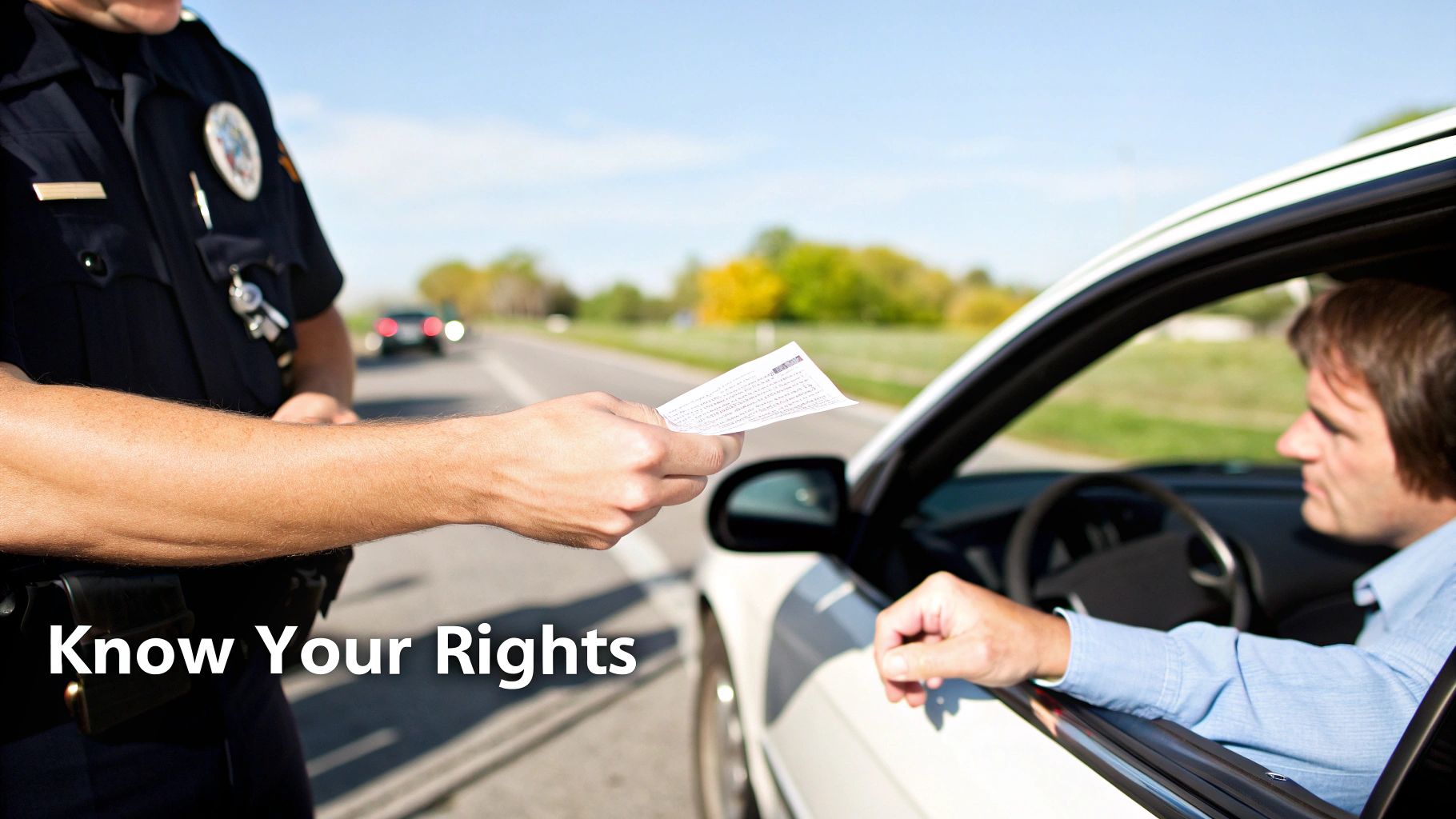
Seeing those flashing lights up ahead can make anyone's heart race. A DUI checkpoint is designed to be intimidating, but your most powerful tool in this situation is simply knowing your rights. The key is to stay calm, protect yourself, and get through the stop without making things worse.
When an officer walks up to your window, you need to remember one critical distinction: you are required to comply with lawful commands, but you are not required to incriminate yourself. It’s a fine line, but it’s an important one.
You absolutely must provide your driver’s license, registration, and proof of insurance if asked. Refusing to hand those over will only get you a separate ticket. But once that's done, your obligations start to look very different.
The Right to Remain Silent
The officer will almost certainly try to start a casual conversation. You'll hear questions like:
"Where are you coming from tonight?"
"Have you had anything to drink?"
"Where are you headed?"
These aren't just friendly chit-chat; they're investigative questions designed to gather evidence against you. You have a constitutional right not to answer them.
You can decline politely and respectfully. Something as simple as, "Officer, I prefer to exercise my right to remain silent, but I am happy to provide my license and registration," works perfectly. The goal is to be firm, not confrontational.
Field Sobriety Exercises Are Voluntary
If the officer suspects you’ve been drinking, they'll likely ask you to get out of the car to perform Field Sobriety Exercises (FSEs). We've all seen them on TV—the walk-and-turn, the one-leg stand, and the eye-tracking test.
Here's what they don't always tell you: in Florida, these tests are voluntary. You can, and often should, politely refuse. FSEs are notoriously subjective and are tough for anyone to pass perfectly, especially on the side of a road at night. Nerves, medical issues, or even uneven pavement can make you look impaired when you're not.
Saying no to these exercises means you aren't giving the state subjective evidence to build a case. Just be aware, your refusal can still be noted and used alongside other observations (like slurred speech or the smell of alcohol) as a reason to arrest you.
Refusing a Breathalyzer Test: The Implied Consent Law
This is where things get tricky. Deciding whether to take a chemical test—like a breathalyzer—is a completely different ballgame from refusing FSEs. It comes with its own set of serious consequences because of Florida's implied consent law.
Simply by having a Florida driver's license, you have already legally agreed to take a chemical test if you are lawfully arrested for DUI.
Here’s how it breaks down:
Roadside Breathalyzer: Sometimes an officer will have a small, handheld breathalyzer at the scene. These are generally considered part of field sobriety testing, and their results are often inadmissible in court to prove intoxication. You can typically refuse this test without triggering the major penalties of the implied consent law.
Evidentiary Breathalyzer: This is the big one. It's the official test, done on a more accurate machine back at the station or in a mobile booking unit after you've been arrested. Refusing this test is what kicks the implied consent law into gear.
The consequences for refusing a post-arrest chemical test are administrative, meaning they happen automatically and are separate from any criminal DUI case:
First Refusal: Your driver's license is suspended for one full year.
Second or Subsequent Refusal: The suspension jumps to 18 months, and you can even be charged with a separate misdemeanor for refusing.
It puts you in a tough spot. Submitting could give the prosecutor the evidence they need, but refusing means you're guaranteed to lose your license for a long time. It’s crucial to understand these administrative penalties, which you can read more about in our guide on what happens after a DUI arrest.
Of course, the best strategy is prevention by making responsible driving choices from the start. But if you find yourself at a checkpoint, remember to stay calm, be respectful, and know exactly where the line is between lawful compliance and giving up your rights.
How to Challenge an Unlawful DUI Checkpoint Stop
An arrest at a DUI checkpoint does not have to be the end of the story. Because these stops are so unique, they often open up powerful ways for a skilled defense attorney to challenge the charges against you. The state's entire case is built on the dui checkpoint legality—if we can show that foundation is cracked, the whole thing can come tumbling down.
The primary legal tool used to fight these charges is a Motion to Suppress Evidence. This is a formal legal argument we make to the court, asking the judge to throw out any and all evidence the police gathered from the checkpoint stop because they violated your constitutional rights to get it.
If a motion to suppress is successful, any evidence from that moment forward—the officer's observations, your statements, even the breathalyzer results—gets tossed out. Without that evidence, the prosecutor is often left with an empty file and may be forced to drop the charges.
The Motion to Suppress Explained
Think of a Motion to Suppress like a legal shield. Its job is to block the prosecution from using tainted evidence against you. The logic is straightforward: if the police didn’t follow the incredibly strict rules for setting up and running a checkpoint, the stop itself was an illegal seizure under the Fourth Amendment.
From there, any evidence they collected is considered "fruit of the poisonous tree" and can't be used to convict you. This is exactly why a deep dive into the checkpoint's procedures is the cornerstone of any strong DUI defense. Our goal is always to protect your license and your record by making sure law enforcement is held to the highest legal standard.
Common Grounds for a Checkpoint Challenge
A good defense attorney will go through every single detail of the checkpoint's operation with a fine-tooth comb, looking for mistakes. Even minor deviations from the required guidelines can be enough to get the entire stop thrown out.
Here are some of the most common weak points we look for:
No Written Plan: If the police department can't show us a detailed, pre-approved written plan for the checkpoint, it might be unconstitutional right from the start.
Failure to Follow the Neutral Formula: The plan will say something like "stop every third car." If officers start picking and choosing who to pull over based on a hunch, the stop loses its impartial basis.
Inadequate Signage or Safety: Checkpoints have to be clearly marked with warning signs. If the lighting is poor or the setup is unsafe, it can make the stop legally unreasonable.
Lack of Supervisory Oversight: A supervising officer must be on-site, and the whole operation needs to have been approved by a supervisor beforehand. No supervisor, no valid checkpoint.
Improper Location Selection: The police can't just set up a checkpoint wherever they feel like it. The location has to be chosen based on data showing a history of DUI-related accidents or arrests.
A successful challenge doesn't just poke holes in the prosecutor's case—it can completely dismantle it. When the key evidence is suppressed, the state often has nothing left to stand on, potentially leading to a full dismissal of the DUI charge.
While checkpoints can be a tool for public safety, they have to be run perfectly. A meta-analysis showed that well-publicized sobriety checkpoint programs can significantly cut down on alcohol-related crashes. You can explore the data on checkpoint effectiveness to see why law enforcement still uses them despite the tight legal restrictions.
Keep in mind, a DUI charge also kicks off immediate administrative penalties, like a license suspension, that happen before your criminal case is decided. It's critical to fight this on a separate track. Past results don't guarantee future outcomes, but a complete defense strategy has to tackle both the criminal and administrative sides of your case.
Common Questions About Florida DUI Checkpoints
Even when you know the rules, driving up to a DUI checkpoint can be a nerve-wracking experience. Let's clear the air and tackle some of the most common questions we hear from Florida drivers. Keep in mind, this is for your general knowledge—it’s not a substitute for sitting down with an attorney about your specific case.
Can I Legally Turn Around to Avoid a DUI Checkpoint?
Yes, you can. Making a legal turn or a U-turn before you actually enter the checkpoint zone is perfectly within your rights. Simply avoiding the checkpoint isn't, by itself, a reason for an officer to pull you over.
But here’s the catch: police know this. They often have officers staged specifically to watch for cars that turn away. If you commit any traffic violation while making your exit—an illegal U-turn, forgetting to signal, or speeding up—they now have a completely separate and valid reason to stop you.
What starts as a simple traffic stop can quickly pivot into a full-blown DUI investigation if the officer notices anything that suggests impairment.
Do I Have to Perform Field Sobriety Tests at a Checkpoint?
No, you do not. In Florida, Field Sobriety Exercises (FSEs)—like the walk-and-turn, the one-leg stand, or the eye test (Horizontal Gaze Nystagmus)—are completely voluntary. You have every right to politely decline an officer's request to perform them.
It's crucial to understand the difference between these physical exercises and a chemical test (breath, blood, or urine). While you can say no to FSEs without an immediate penalty, refusing a lawful request for a chemical test after you've been arrested is a different story. Under Florida's implied consent law, that refusal triggers serious administrative consequences, including a long, automatic suspension of your driver's license.
Key Takeaway: You can refuse the voluntary physical tests without a direct penalty. But refusing a chemical test after you're arrested means your license is getting suspended—no questions asked.
How Are DUI Checkpoints Different from Saturation Patrols?
While both strategies aim to get impaired drivers off the road, they operate under completely different legal principles. It all comes down to the reason for the stop.
DUI Checkpoints: These are stationary roadblocks where officers stop drivers based on a predetermined, neutral pattern (like every third vehicle). The initial stop doesn't require any suspicion that you've done something wrong, but the entire operation has to follow strict procedural rules to be legal.
Saturation Patrols: This is when a large number of officers flood a high-DUI area. In this scenario, an officer must have reasonable suspicion or probable cause that you broke a law before they can pull you over. They can't just stop you randomly.
Put simply, a checkpoint stop is suspicionless but heavily regulated. A saturation patrol stop requires a specific, individual reason to single out your car.
Are Police Required to Announce Checkpoints in Advance?
While there's no hard-and-fast constitutional rule that says they must, Florida courts and best practices definitely lean toward publicizing checkpoints beforehand. The official goal, after all, is to deter drunk driving, not just to rack up arrests. Announcing the location and time helps achieve that deterrent effect.
If a law enforcement agency completely fails to provide any public notice, it could become a key point in a legal challenge. A defense attorney might argue that this failure made the checkpoint unreasonable, especially given the surprise and anxiety it can cause drivers. A lack of publicity could be one of several factors used to attack the overall dui checkpoint legality.
It's also important to grasp what a conviction could do to your life. To learn more, read our detailed guide on the consequences of a DUI in Florida. Understanding the stakes from day one will help you make smarter decisions.
Attorney Advertisement. The information provided here is for educational purposes only and not legal advice. Submitting information via our website form does not create an attorney-client relationship. All legal questions should be directed to a licensed attorney. Past results do not guarantee future outcomes. Office in Broward.
An arrest at a DUI checkpoint can throw your life into chaos, threatening everything from your license to your career. At Ticket Shield, PLLC, our practice focuses on DUI and traffic defense across Florida. We handle criminal traffic matters and dig into every detail of a checkpoint stop to make sure your rights were respected every step of the way. If you've been arrested, don't wait. Contact us for a free consultation to talk about your case and find out how we can help. Get Your Free Consultation Today.
