

Understanding The BAC Limit In Florida: A Complete Guide
What is the BAC limit in Florida? Our guide explains the 0.08%, 0.04%, and 0.02% limits, potential penalties, and how to approach a DUI charge.
In Florida, the key number for most drivers over 21 is a Blood Alcohol Concentration (BAC) of 0.08%. Exceeding that level means you are legally considered impaired. However, that is not the complete picture. The state enforces much stricter limits for commercial drivers and has a firm, zero-tolerance policy for anyone under 21.
Understanding The Legal BAC Limit In Florida
Navigating Florida's roads safely means knowing exactly where the state draws the line on drinking and driving. The BAC limit isn't a one-size-fits-all rule; it's actually three distinct thresholds designed for different types of drivers. These varying limits reflect the unique risks and responsibilities tied to each group, from everyday commuters to professional truckers and young drivers just starting out.
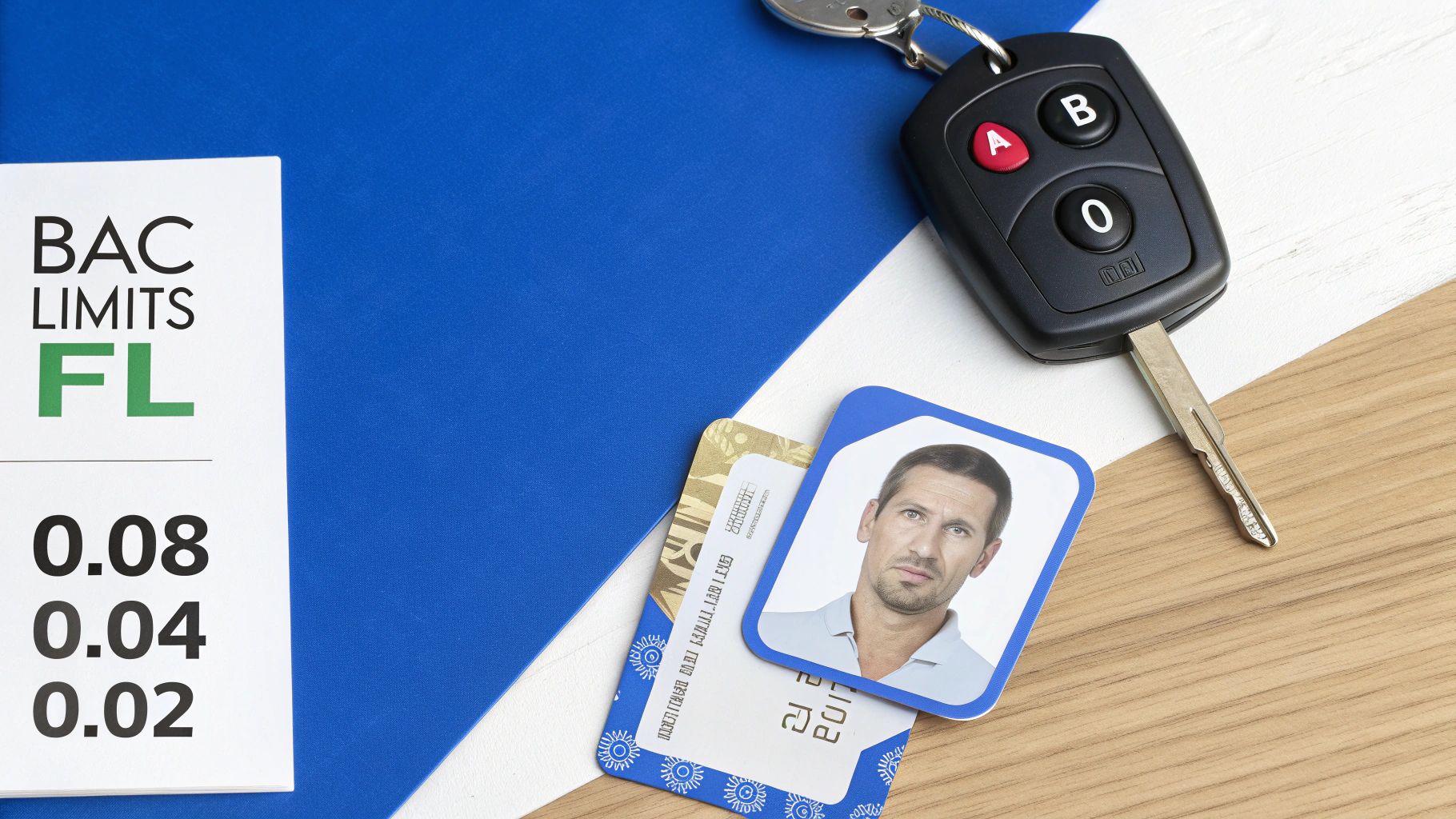
Different Limits For Different Drivers
The state sets these different BAC levels for one simple reason: public safety. While a standard driver over 21 is held to the 0.08% national standard, the law recognizes that some situations demand far more caution.
Commercial Drivers (0.04%): Anyone behind the wheel of a large truck, bus, or other commercial vehicle carries a significant responsibility. The lower 0.04% limit is a direct acknowledgment of the devastating damage an accident involving one of these vehicles can cause.
Drivers Under 21 (0.02%): Florida’s zero-tolerance policy for young drivers is designed to be strict. The 0.02% limit is so low that even a single beer or glass of wine could push a young driver over the legal line, triggering immediate and serious administrative penalties.
These specific limits are not arbitrary. They are part of a broader strategy to address a serious public safety issue. National data is clear: at a 0.08% BAC, the risk of a fatal crash increases significantly, especially for younger drivers. It's a stark reminder of the real-world dangers of impaired driving.
Your Quick Reference Guide
To keep it simple, here’s a quick breakdown of the legal BAC limits you absolutely need to know. Understanding these numbers is the first step in protecting your driving privileges.
Here's a quick summary to keep things clear.
Florida BAC Limits At A Glance
A quick summary of the legal Blood Alcohol Concentration (BAC) limits for different types of drivers in the state of Florida.
Driver Category | Legal BAC Limit | Key Consideration |
|---|---|---|
Standard Drivers (21+) | 0.08% | This is the national standard for non-commercial drivers of legal drinking age. |
Commercial (CDL) Drivers | 0.04% | This stricter limit applies whether the driver is on or off duty in a commercial vehicle. |
Underage Drivers (<21) | 0.02% | Florida’s zero-tolerance law means almost any detectable alcohol can trigger a penalty. |
Being charged for driving over the BAC limit in Florida can be a confusing and stressful experience. If you find yourself in this situation, it’s critical to understand the full range of potential consequences. Our firm's practice focuses on Florida DUI defense and is prepared to help you navigate every step of the legal process.
The 0.08 BAC Limit: What It Really Means for Florida Drivers
Every driver in Florida is familiar with the number: 0.08%. It’s the legal Blood Alcohol Concentration (BAC) limit that has been widely publicized. However, most people don’t truly understand what that number means in the real world. It’s not a simple drink-counting game; it's a scientific measure that is different for every individual.
This standard was not chosen at random. The 0.08% BAC limit became the national standard by 2004 after a major push from federal safety initiatives. Research clearly showed that this specific threshold is where the risk of a crash increases dramatically. Studies have found that drivers at 0.08% are significantly more likely to be in a fatal accident than sober drivers—for some, the risk is 7 to 10 times higher.
What’s Happening Inside Your Body?
Think of your body as a container of water. When you drink alcohol, it gets absorbed into your bloodstream and distributed throughout that water. Your BAC is a measurement of how much alcohol is concentrated in your blood at any given moment.
The important thing to remember is that no two "containers" are the same. This is where it gets personal and why common rules of thumb like "one drink per hour" can be dangerously misleading.
A common mistake is assuming that two people can have the same number of drinks and have the same BAC. In reality, one could be fine while the other is well over the legal limit and facing a DUI.
What Actually Affects Your BAC?
A number of factors can dramatically change how quickly your BAC rises. Knowing what they are is the first step in making a smart decision before you get behind the wheel.
Body Weight and Composition: A larger person generally has more water in their body to dilute alcohol, which usually leads to a lower BAC. Body fat also plays a role, as alcohol is not absorbed well by fat tissue.
Gender: On average, women tend to have a higher percentage of body fat and less water than men of the same weight. This often causes alcohol to become more concentrated in their system, and more quickly.
Metabolism: Everyone's liver works at its own pace. A faster metabolism can clear alcohol from your system more quickly, but you cannot speed it up or control it.
Food: Drinking on an empty stomach can lead to a rapid BAC spike because the alcohol is absorbed directly into your bloodstream. Having food in your stomach—especially proteins and fats—slows that process down.
The Two-Front Battle of a DUI Arrest
Here’s something most people don't realize until it's too late: being arrested for a DUI in Florida initiates two separate legal battles that must be fought at the same time.
The Administrative License Suspension: This is handled by the Florida Department of Highway Safety and Motor Vehicles (DHSMV), not the court. It’s a civil penalty that begins the moment you are arrested or refuse a breath test. You have a very short window—just 10 days—to challenge this automatic suspension and fight to keep your license.
The Criminal Court Case: This is the legal proceeding where a prosecutor must prove you were driving under the influence beyond a reasonable doubt. The penalties here are what most people think of: fines, probation, DUI school, and even potential jail time.
Understanding this dual-track system is absolutely critical. A favorable outcome in one case doesn't automatically resolve the other. You have to navigate both the administrative and criminal sides to protect your license and your record. Our practice focuses on DUI defense, and our job is to guide clients through both of these complex processes. Please keep in mind that past results do not guarantee future outcomes.
Special Cases: Harsher BAC Limits for Commercial and Underage Drivers
While the standard 0.08% BAC is the legal line for most adult drivers in Florida, the law does not treat everyone the same. The rules become much stricter for two specific groups: professional commercial drivers and anyone under the age of 21.
For these drivers, the margin for error shrinks dramatically. The state's logic is straightforward: protect the public from the significant risk of an impaired commercial truck driver and shield young, inexperienced drivers from the consequences of mixing alcohol and driving. Violating these lower limits triggers severe penalties that go beyond a typical DUI.
The 0.04% BAC Limit For Commercial Drivers
Commercial Driver’s License (CDL) holders are essential to Florida's economy, responsible for operating everything from massive trucks to city buses. Because of the sheer size and weight of their vehicles, a crash can be catastrophic.
Recognizing this immense responsibility, Florida law cuts the legal limit in half for CDL holders, setting the BAC at a strict 0.04%.
This is a career-defining rule that applies anytime they are behind the wheel of a commercial vehicle. A conviction for driving a commercial vehicle with a BAC of 0.04% or higher can be a career-ending event. The penalties are swift and severe:
CDL Disqualification: A first offense usually means losing your CDL for one full year. If you were hauling hazardous materials, that increases to three years.
Lifetime Ban: A second offense can result in a lifetime ban from ever holding a CDL again, effectively ending your professional driving career for good.
Criminal Charges: In addition to losing your livelihood, you still face standard criminal DUI penalties, including hefty fines and potential jail time.
Understanding the difference between commercial vs personal auto insurance is critical for professional drivers, who face not only these stricter limits but also much harsher consequences. The stakes are simply too high to take any chances.
Florida’s Zero Tolerance Law For Drivers Under 21
When it comes to drivers under the legal drinking age of 21, Florida takes an extremely firm stance with its "Zero Tolerance" policy. The BAC limit for anyone under 21 is just 0.02%.
This incredibly low number isn't about measuring impairment—it's about detecting the mere presence of alcohol. It’s a line so fine that it’s almost impossible not to cross if you have had anything to drink at all.
A BAC of 0.02% is so low it can be triggered by a single beer, some cough syrups, or even certain types of mouthwash. It leaves absolutely no room for judgment calls.
This policy isn't arbitrary. It’s a direct response to statistics surrounding underage drinking and driving. The law, Florida Statute 322.2616, was created to address the problem by allowing for an immediate administrative license suspension for any driver under 21 with a BAC of 0.02% or higher. Given a 2024 SAMHSA report found an estimated 236,000 Florida residents aged 12-20 used alcohol in the past month, the need for this unforgiving law is clear.
The penalties for violating the Zero Tolerance law are administrative, meaning they happen automatically and are separate from any criminal court proceedings.
First Offense: An underage driver who registers a 0.02% BAC or higher will have their license suspended on the spot for six months.
Subsequent Offenses: If it happens a second time, that suspension doubles to one year.
Refusing the Test: Refusing to take a breath test often results in a worse outcome. It leads to a one-year suspension for a first refusal and an 18-month suspension for any subsequent refusal.
These administrative penalties are designed to be immediate and decisive. The message is simple and powerful: for young drivers, the only safe—and legal—BAC is zero.
How Law Enforcement Measures BAC In Florida
When a police officer suspects a driver is impaired, they follow a specific, multi-step process to measure a driver's Blood Alcohol Concentration (BAC), using a combination of observation, roadside exercises, and, ultimately, chemical tests. The entire process hinges on a critical legal concept known as Florida's "implied consent" law.
In simple terms, by having a Florida driver's license, you have already agreed to submit to a chemical test—like a breath, blood, or urine test—if you are lawfully arrested for DUI. Refusing does not get you out of it. In fact, it triggers a separate set of administrative penalties, starting with an immediate license suspension.
The Initial Stop And Field Sobriety Exercises
It almost always starts with a routine traffic stop. An officer might pull you over for a moving violation like swerving or speeding, or you might be stopped at a DUI checkpoint. If you want to know more about your rights in those situations, our guide on the legality of DUI checkpoints in Florida breaks it down.
Once you're stopped, if the officer notices any signs of impairment—such as the smell of alcohol, slurred speech, or fumbling to get your license—they will likely ask you to step out of your car to perform Standardized Field Sobriety Tests (SFSTs).
These are not chemical tests; they're physical coordination exercises designed to give the officer probable cause to believe you're impaired. The three most common SFSTs are:
Horizontal Gaze Nystagmus (HGN): The officer asks you to follow a pen or their finger with just your eyes, checking for an involuntary jerking motion.
Walk-and-Turn: You’ll be instructed to walk nine steps, heel-to-toe, along a straight line, turn around, and walk back the same way.
One-Leg Stand: This test requires you to stand on one foot while counting aloud for about 30 seconds.
It’s crucial to remember that factors like medical conditions, being tired, or nervousness can affect your performance on these tests. The results can give an officer grounds for an arrest, but they are not direct proof of your actual BAC level.
Preliminary and Evidentiary Breath Tests
After the field sobriety tests, the officer might ask you to take a Preliminary Alcohol Screening (PAS) test, often just called a Preliminary Breath Test (PBT). This is a small, handheld device you blow into on the side of the road. While the result of a PBT generally cannot be used in court to prove you were over the BAC limit in Florida, it can be used to establish probable cause for a DUI arrest.
If you are arrested, you will be transported to a police station or a dedicated testing facility for an official evidentiary breath test. This is the one that really counts. In Florida, law enforcement primarily uses a machine called the Intoxilyzer 8000.
The reading from this evidentiary breathalyzer is one of the most important pieces of evidence the prosecution will use to prove your BAC was over the legal limit. Unlike the roadside PBT, this result is admissible in court.
Blood And Urine Tests
While breath tests are the common method for measuring BAC, they aren't the only tool police have. In certain circumstances, law enforcement can require a blood or urine test instead.
Blood Tests: A blood draw is usually required if a driver is unconscious, has been in an accident causing serious injury or death, or is suspected of being impaired by drugs that a breathalyzer can't detect.
Urine Tests: These are less common for alcohol but may be used if the officer suspects drug impairment, as a urine sample can screen for a wider range of substances.
This infographic clearly lays out the much stricter BAC limits for commercial and underage drivers, which often plays a role in an officer's decision-making process for testing.
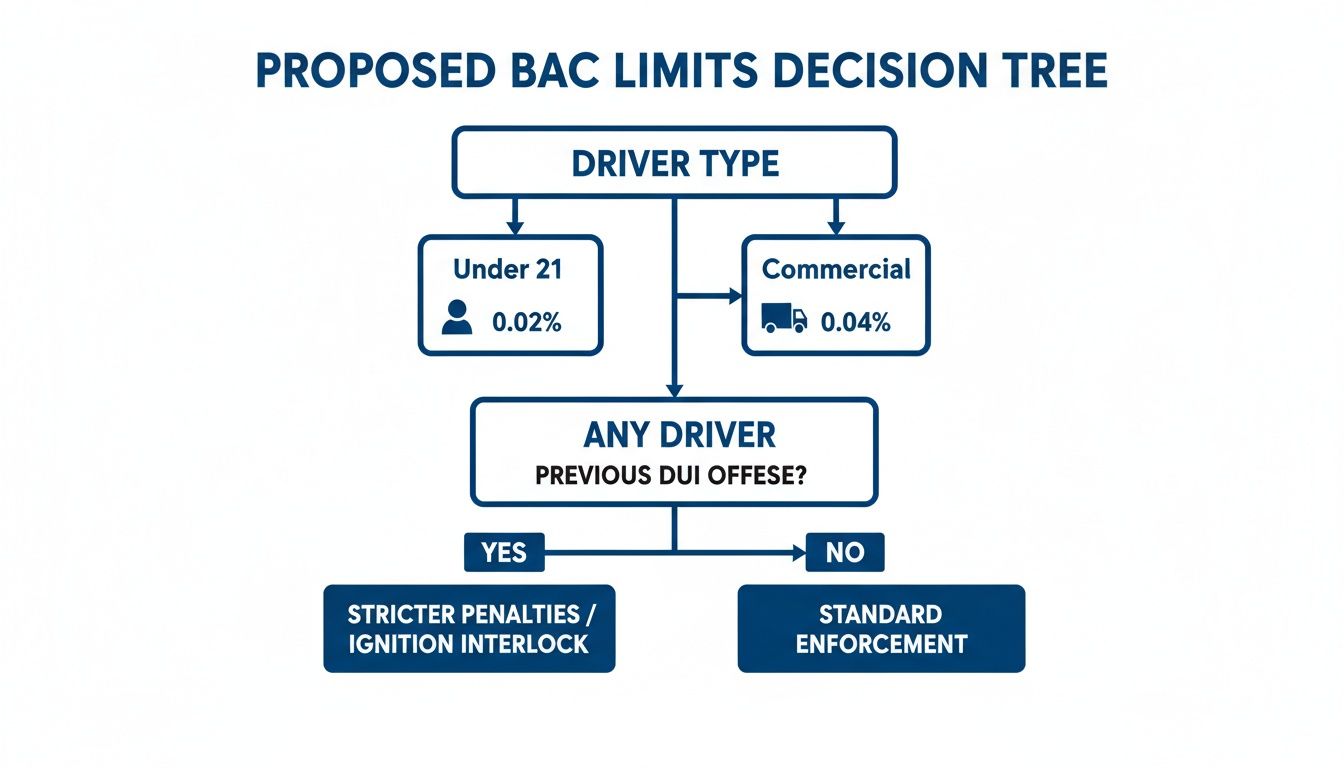
The chart highlights the significantly lower thresholds for underage drivers (0.02%) and commercial drivers (0.04%), underscoring the state's zero-tolerance policy for these groups.
Crucially, every one of these testing methods has potential flaws. An attorney experienced in DUI defense will examine whether the breathalyzer was properly calibrated, if the officer followed every procedural step correctly, or if a medical condition could have affected the results. These details are often key to building a defense. Our goal is to protect your license and record by carefully examining every aspect of your case. Past results do not guarantee future outcomes.
The Full Spectrum Of Florida DUI Penalties
A DUI charge in Florida kicks off a confusing and overwhelming chain of events. The penalties are not just a simple fine—they’re a multi-layered system of administrative actions from the DMV, criminal sentences from a judge, and long-term financial burdens that can follow you for years.
The moment you're charged, you're suddenly fighting a battle on two separate fronts. First, there's the immediate administrative action taken against your driver's license. At the same time, a separate criminal case begins to work its way through the court system. Both carry their own serious set of penalties, and you must deal with both simultaneously.
Administrative Penalties Handled By The DHSMV
Before you even step foot in a courtroom, the Florida Department of Highway Safety and Motor Vehicles (DHSMV) can suspend your license. These penalties are civil, not criminal, and they're triggered automatically by the arrest itself.
Immediate License Suspension: If your BAC is over the legal limit or you refuse a breathalyzer test, the officer will confiscate your license on the spot.
A Strict 10-Day Deadline: You have only 10 days from the date of your arrest to formally request a hearing to challenge this administrative suspension. If you miss this deadline, you automatically lose your right to fight it.
This administrative process is designed to be swift and unforgiving. Its goal is to get drivers suspected of impairment off the road immediately, long before the criminal case is resolved.
Criminal Penalties Determined By The Court
If you are convicted of DUI in criminal court, a judge will impose a range of penalties based on the specifics of your case. These are designed to be punitive and act as a deterrent. The severity often depends on your BAC level, if you have prior offenses, and whether an accident was involved.
A common misconception is that a first-offense DUI is just a minor traffic violation. It is not. It's a criminal charge that creates a permanent record and carries mandatory penalties that can include jail time and thousands of dollars in fines and fees.
For a deeper dive into what you can expect, you can learn more about the specific first-time DUI penalties in Florida in our detailed guide.
To give you a clearer picture, here's a breakdown of the typical penalties for a first-offense DUI.
Potential Penalties For A First-Time Florida DUI
This table outlines the common administrative and criminal penalties for a standard first-offense DUI in Florida. Penalties can increase based on BAC level and other factors.
Penalty Category | Typical Range or Requirement |
|---|---|
Jail Time | Up to 6 months (or 9 months with BAC > 0.15) |
Fines | $500 to $1,000 (or $1,000 to $2,000 with BAC > 0.15) |
Probation | Up to 12 months |
License Suspension | 180 days to 1 year |
Community Service | Mandatory 50 hours |
Vehicle Impoundment | 10 days |
DUI School | Level 1 (12 hours) |
Ignition Interlock Device | Required for at least 6 months if BAC was 0.15 or higher |
Remember, these are just the starting points. The consequences can quickly escalate depending on the circumstances of your case. Past results do not guarantee future outcomes.
The Hidden Financial And Personal Costs
Beyond the court-ordered fines and potential jail time, a DUI conviction brings a host of other expensive and time-consuming requirements. These "hidden" costs are often more burdensome than the initial penalties themselves.
Drastic Insurance Hikes: A DUI conviction forces you to get FR-44 insurance, a special type of high-risk coverage. Premiums can easily triple or quadruple and are required for at least three years.
Ignition Interlock Device (IID): For many convictions, especially those with a high BAC, you will have to install an IID in your car at your own expense. This device is a mini-breathalyzer that stops your car from starting if it detects alcohol.
Mandatory DUI School: All convictions require completing a state-approved substance abuse course, which you have to pay for.
Probation and Community Service: You will likely face a probation period with regular check-ins and be required to complete 50 hours of community service.
The cumulative effect of these penalties can impact your finances, your job, and your personal freedom for years to come. Our practice focuses on criminal traffic matters across Florida, and our goal is to protect your license and record by carefully examining every detail of your case.
Navigating A DUI Charge In Florida
Being pulled over for a DUI in Florida is a disorienting, stressful experience. One minute you’re driving, and the next you’re thrown into a complex legal maze with tight deadlines and life-altering consequences. Knowing what to do from the moment you're charged is absolutely critical.
It’s about more than just understanding the charge itself. It’s about knowing how to respond. A DUI case is never as simple as the number on a breathalyzer printout. It involves a deep dive into every piece of evidence, questioning everything from the officer's reason for pulling you over to the exact procedures they followed during the stop.
Building A Strategic Defense
The foundation of a DUI defense is a thorough, methodical investigation of your specific case. An attorney experienced in DUI defense does not just accept the final BAC reading at face value. We scrutinize the entire chain of events, looking for procedural errors and legal issues that can change the outcome.
Here are the key areas we immediately examine:
The Traffic Stop: Did the officer have a legitimate, legal reason to pull you over in the first place? An unlawful stop could lead to all evidence collected afterward being thrown out of court.
Field Sobriety Exercises: These tests have strict, standardized procedures. We look at whether they were administered correctly. Factors like the weather, your physical condition, or even confusing instructions from the officer can make the results unreliable.
Breathalyzer Maintenance: The Intoxilyzer 8000 machines used across Florida require constant calibration and maintenance. We review these records to see if the device that tested you was working properly.
Our practice is built around traffic and DUI defense. We handle criminal traffic matters across Florida, and our goal is to protect your license and your record.
The central focus is always on protecting your driving privileges and minimizing the long-term damage to your life. A proactive defense strategy is essential to pursuing that goal.
Our Approach to Your Case
At Ticket Shield, we understand. A DUI charge creates a mountain of anxiety. Our entire process is designed to bring you clarity and support while we handle the legal aspects of your case. With our office in Broward, our team has the experience to help clients across the state.
From your very first free consultation, we’ll listen to your side of the story and lay out your options in plain English. We take over communication with the court and the DHSMV, streamlining the process so you can focus on your life. In fact, over 99% of our clients never have to set foot in a courtroom.
If you’re facing a DUI charge related to the BAC limit in Florida, you have to act fast. Contact us for a free, confidential consultation to go over your case. Submitting your information does not create an attorney-client relationship.
Attorney Advertisement. Office in Broward. Past results do not guarantee future outcomes.
Frequently Asked Questions About Florida BAC Limits
When you're dealing with a DUI charge, questions come up fast. This section addresses some of the most common things we hear about the BAC limit in Florida. Think of this as a starting point, but remember, it’s not a substitute for legal advice from an attorney who can look at the specifics of your case.
Can I Be Charged With DUI If My BAC Is Below 0.08%?
Yes, absolutely. This is a critical point that many people misunderstand. While a BAC of 0.08% or higher is what’s known as “per se” evidence—meaning the number itself is sufficient proof of impairment—you can still be convicted of DUI with a lower BAC.
Florida law is clear: you can be convicted if your "normal faculties" were impaired by alcohol or drugs. An officer will use everything they observed during the stop as evidence. This includes how you were driving, if your speech was slurred, or how you performed on field sobriety tests. That evidence can be enough for a conviction, regardless of what the breathalyzer says.
What Happens If I Refuse A Breathalyzer Test?
Refusing a breathalyzer test in Florida has immediate and serious consequences due to the state's "implied consent" law. The moment you received your driver's license, you legally agreed to submit to a chemical test if an officer lawfully arrests you for DUI.
The penalties for refusal are steep:
First Refusal: You are looking at an automatic administrative license suspension for one year.
Second or Subsequent Refusal: The stakes get much higher. The suspension jumps to 18 months, and the refusal itself becomes a separate first-degree misdemeanor criminal charge.
In addition, the prosecutor can and will use your refusal against you in court. They may argue that it shows "consciousness of guilt"—essentially, that you refused because you knew you were over the legal limit.
Crucial Deadline: After a DUI arrest and license suspension (for either blowing over the limit or refusing), you have only 10 days to request a formal review hearing with the DHSMV to challenge it. If you miss this deadline, you lose your right to fight the administrative suspension.
Can A DUI Conviction Be Removed From My Record?
This is one of the most important questions people ask, and the answer is sobering. In Florida, a DUI conviction is permanent. It cannot be expunged or sealed from your criminal record if you were convicted or pleaded no contest.
This is exactly why fighting the charge from the very beginning is so critical. To understand the full, long-term impact, check out our guide on whether you can get a DUI off your record in Florida. Our focus is on protecting your record from day one.
If you are facing a DUI charge related to the BAC limit in Florida, the time to act is now. At Ticket Shield, PLLC, our practice focuses on traffic and DUI defense. Contact us for a free, confidential consultation to discuss your case and learn how we can help. https://www.ticketshield.com
